Taiwan’s first two F-16 Block 70 fighters have left the United States
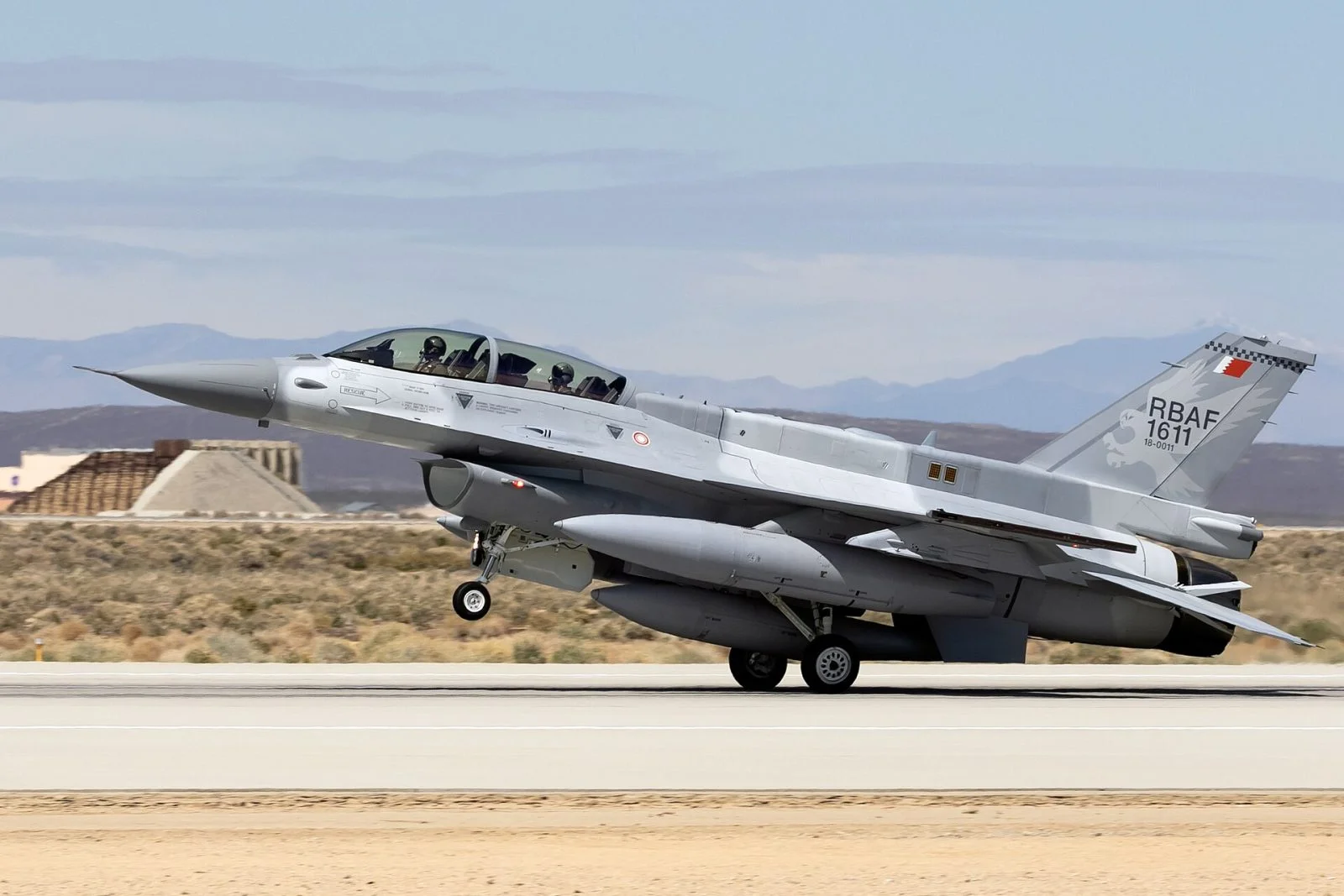
Taiwan’s long-delayed fighter procurement has finally produced an aircraft in transit. The first two of 66 F-16C/D Block 70 jets ordered from the United States departed American soil on 17 August, Eastern Time, beginning the trans-Pacific ferry flight to the island.
A long crossing
Getting the aircraft home is not a single-leg proposition. The route involves aerial refuelling and at least one maintenance and crew-rest stop, driven as much by pilot endurance as by range. Block 70 jets carry conformal fuel tanks that give them noticeably greater reach than the Block 20 airframes already in Taiwanese service, but a Pacific crossing still depends on tanker support.
An $8.2 billion programme
Taiwan contracted for the 66 aircraft in 2019. The programme is budgeted at NT$247.2 billion — roughly $8.2 billion — with spending authority running from 2020 to 2026.
Before this buy, Taipei upgraded its existing 140 F-16A/B Block 20 jets to F-16V standard, a programme completed in December 2023. The new-build aircraft therefore slot into an air force that already operates the APG-83 AESA radar, the associated mission computer and the upgraded electronic warfare suite, which shortens the training and sustainment ramp considerably.
What pushed the schedule right
Under the original plan the first jets should have reached Taiwanese bases in 2024, with deliveries complete by the end of 2026. Two factors moved that:
- Production line relocation. Lockheed Martin moved F-16 assembly from Fort Worth to Greenville, South Carolina. Bringing the new line up to rate took longer than projected.
- Supply chain and subcontractor delays. Component shortages and assembly-sequence adjustments pushed the first handover back repeatedly.
Lockheed has moved Greenville to two shifts, with the line reported to be running up to 20 hours a day. Even so, the remaining aircraft are expected across 2027 and 2028. Taiwan’s defence ministry warned through 2025 that completing all 66 deliveries by the end of 2026 had become increasingly unrealistic.
What Block 70 actually brings
Block 70 is the newest production variant of the F-16. Standard fit includes the APG-83 AESA radar, a new centre display and mission computer, an advanced data link and Auto-GCAS, with airframe life extended to 12,000 flight hours.
For Taiwan, the decisive capabilities are long-range air-to-air and anti-ship. The jets can carry the AIM-120 family and the AGM-84 Harpoon, which in an island-defence scenario translates into both a counter-air contribution and a repositionable strike option against an amphibious force at sea.
The qualification is that Block 70 remains a fourth-generation-plus platform. Against an adversary fielding low-observable aircraft and dense long-range surface-to-air layers, survivability depends heavily on electronic warfare fit, data-link integration and the ability to keep generating sorties — which is why hardened shelters and dispersed basing absorb a meaningful share of Taiwan’s air budget.
Where the jets go
Taiwan’s basing preference leans toward the island’s east coast, where the central mountain range offers natural shielding against the first wave of missile strikes from the mainland. The hardened, mountain-excavated shelter complexes on that side of the island exist precisely so combat aircraft can survive the opening hours of a conflict.
That preference reflects the core planning assumption: in a crisis, the air battle will be decided as much by how well aircraft are protected on the ground as by how they perform in the air. Rapid runway repair, dispersed operations and highway landing drills are integral to the programme, not adjuncts to it.
A familiar picture from Ankara’s side
The Greenville bottleneck is not Taiwan’s problem alone. The same line has to serve Bahrain, Slovakia, Bulgaria, Jordan and Türkiye. Reports that Bulgaria’s second batch of eight aircraft could slip to 2030 confirm the congestion is structural rather than customer-specific.
Türkiye is working through a package for 40 new F-16 Block 70 aircraft plus modernisation kits for its existing fleet. The Taiwanese and Bulgarian cases show concretely how long the gap between contract signature and an aircraft on the ramp can stretch — and make Ankara’s parallel weight on the KAAN programme and on indigenous upgrades to the existing F-16 fleet easier to read. A platform whose delivery schedule is set abroad cannot be the sole load-bearing element of a defence plan.
Sources
- Taiwan Ministry of National Defense programme briefings, 2025–2026
- US Defense Security Cooperation Agency notification, 2019
- Lockheed Martin public statements on Greenville production