Turkey on the Global Defense Production Map: A Field-by-Field Report

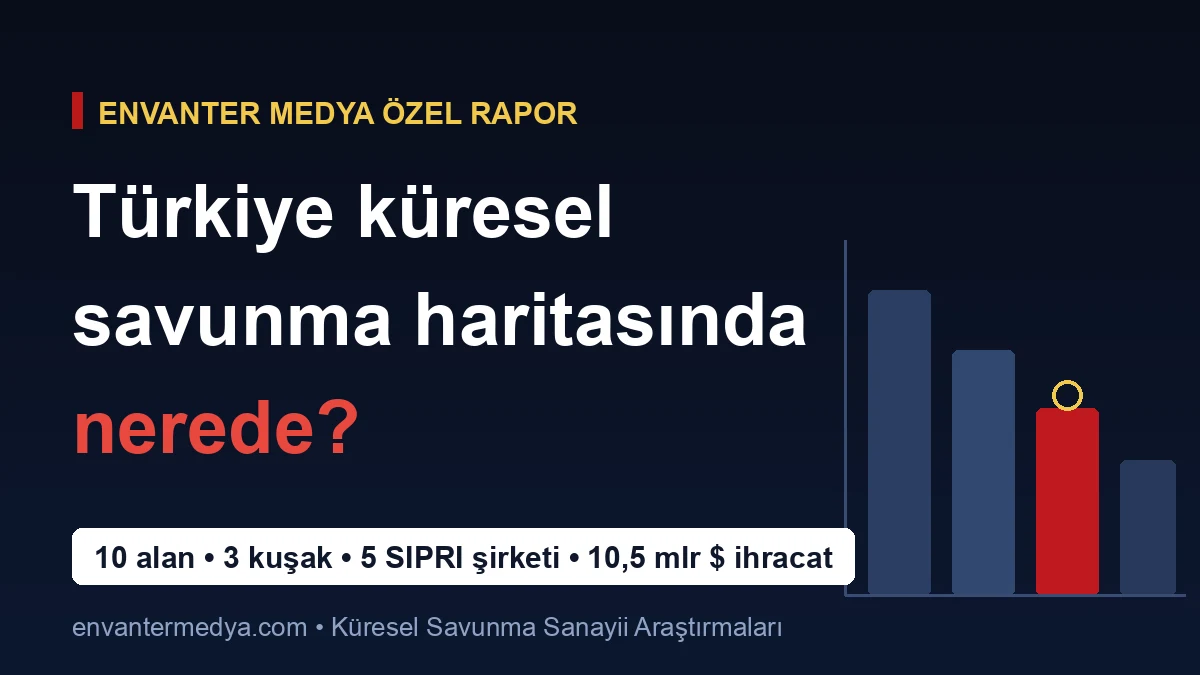
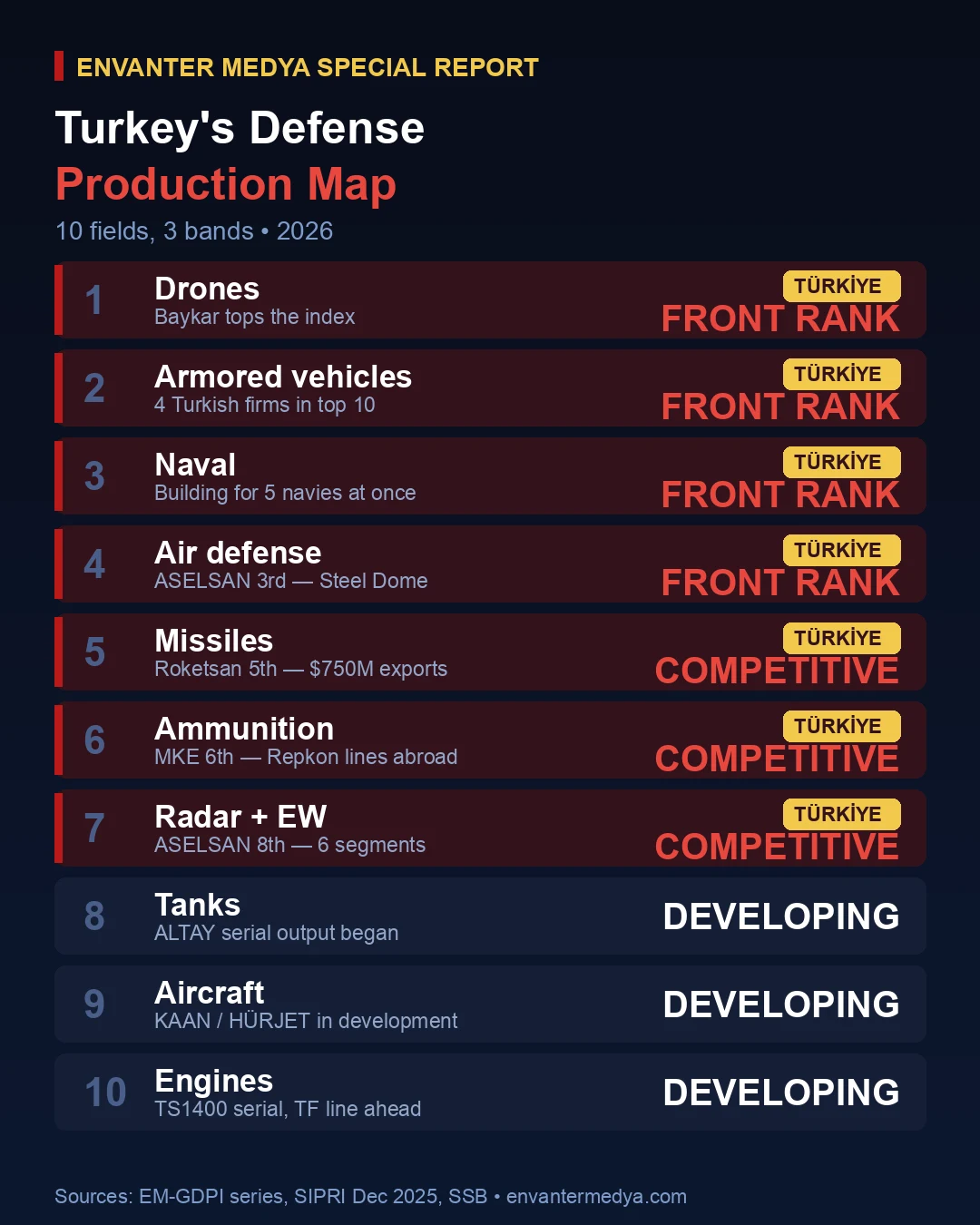
Maps are honest in a way headlines are not. Put Turkey on the global defense production map and you get neither the triumphal picture of its boosters nor the dismissive one of its skeptics, but a three-band structure: a front rank in four fields — drones, naval shipbuilding, air defense and armored vehicles — a competitive middle band in missiles, ammunition and radar, and a development band in tanks, fighter aircraft and large engines, where the world’s most expensive industrial cycles are still in their first Turkish iterations. Five Turkish firms now sit in the SIPRI Top 100, exports hit a record $10.5 billion in 2025, and users span four continents. This special report from our Global Defense Industry Research series lays Turkey’s position out field by field, in one table.
Editorial note: This is an editorial study prepared by Envanter Medya using publicly available data; it is not an official ranking. Field assessments rest on the EM-GDPI indices and verified program data published across the series’ nine sector studies.
The report at a glance
Turkey’s defense production map, field by field
The table below condenses the data verified across the series’ nine studies; each field’s detailed index and raw tables are in the linked files.
| Field | Turkey’s position | Leading companies | Trend |
|---|---|---|---|
| Drones | Global leader group — first in the EM-GDPI index; the category reference for export reach and production tempo | Baykar, TUSAŞ, STM | ↑ Strong |
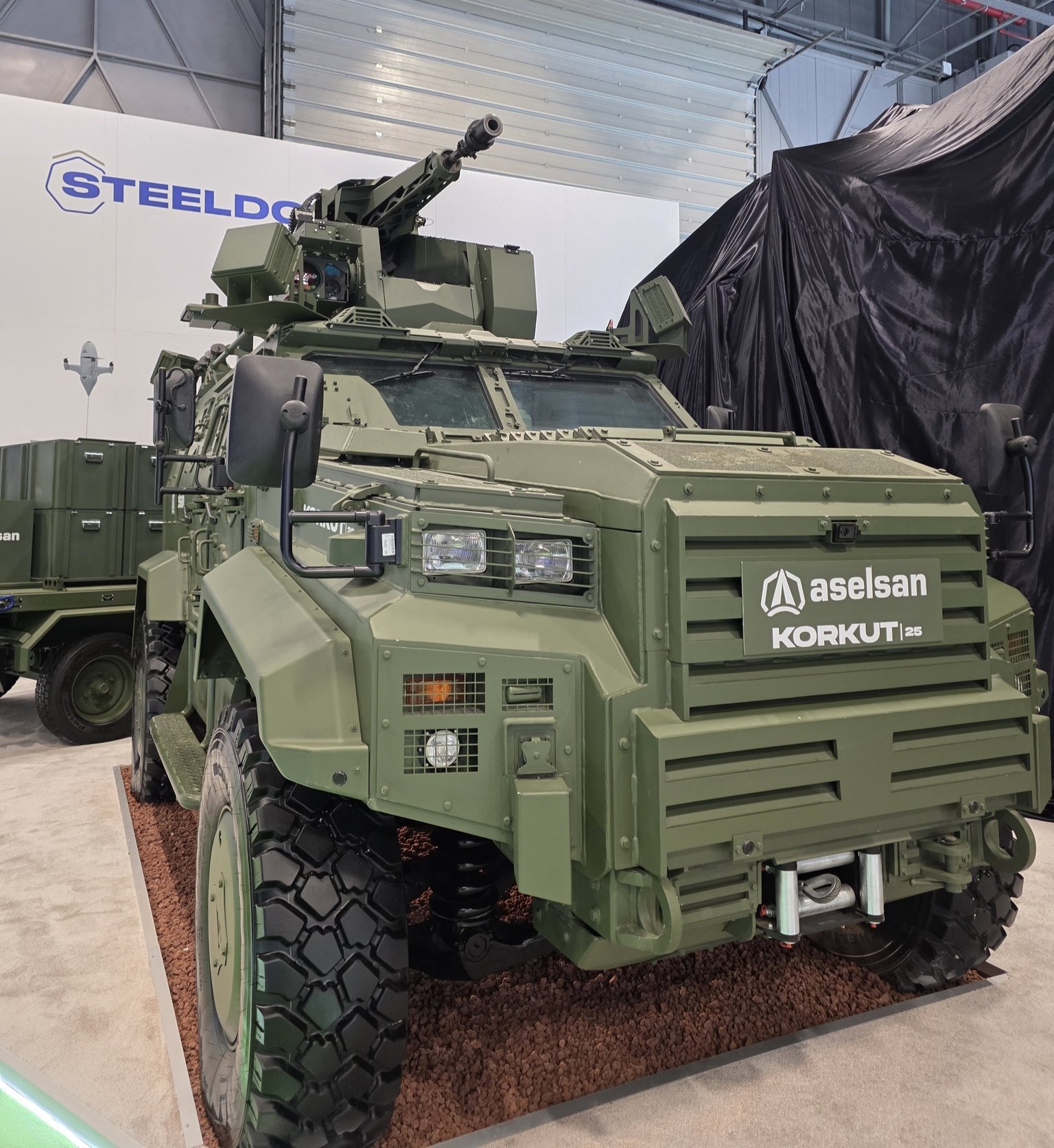
| Armored vehicles | Front rank — four firms in the top ten; top two spots on the user-country criterion; Romania’s 1,059-vehicle program | Otokar, Nurol Makina, FNSS, BMC, Katmerciler | ↑ Strong |
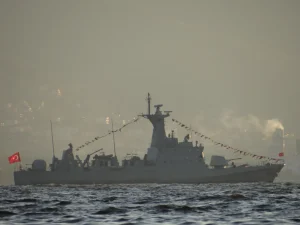
| Naval | Front rank — second in the index; building for five navies at once (Pakistan, Ukraine, Malaysia, Portugal, Romania) | STM, ASFAT, Dearsan, Sefine and the yard ecosystem | ↑ Strong |
| Air defense | Front rank — third in the index; one of the few countries producing every layer domestically (Steel Dome) | ASELSAN, Roketsan | ↑ Strong |
| Missiles | Competitive — fifth in the index; $750M exports and the ATMACA/HİSAR/TAYFUN portfolio; scale gap with volume giants remains | Roketsan, TÜBİTAK SAGE, MKE | ↑ Rising |
| Ammunition | Competitive — MKE sixth in the index and a SIPRI debutant; Repkon has exported production lines to four countries | MKE, Repkon | ↑ Rising |
| Radar + EW | Competitive — strong portfolio breadth (six segments), far from RTX/Thales revenue scale; eighth in the index | ASELSAN, Meteksan | ↑ Rising |
| Tanks | In development — ALTAY serial deliveries just began; capacity ramping to 96/year; 41 points in the index | BMC, Otokar (program roles), MKE (ammunition) | → Watching |
| Combat aircraft | In development — KAAN and HÜRJET in development/initial production; the serial-output league is still ahead | TUSAŞ | → Watching |
| Engines | In development — TS1400/TJ family in serial production; not yet a large-turbofan producer; TF line under development | TEI, Kale Jet, TRMotor, BMC Power | → Watching |
Trend marks: ↑ verified order/export growth; → program maturation being watched. Assessments are editorial; each row’s data base is in the linked sector study.

The revenue side: five firms, $10.1 billion
SIPRI’s December 2025 table lists ASELSAN (47th, $3.47B), TUSAŞ (65th, $2.16B), Baykar (73rd, $1.90B), Roketsan (87th, $1.39B) and first-time entrant MKE (93rd, $1.21B) — $10.1 billion combined, roughly 1.5 percent of Top 100 revenue. That share understates production power: unit prices in the drone, armored vehicle and ammunition segments where Turkish firms concentrate run far below fighter jet and submarine programs, so equal quantities generate far less revenue.
Source: official statements by SSB President Haluk Görgün (January 2026, Anadolu Agency). The 78% jump in the contract pipeline is the leading indicator that exports will keep growing.
Source: SIPRI (December 2025). Turkish companies are marked separately. ASELSAN grew four times faster than the global average, in the same high-growth cluster as Europe’s and Korea’s rearmament giants.
Reading the map: a three-band structure
Translate the table into a map and three bands appear. In the first band — drones, naval, air defense, armored vehicles — Turkey is among the rule-setters: platforms fielded on four continents, multi-year export programs, and a production model mature enough to include technology transfer. In the second band — missiles, ammunition, radar-EW — the products are world-class and exports are climbing; what is missing is the volume that reflects decades of accumulation. The third band — tanks, combat aircraft, engines — covers the industry’s most expensive, longest-cycle fields, where programs like ALTAY, KAAN and the TF engine family are at the start of their production cycles. The series’ core finding: the model that built the first band — field-proven designs, fast delivery, production partnership with the customer — is being applied to the third; the difference is cycle length, not method.
How this report was prepared
Data base: A synthesis of data verified across the series’ nine sector studies, SIPRI’s December 2025 release and official SSB statements (January 2026). Combat aircraft row: the series has not yet published a dedicated fighter study, so that row rests solely on official program announcements and carries no index score. Limits: the “front rank / competitive / in development” categories are editorial; each field’s numerical index is explained in its study. Missing data were not filled with estimates.
Frequently asked questions
Where does Turkey sit on the global defense production map?
Front rank in four fields (drones, naval, air defense, armored vehicles), competitive in three (missiles, ammunition, radar-EW), and in development in three (tanks, combat aircraft, engines). The full table is in this report.
How big is Turkey’s defense industry globally?
There is no single official ranking. Five firms hold about 1.5% of SIPRI Top 100 revenue, and 2025 exports reached a record $10.5 billion. On quantity-based measures (drones, armored vehicles), Turkey’s position sits well above its revenue share.
How fast are Turkish defense exports growing?
From $7.1 billion in 2024 to $10.5 billion in 2025 per SSB — about 48% — with new contracts up 78% to $17.8 billion.
Which Turkish companies are in the SIPRI Top 100?
ASELSAN (47th), TUSAŞ (65th), Baykar (73rd), Roketsan (87th) and MKE (93rd), which entered the list for the first time with 2024 data.
Is Turkey the world leader in any field?
In our nine-sector index set, the only Turkish first place is Baykar in military drones. We do not use “leader” on a single metric; the drone study presents every criterion separately.
Why are Turkish shipyards marked “front rank”?
As of August 2026 they are building for five foreign navies simultaneously — a parallelism very few countries can sustain.
What is the real state of the tank program?
ALTAY serial deliveries have begun and BMC’s plant is ramping to 96 tanks a year, but cumulative output remains far behind rivals with decades of production. The index’s 41-point score reflects that transition honestly.
Why is KAAN listed as “in development”?
The program is in flight testing and initial production; the serial-output and export league (F-35, Rafale scale) lies ahead. The row will be updated as data firms up.
When does the engine gap close?
The TS1400 and TJ family are in serial production; the TF-6000/TF-10000 line and the TF-35000 targeted for KAAN are in development. The large-turbofan producers’ league still counts only a handful of countries.
What data underpins this report?
Production, export and user data verified across nine sector studies, plus SIPRI (December 2025) and SSB (January 2026). All raw tables are in the linked files.
What do Turkey’s strong fields have in common?
Field-proven products, fast delivery and a production-partnership offer to customers; the naval field fits the same mold through multi-yard flexibility.
How often will this report be updated?
It is living content, refreshed in annual report seasons and after major contract announcements; the “last updated” date is at the bottom of the page.
Sources and methodology notes
This is an editorial study prepared by Envanter Medya by cross-checking publicly available official company data, institutional reports, contract and delivery records, and industry sources. Principal sources:
- SIPRI Top 100 Fact Sheet (December 2025) — 2024 revenues, shares, growth
- SSB / Anadolu Agency (January 2026) — 2025 export and contract figures
- The series’ studies: drones, armored vehicles, tanks, ammunition, missiles, air defense, radar-EW, naval, engines; syntheses: where Turkey leads and the armored vehicle special
Last updated: August 16, 2026. This is a living study and will be updated in annual report seasons.