Why the Strait of Hormuz matters so much to world oil

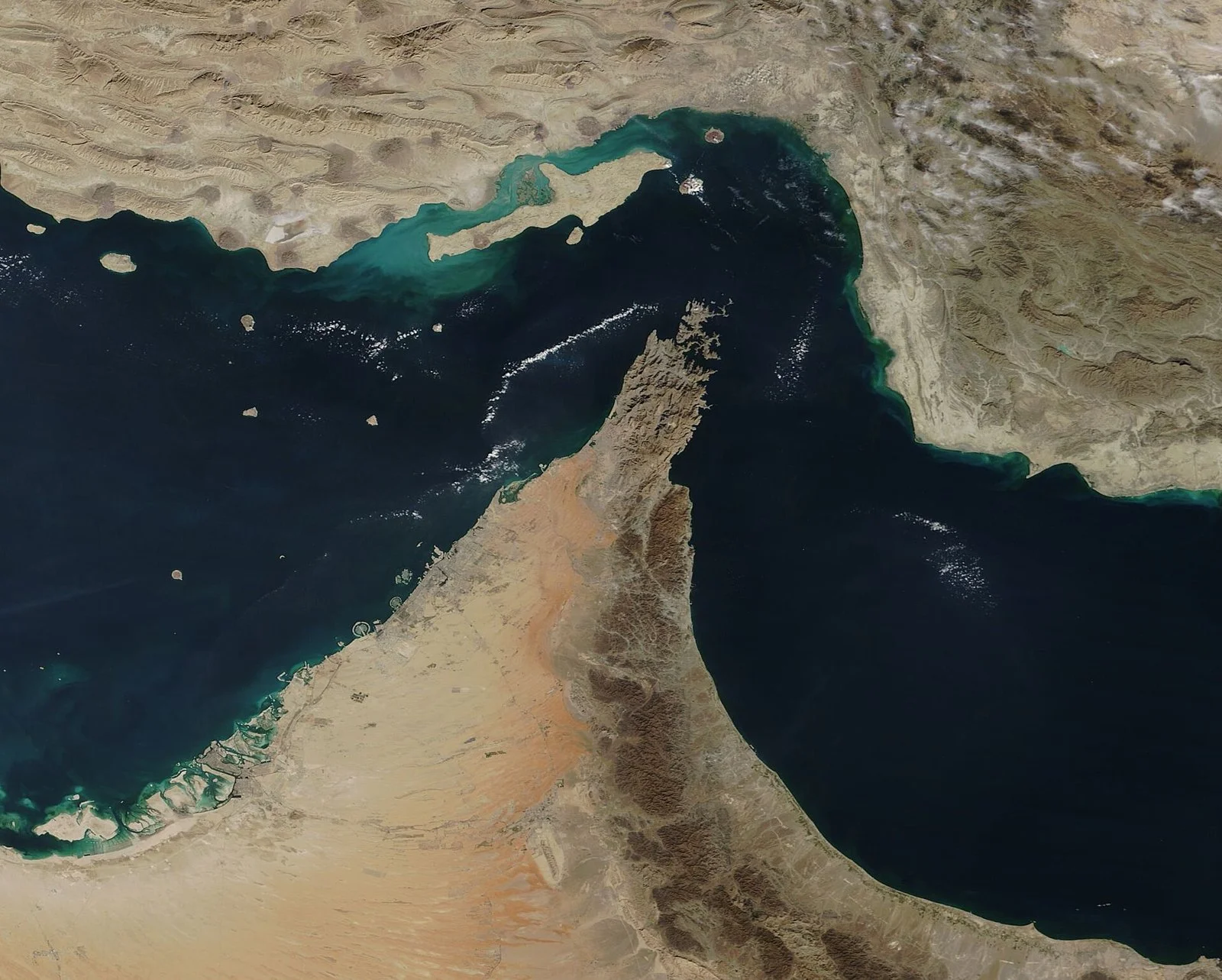
According to the International Energy Agency, about a quarter of the world’s seaborne oil trade passed through the Strait of Hormuz in 2025. Since 28 February 2026 the waterway has been overshadowed by war and attacks.
Short answer: The Strait of Hormuz is the only sea route linking the Persian Gulf to the Gulf of Oman and the open ocean. Saudi Arabia, Iraq, the United Arab Emirates, Iran, Kuwait, Qatar and Bahrain send much of their oil to world markets through it. Pipelines that can avoid the strait have room for only a small part of what normally passes.
How wide is the strait
At its narrowest point the strait is 21 nautical miles across, or about 39 kilometres, according to the International Energy Agency (IEA). Shipping does not use that whole width. There is one lane for inbound traffic and one for outbound traffic, each 2 miles (3.7 kilometres) wide, with a 2-mile safety buffer between them.
The northern shore belongs to Iran. The southern shore is Oman’s Musandam Peninsula. The water is deep enough for the largest oil tankers in the world. What makes the passage sensitive is that so much cargo depends on a narrow route between two coastal states.
How much oil and gas goes through
The IEA says about 20 million barrels a day of crude oil and oil products were shipped through the strait in 2025, roughly 25 per cent of global seaborne oil trade. The US Energy Information Administration (EIA) put the figure for the first half of 2025 at 20.9 million barrels a day, equal to about 20 per cent of world consumption of petroleum liquids.
The two percentages differ mainly in what they are measured against: one compares the flow with oil traded by sea, the other with all the petroleum liquids the world consumes. The periods covered are also not the same.
| Country | Volume |
|---|---|
| Saudi Arabia | 6.23 |
| Iraq | 3.63 |
| United Arab Emirates | 3.24 |
| Iran | 2.41 |
| Kuwait | 2.37 |
| Qatar | 1.43 |
| Bahrain | 0.21 |
Source: IEA.
Who depends on it most
The main buyers are in Asia. About 80 per cent of the oil passing through the strait went to Asian markets, the IEA says. China and India together received 44 per cent of the crude exported via Hormuz. Europe’s share of that crude was only around 4 per cent.
Liquefied natural gas (LNG) is even more concentrated. More than 112 billion cubic metres of LNG moved through the strait in 2025, about 20 per cent of global LNG trade. The route carried 93 per cent of Qatar’s LNG exports and 96 per cent of the UAE’s, and according to the IEA those cargoes have no other way out by sea.
On the receiving end, Bangladesh, India and Pakistan obtained almost two thirds of their LNG imports through Hormuz that year.
Can pipelines bypass the strait
Two countries can export part of their oil without touching Hormuz. Saudi Arabia’s East-West pipeline runs from Abqaiq to Yanbu on the Red Sea coast. Its design capacity is 5 million barrels a day, and Aramco said in March 2025 that it could be raised to 7 million. The UAE’s Habshan-Fujairah line ends at the port of Fujairah, outside the strait, and has a nameplate capacity of 1.5 million barrels a day.
The IEA estimates that the spare capacity actually available on these routes totals 3.5 to 5.5 million barrels a day. The EIA’s estimate for 2025 is lower. On either reading, most of the roughly 20 million barrels a day crossing the strait has no alternative. Iran’s own Goreh-Jask pipeline to the Gulf of Oman is, according to the IEA, not operating in practice.
What happened in the 2026 crisis
After the United States and Israel launched their campaign against Iran on 28 February 2026, the strait became one of the main fronts of the conflict. A legal analysis published by the American Society of International Law (ASIL) on 15 October 2026 sets out the following sequence:
- 30 March: Iran’s parliament approved a transit toll law allowing charges of up to 2 million dollars per voyage.
- May: Iran set up the Persian Gulf Strait Authority, which asserts that ships without its permission may not pass.
- 17 June: A memorandum of understanding signed by Iranian President Masoud Pezeshkian and US President Donald Trump suspended the fees for 60 days. The period ran out on 17 August without a permanent settlement.
- 25 August: Iran and Oman announced a temporary transit route.
In a statement dated 11 November 2026, the International Maritime Organization (IMO) said it had confirmed more than 130 attacks on commercial ships in the strait since 28 February, with at least 25 seafarers killed. The IMO Council had also noted on 6 November that some ships were still unable to leave the Gulf.
Current transit counts and individual attack claims change quickly. This guide relies only on figures confirmed by institutional sources.
Can anyone legally close it or charge a toll
Article 38 of the UN Convention on the Law of the Sea (UNCLOS) grants a right of “transit passage”, which may not be impeded, in straits used for international navigation. Article 44 states that this passage cannot be suspended.
The dispute is partly about who holds the right. Iran signed the convention in 1982 but never ratified it, and the United States is not a party either. Washington regards transit passage as customary international law, binding regardless of ratification. Tehran argues that the right extends only to parties to the convention.
According to the ASIL analysis, neither reading contains an explicit provision that authorises a fee simply for passing through. The IMO Secretary-General has also stated that there is no legal basis for imposing taxes, customs duties or fees on transit through international straits.
How it differs from the Turkish Straits
A useful comparison lies in Türkiye, which controls both shores of the Istanbul Strait (Bosphorus) and the Çanakkale Strait (Dardanelles), the route between the Black Sea and the Mediterranean. Passage there is governed by a dedicated treaty, the 1936 Montreux Convention.
Montreux lets Türkiye charge merchant ships in transit only for services listed in an annex to the convention, such as sanitary inspection, lighthouses and buoys, and life-saving. Hormuz has no comparable text agreed between its two coastal states and the countries whose ships use it.
The scale is different too. EIA data show about 3.7 million barrels of oil a day moving through the Turkish Straits in the first half of 2025, compared with 20.9 million through Hormuz in the same period.
Frequently asked questions
Which country owns the Strait of Hormuz?
No single country. Iran holds the northern shore and Oman the southern one, and shipping is subject to the rules for straits used for international navigation.
How wide is the Strait of Hormuz?
About 39 kilometres (21 nautical miles) at its narrowest point.
Who would be hit hardest by a closure?
Asian economies that receive much of their oil and LNG by this route. Among sellers, Qatari gas stands out because it has no other sea outlet.
Is there a toll to pass through Hormuz?
Iran created a law and an authority to demand fees in 2026. The IMO and the United States say such charges are unlawful, and the issue has not been resolved.
Sources
- IEA, Strait of Hormuz factsheet (February 2026)
- EIA, World Oil Transit Chokepoints (3 March 2026)
- Statement by the IMO Secretary-General (11 November 2026)
- IMO Council statement (6 November 2026)
- ASIL Insights on the law of transit tolls in Hormuz (15 October 2026)
Related articles
- Iran claims tankers hit naval mines in the Strait of Hormuz
- US Navy chief on the limits of escorting ships through Hormuz
- Mecca Defence Pact members hold security talks with Iran in Tehran
Last checked: 28 November 2026. Cover image: MODIS Land Rapid Response Team, NASA GSFC / Public domain / Wikimedia Commons.