Northrop exits Navy trainer team, leaving UJTS a two-horse race

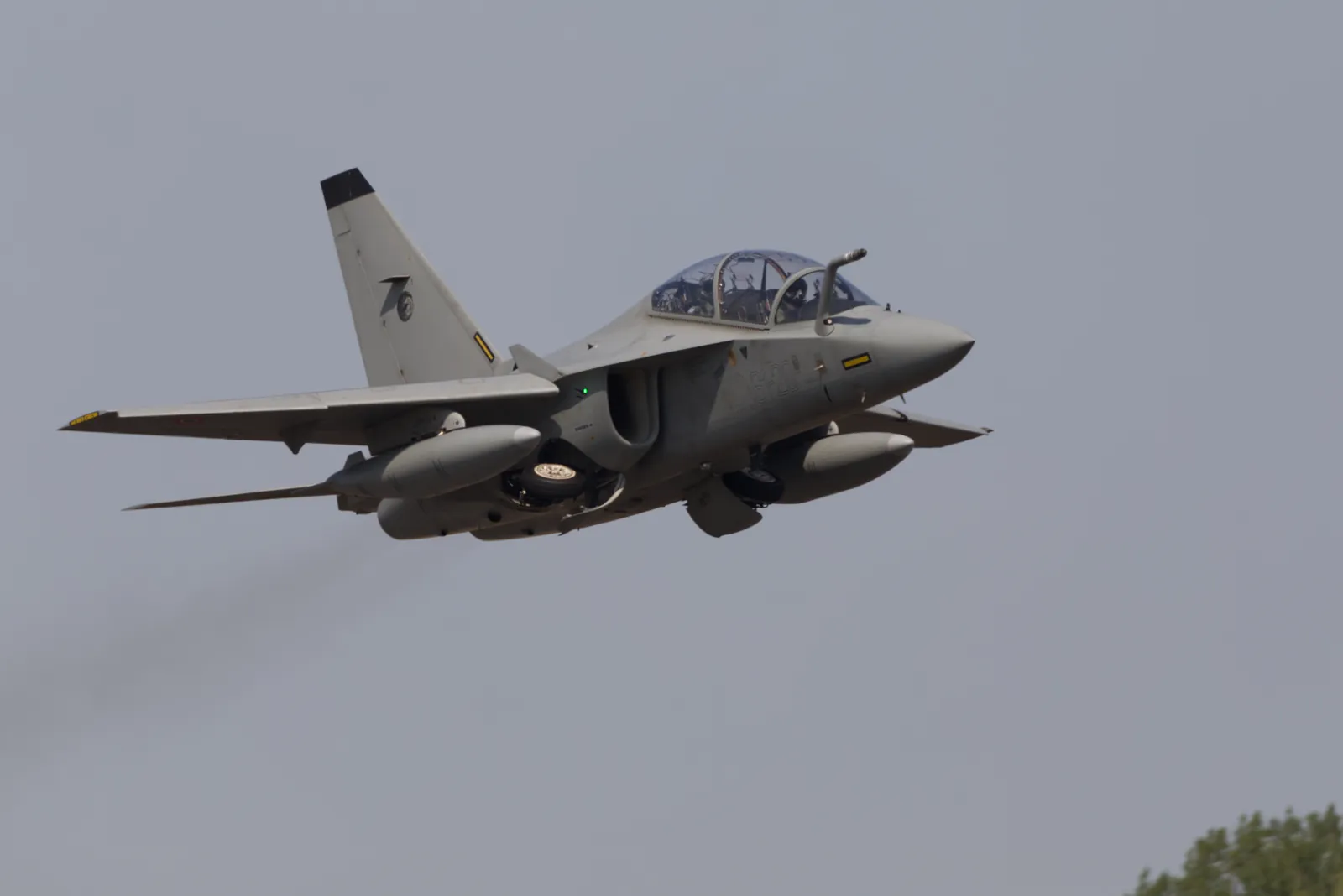
Northrop Grumman has pulled out of the Sierra Nevada Corporation-led team bidding for the US Navy’s Undergraduate Jet Training System. The company joined in February 2026 and was gone seven months later, leaving only two offers on a 216-aircraft programme worth roughly $10 billion. The Navy has moved its award decision to 30 June 2027.
At a Glance
- What happened: Northrop Grumman announced it is leaving the SNC-led “Team Freedom”.
- The programme: UJTS, the US Navy’s Undergraduate Jet Training System.
- How many aircraft: 216, replacing the in-service T-45 Goshawk fleet.
- How much: Around $10 billion across the programme; roughly $1.8 billion capped for the development and initial manufacturing phase.
- Who is left: SNC with General Atomics Aeronautical Systems (Freedom Trainer) and Textron Aviation Defense with Leonardo (M-346N).
- Who walked: Lockheed Martin–KAI (TF-50N) in April 2026, Boeing (T-7A) in June 2026, Northrop Grumman in September 2026.
- Timeline: Final RFP 26 March 2026, proposals closed 29 June 2026, award now expected by 30 June 2027.
In for seven months, out in seven months
Northrop Grumman signed an executive charter with SNC and General Atomics Aeronautical Systems (GA-ASI) in February 2026, forming what the partners branded “Team Freedom”. The logic was straightforward: take SNC’s clean-sheet trainer design, add Northrop’s naval aviation pedigree and GA-ASI’s production capacity, and present the Navy with what the companies called a zero-compromise training solution. Seven months on, Northrop is out.
The company’s statement is a textbook example of how the industry explains a portfolio decision. “As part of our disciplined portfolio management and ongoing commitment to prioritizing the warfighter, we have elected to focus our resources on opportunities where our mature capabilities and investments can deliver the greatest mission impact.” Translated out of contractor language: the odds of winning did not justify what winning would cost to chase.
GA-ASI is staying. The Freedom Trainer bid itself has not been withdrawn — the industrial coalition behind it has simply lost a layer. The Navy has not commented publicly, which is normal while a source selection is live.
Read on its own, Northrop’s exit is a minor industrial reshuffle. Read against the last twelve months of this competition, it is something else.
Four bids became two — and the carrier did the cutting
UJTS will replace the T-45 Goshawk, the trainer the Navy has flown since the early 1990s. The programme covers the entire pipeline that turns a student into a carrier-qualified jet pilot: the aircraft, the simulators, the ground-based training system and the support infrastructure behind all of it. The final RFP went out on 26 March 2026 and proposals closed on 29 June. Industry expected an award in March 2027; the Navy has since pushed that to 30 June 2027.
Four serious contenders lined up: Boeing’s T-7A Red Hawk, already selected by the US Air Force; the TF-50N offered by Lockheed Martin with Korea Aerospace Industries; the M-346N from Textron Aviation Defense and Leonardo; and SNC’s clean-sheet Freedom Trainer. Lockheed Martin and KAI withdrew in April 2026. Boeing followed in June.
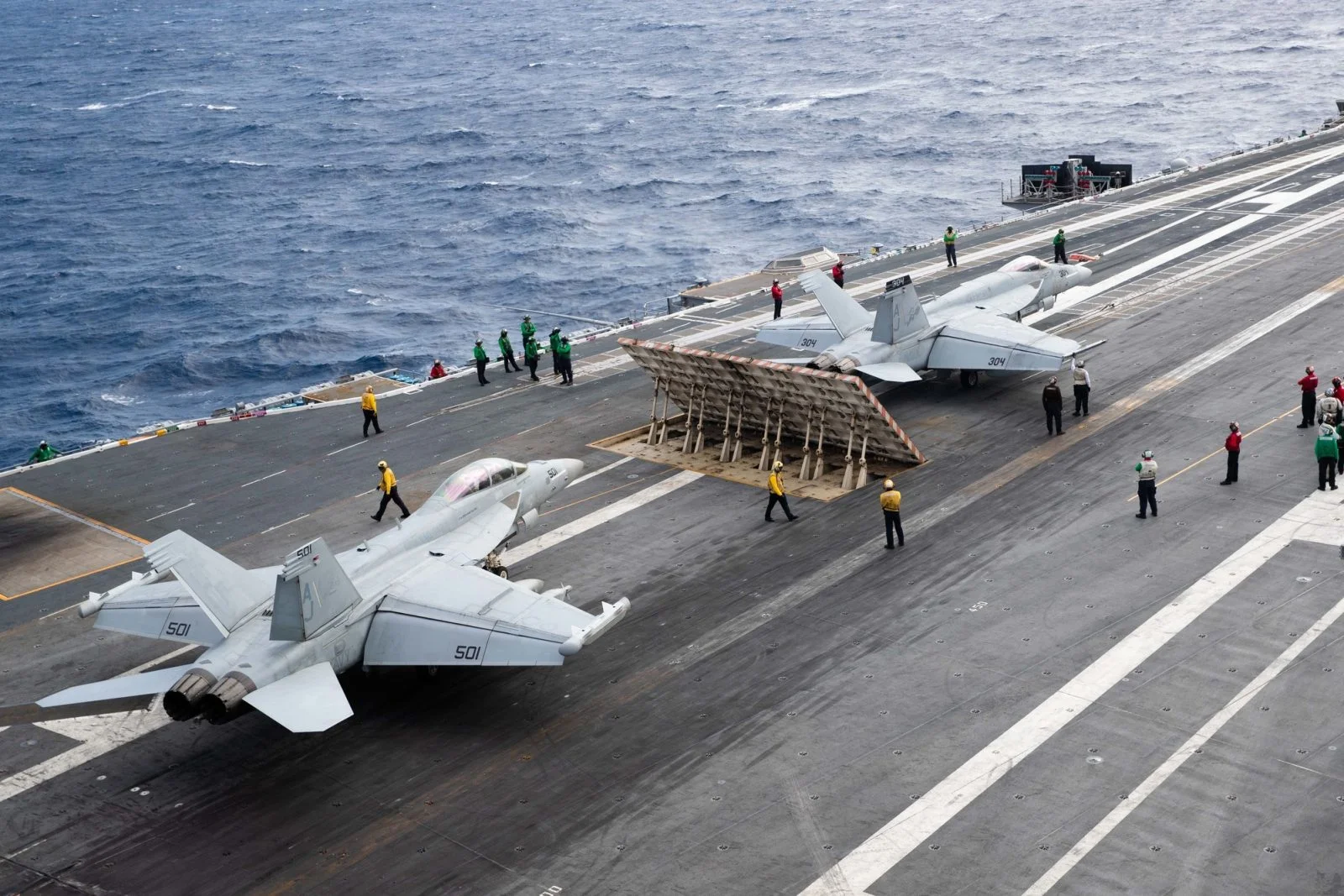
The pattern in those departures is worth pausing on: each company that left was offering an existing land-based trainer adapted for the sea. The hardest line in the Navy’s requirement is not speed, range or avionics. It is carrier landing training. Teaching a student to plant an aircraft on a deck means the landing gear, the fuselage keel and the wing attachments have to absorb loads that a land trainer never sees — thousands upon thousands of times.
The T-45 exists for exactly that reason. It began life as the British BAE Hawk and was rebuilt by McDonnell Douglas with strengthened structure, a twin-wheel nose gear and an arresting hook. Three decades later the Navy is back at the same door, which tells you the problem is structural rather than something a new mission computer or a different engine can solve.
Two philosophies left standing: adapt or start clean
The two surviving offers approach the same requirement from opposite ends of the engineering spectrum. The M-346N from Textron Aviation Defense and Leonardo is the navalised branch of the Italian M-346 Master, a type already in service with Italy, Poland, Israel, Singapore, Greece and others. Its pitch is maturity: the aircraft flies, the syllabus exists, the cost curve is known.
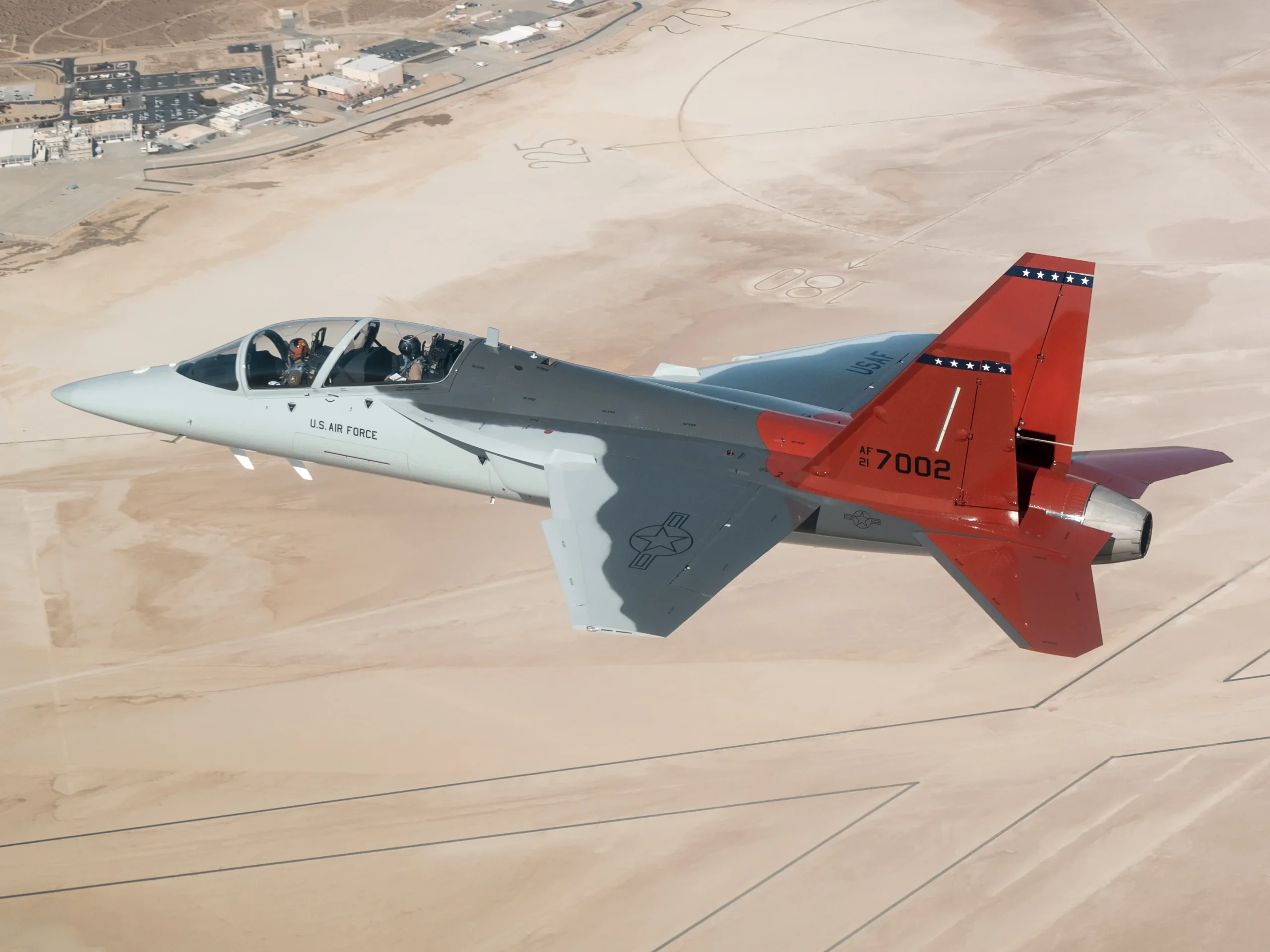
SNC’s Freedom Trainer is the only clean-sheet design in the race. Developed in a digital environment and sized from the outset for the naval training mission, its published numbers explain why the company chose to start from nothing: a 16,000-hour airframe life and the ability to absorb up to 35,000 carrier touch-and-go and Field Carrier Landing Practice recoveries — including FCLP flown all the way to touchdown rather than waved off short of it.
That last detail reads like a footnote and is in fact the heart of the programme. FCLP puts students on a virtual deck painted onto a runway and has them fly the approach exactly as they would to a ship. Most land-based trainers can only rehearse the approach; carrying it through to wheels-on-concrete loads the structure close to a real recovery every single time. Multiply that by tens of thousands and it stops being a flight profile and becomes a fatigue specification.
Both bids promise open system architecture, and for the Navy that is not a buzzword. An aircraft it intends to fly for thirty years cannot have its mission computer and courseware locked to a single vendor, and the service wants the simulator and the jet to share one digital backbone so that the expensive part of the syllabus can migrate to the ground.
UJTS at a glance: the programme numbers
| Item | Detail |
|---|---|
| Programme | UJTS — Undergraduate Jet Training System |
| Customer | US Navy (including Marine Corps jet training) |
| Aircraft replaced | T-45 Goshawk (BAE Hawk derivative, in service since the early 1990s) |
| Requirement | 216 aircraft |
| Estimated programme value | ~$10 billion |
| Development / initial manufacturing cap | ~$1.8 billion |
| Final RFP | 26 March 2026 |
| Proposals closed | 29 June 2026 |
| Award decision (current) | 30 June 2027 |
| Remaining bids | Freedom Trainer (SNC + GA-ASI) · M-346N (Textron Aviation Defense + Leonardo) |
| Withdrawals | Lockheed Martin–KAI TF-50N (April 2026) · Boeing T-7A (June 2026) · Northrop Grumman (September 2026, as team partner) |
| Freedom Trainer airframe life | 16,000 hours |
| Freedom Trainer recovery capacity | Up to 35,000 touch-and-go / FCLP landings |
Why so few companies can build this aircraft
The advanced jet trainer is the most deceptive category in military aviation. It looks like a small fighter and is specified like something harder. A fighter logs a few thousand landings in its life; a trainer logs tens of thousands. A fighter is flown by an experienced pilot; a trainer is flown, by definition, by someone who does not yet know what they are doing — which means the airframe has to forgive.
That is why the list of countries with a credible advanced jet trainer barely fills a hand: Italy with the Leonardo M-346, South Korea with the KAI T-50 family, the United States with the Boeing T-7A, China with the Hongdu L-15, Russia with the Yak-130 and Türkiye with the TUSAŞ HÜRJET. Most other air forces either stop at turboprops or buy second-hand.
Add carrier capability and the list collapses to a single entry. The T-45 is effectively the only carrier-capable jet trainer flying today; other navies either train ashore and transition students straight onto a frontline type, or send them through an allied pipeline. The supplier scarcity the US Navy is now experiencing is the arithmetic of that very narrow market.
Narrow does not mean lucrative. The delays and fixed-price losses that hit Boeing on T-7A have visibly changed how the industry prices trainer competitions. Northrop’s “focus our resources elsewhere” line belongs in that context.
A different answer to the same question
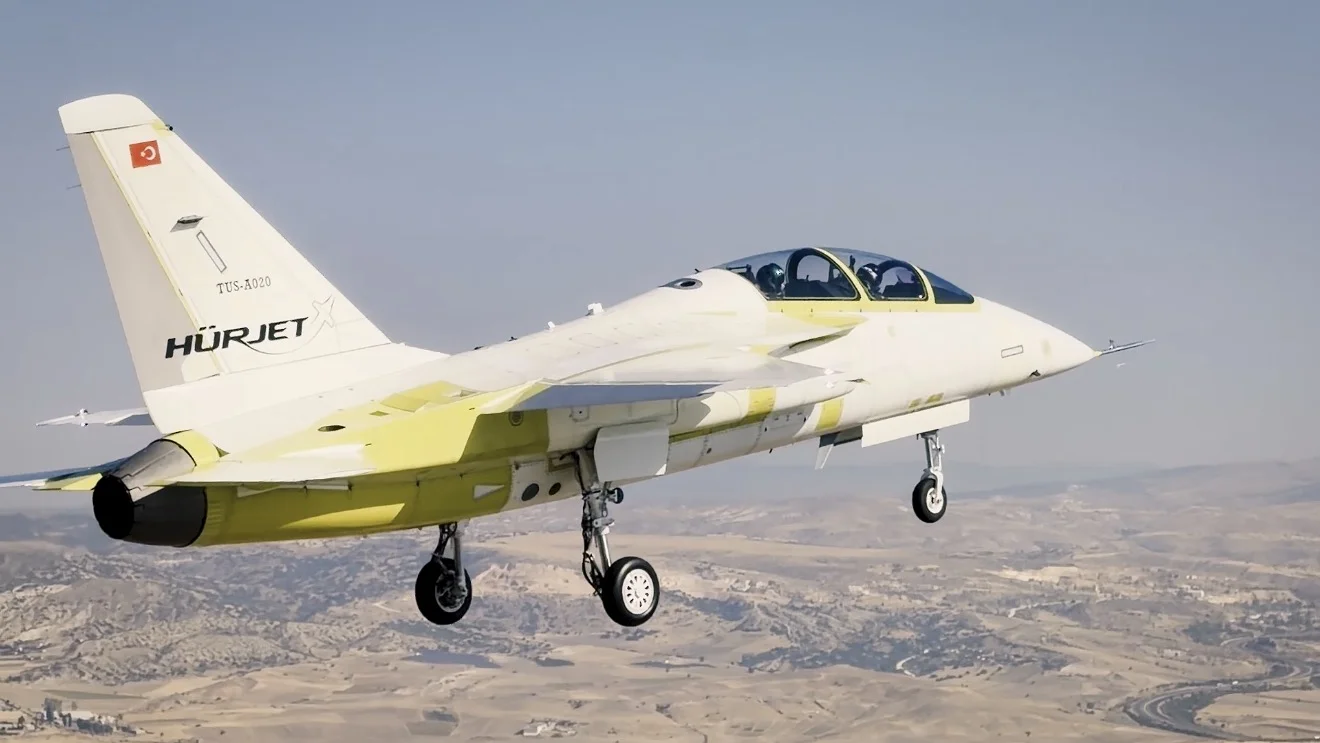
The trap the US Navy has walked into — discovering that navalising an existing land trainer is costlier and riskier than it looks — is a version of a question Türkiye answered a decade ago from a different starting point. When TUSAŞ went looking for a successor to its T-38 and F-5 generation, it chose to design rather than adapt, and HÜRJET is the result.
Where the programme stands today: the first prototype flew on 25 April 2023, and the first series-production aircraft for the Turkish Air Force made its 18-minute maiden flight on 30 August 2026 from the company’s Kahramankazan plant. On export, Spain has approved a package for 45 HÜRJETs worth roughly €3.12 billion to replace its F-5 fleet, of which 30 are under firm contract with the balance held as options; deliveries are planned from 2028. On propulsion, TUSAŞ and GE Aerospace announced an agreement on 5 May 2026 covering F404 engines, with assembly, inspection and test work in Türkiye through TEI on the table.
The part that touches this story directly is the naval branch. TUSAŞ has confirmed work on a ship-borne HÜRJET intended for Türkiye’s future carrier, MUGEM. As described, the naval variant is being designed for STOBAR operation — ski-jump launch, arrested recovery — with CATOBAR compatibility kept on the shelf as a later upgrade should the catapult technology mature.
Setting the two programmes side by side is not an exercise in ranking them. The US Navy is recapitalising 216 aircraft to feed the busiest carrier training pipeline in the world, and is finding that the requirement pushes it toward a clean sheet. Türkiye made that same architectural choice up front, for a far smaller fleet and a ship still under construction. The scale and the timelines are not comparable; the engineering logic is. And Ankara’s own dependency is visible in the same paragraph: the airframe and the naval derivative are domestic decisions, the engine is not — at least until TEI’s TF-series powerplants are ready.
What happens next
The Navy now has two bids and until 30 June 2027 to choose between them. A shorter list makes evaluation simpler on paper, but it is not where a customer wants to be on price: two offers is a thin field from which to extract competitive pressure.
The real question is where the service would rather carry its risk. Navalising a mature platform puts the risk in engineering. Starting clean puts it in schedule and cost. Every year the T-45 fleet ages makes that trade more expensive to defer.
The thread to watch out of Türkiye is how concrete the ship-borne HÜRJET becomes. To the extent that MUGEM’s build schedule and the aircraft’s maturity converge, Türkiye keeps alive a plausible claim to the second seat in a club that currently has one member.
Sources
- Breaking Defense — “Northrop drops off SNC-led Navy trainer team”, 14 September 2026
- Sierra Nevada Corporation — “SNC Signs Charter with Northrop Grumman and General Atomics Aeronautical Systems to Deliver Freedom Trainer for UJTS”
- The Aviationist — “U.S. Navy Launches Competition for T-45’s Replacement with Final RFP”, 30 March 2026
- GE Aerospace — “GE Aerospace and Turkish Aerospace Announce Agreement for F404 Engines for the HÜRJET Program”, 5 May 2026
- Turkish Aerospace (TUSAŞ) / Anadolu Agency — HÜRJET Spain export agreement and first series-production flight