





World’s Largest Trainer Aircraft Manufacturers: HÜRJET’s Spanish Contract and the M-346’s Nine Countries (2026)

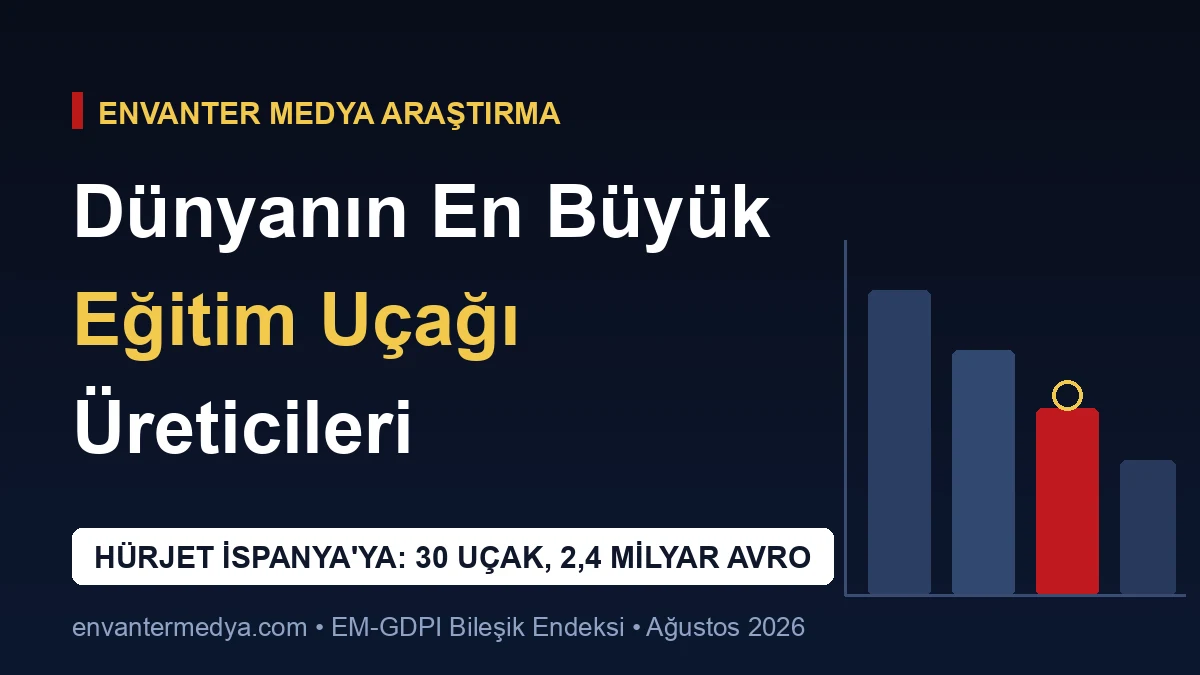
Trainer aircraft are defense aviation’s least-discussed and most decisive link: a country can buy a fighter, but without trained pilots it cannot fly one. That is why this market has shifted in recent years from selling aircraft to selling training systems — Leonardo’s M-346 has reached nine countries, and through the International Flight Training School in Italy it now trains US Air Force student pilots as well. Türkiye enters this table with the single strongest export figure in the entire series: TUSAŞ’s HÜRJET was sold to Spain in a 30-aircraft, €2.4 billion contract signed on 28 December 2025 — the first sale of a Turkish combat aircraft to a country that is both a NATO and an EU member. Following our small arms file, Envanter Medya compares the world’s trainer aircraft builders across user base, exports, combat-derivative capability and training-system completeness.
Editorial note: This ranking is an editorial research product compiled by Envanter Medya from publicly available data; it is not an official international ranking. Sources and methodology are explained at the end.
The research at a glance
“Largest” by which measure?
The trainer market works on two layers: turboprops for basic training (Pilatus PC-21, Beechcraft T-6, HÜRKUŞ, KAI KT-1) and jets for advanced training (M-346, T-50, T-7A, HÜRJET). What distinguishes the second layer is that most of these aircraft also have light combat derivatives — an FA-50 both trains students and goes to war. So “largest” is measured here on four yardsticks: user countries, export volume, combat-derivative capability and training-system completeness — the ability to sell simulators, ground-based training and even the training service alongside the aircraft. That last measure increasingly decides competitions: modern tenders buy an end-to-end training system, not an airframe.
Why this sector matters: training a fifth-generation fighter pilot requires different ground and flight infrastructure than a fourth-generation one. Every country buying F-35-class aircraft therefore has to renew its training fleet too — that chain reaction is the real driver of the sector’s growth this decade.
By user base: the M-346’s nine countries
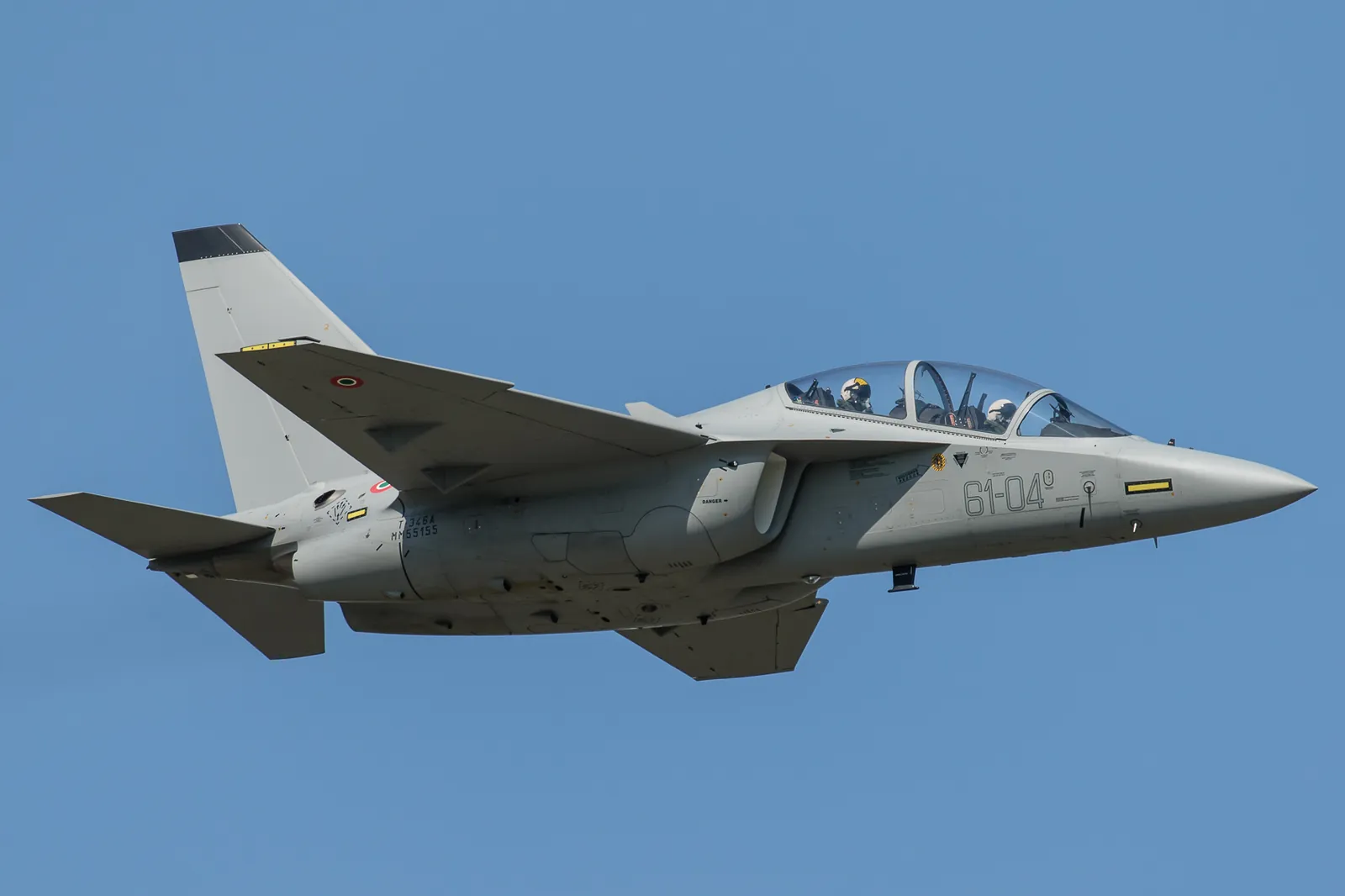
In advanced jet training the widest user base belongs to Leonardo’s M-346, delivered to Italy, Israel, Singapore, Poland, Greece, Azerbaijan, Turkmenistan, Qatar and Canada. Leonardo’s real differentiator is not the product but the business model: through the International Flight Training School (IFTS) in Italy it sells the training service itself. Under an agreement signed between the Italian and US Air Forces in August 2025, American student pilots began training on M-346s in Italy; the first course opened in September 2025 with ten pilots and completed in June 2026. In Canada, ITPS ordered the M-346T Block 20 in May 2026.
Countries with deliveries made or contracts signed (T label). The T-7A has yet to enter full serial production, so its user count is limited to the US. The Turkish program is marked separately.
By export volume: the HÜRJET’s Spanish contract
The biggest trainer export of 2025-26 came out of Türkiye. Spain purchased 30 HÜRJETs under a contract signed on 28 December 2025, valued at €2.4 billion, with Airbus leading work on the new Integrated Training System. Deliveries come in two phases: the first 30 aircraft, in their initial configuration, will be certified in Spain and delivered to the Spanish Air and Space Force between 2028 and 2029; in the next phase the aircraft undergo conversion with national content and are delivered in batches from the second half of 2031 through 2035. It is the first sale of a Turkish combat aircraft to a country that is both a NATO and an EU member. At KAI, the FA-50’s export record is older and larger: Poland ordered 48 and Malaysia 18, with the Philippines expanding its fleet.
Publicly contracted export orders; options and programs still in negotiation are excluded. The HÜRJET row is the €2.4 billion Spanish contract. The Turkish program is marked separately.
Verified production and programs
| Builder | Country | Aircraft | Verified indicator | Data type |
|---|---|---|---|---|
| Leonardo | Italy | M-346 (Master/FA) | Delivered to 9 countries: Italy, Israel, Singapore, Poland, Greece, Azerbaijan, Turkmenistan, Qatar, Canada; trains US Air Force pilots through IFTS (first course Sep 2025–Jun 2026); Canada M-346T Block 20 order (May 2026) | R |
| KAI | S. Korea | T-50, FA-50, KT-1 | Poland 48 and Malaysia 18 FA-50 orders; Philippines a user; the KT-1 turboprop gives products on both layers | R/T |
| TUSAŞ 🇹🇷 | Türkiye | HÜRJET, HÜRKUŞ | 30 HÜRJETs to Spain, €2.4 billion (28 Dec 2025); deliveries 2028-2029 (phase 1) and 2031-2035 (phase 2); first Turkish deliveries in 2026 to the Turkish Stars; the HÜRKUŞ turboprop has been exported | R |
| Boeing | USA | T-7A Red Hawk | The US Air Force’s new trainer; still years from full production; proposed as a candidate for the UK’s new jet trainer requirement | R/T |
| Pilatus | Switzerland | PC-21, PC-7 | The most widespread aircraft in advanced turboprop training; the training backbone of many NATO and Gulf states | R/T |
| Textron Aviation Defense | USA | T-6 Texan II | Basic trainer of the US and its allies; broad user base | R/T |
| Hongdu | China | L-15, JL-8 | Production figures not disclosed; limited L-15 exports | D (domestic) / T (export) |
Data types: R = official/company statement, T = credible industry reporting, D = insufficient data. Because a trainer and a light combat derivative can share one airframe, both roles are noted in the table.
The Envanter Medya Composite Index: EM-GDPI (adapted)
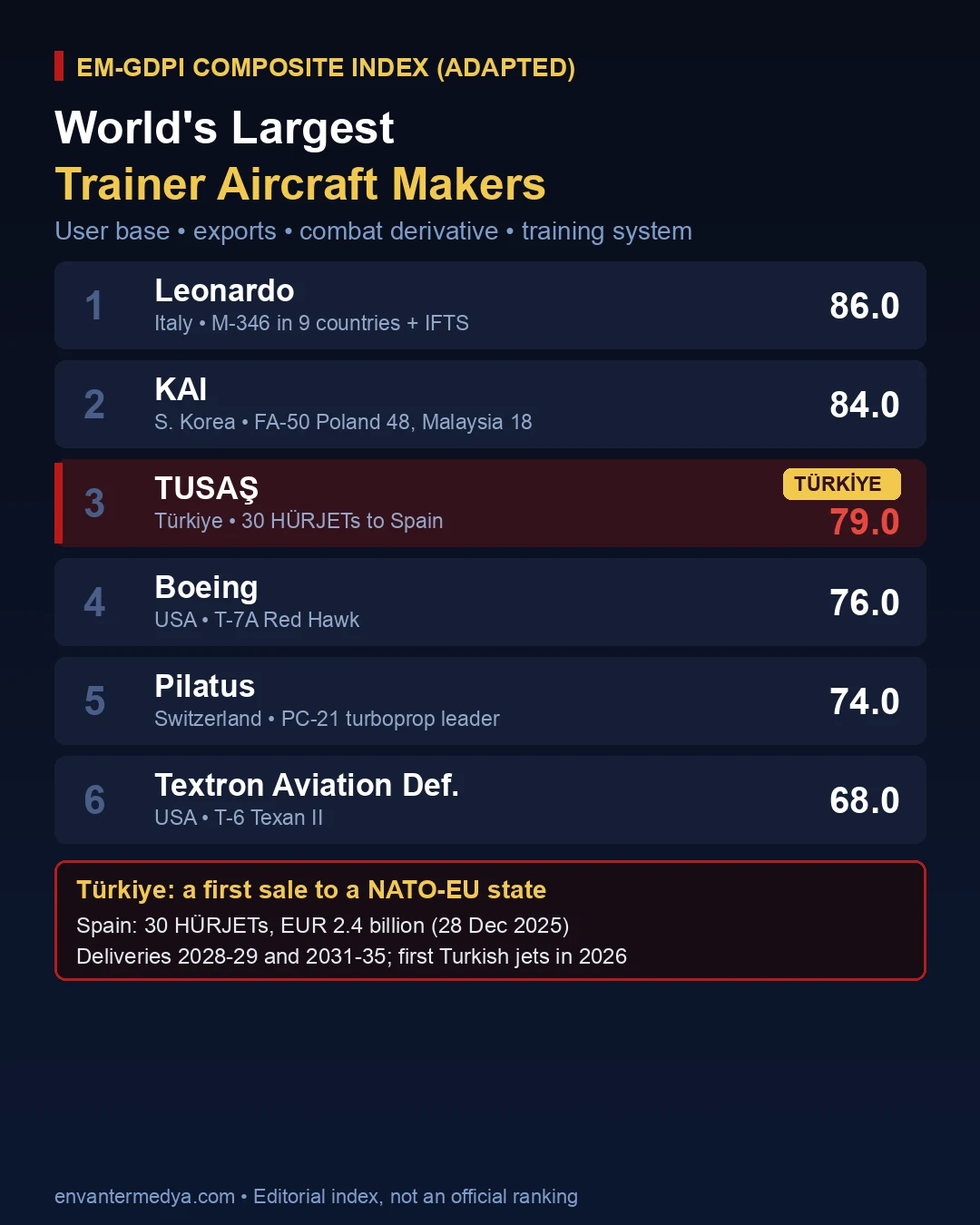
The series’ nine-criterion index was adapted for this sector: the revenue criterion’s weight was reduced (trainer revenue is not reported separately in company accounts) and a training-system completeness criterion added — the capacity to deliver simulators, ground-based training and training services. Hongdu was not scored for lack of data.
An editorial, adapted index — not an official ranking. The revenue criterion’s weight was reduced and training-system completeness added. Hongdu was not scored. The Turkish company is marked separately.
What the index says: Leonardo leads because it pairs a nine-country user base with being the only builder that also sells the training service — the US Air Force sending student pilots to Italy is the proof of that model. KAI ranks second on the FA-50’s combat-derivative success and on covering both layers with the KT-1 turboprop. TUSAŞ’s third place at 79 points is among the Turkish defense industry’s highest placements in this series, resting on one figure: the €2.4 billion Spanish contract, which scored in the upper band on both exports and technology-credibility. What caps the score is that deliveries have not begun — from 2028 this table may change.
Where does Türkiye stand?
Türkiye enters the trainer market with the single strongest export figure in this entire series. Under a contract signed on 28 December 2025, Spain purchased 30 HÜRJETs; the €2.4 billion deal has Airbus leading work on the new Integrated Training System. The first 30 aircraft, in their initial configuration, will be certified in Spain and delivered to the Spanish Air and Space Force in 2028-2029; in the second phase the aircraft are converted with national content and delivered in batches from the second half of 2031 through 2035. In one sentence: a Turkish combat aircraft has been sold for the first time to a country that is both a NATO and an EU member. Domestically, the first HÜRJET deliveries in 2026 go to the Turkish Stars aerobatic team. Türkiye also has a product on the turboprop layer: the HÜRKUŞ has been exported.
Where is Türkiye behind?
Let the data speak, in the right order: HÜRJET deliveries have not started. The Spanish contract is a historic threshold, but the aircraft arrive from 2028 onward — while the M-346 flies in nine countries today and FA-50 deliveries to Poland continue. The user-base gap is plain: HÜRJET’s customers today are Türkiye and Spain, against the M-346’s nine countries. Nor does Türkiye yet operate a training-service business like Leonardo’s IFTS — a strategic gap as the sector shifts from selling aircraft to selling training systems. That Airbus leads the integrated training system in the Spanish contract is the concrete marker of that gap. Against it, three data points support optimism: at €2.4 billion the contract is among the sector’s largest single export items; the customer is a NATO-EU state, meaning the toughest certification bar is being cleared; and with the HÜRKUŞ, Türkiye is one of the few builders fielding products on both training layers.
How this research was prepared
Data year: Contract and delivery data from official announcements and credible industry reporting, January 2025 – August 2026. Scope: Seven groups building military trainers; combat aircraft are covered in a separate file, with light combat derivatives of trainers noted here. Missing data: Hongdu’s production counts are not public; no company reports trainer revenue separately. EM-GDPI (adapted): The revenue criterion’s weight was reduced and training-system completeness added.
| Builder | Data reliability | Note |
|---|---|---|
| Leonardo, TUSAŞ, Boeing | A | Official contract and program announcements current |
| KAI, Pilatus, Textron | B | Program data partly public; delivery breakdown limited |
| Hongdu | D | No reliable current data; excluded from the index |
Frequently asked questions
Which company is the world’s largest trainer aircraft manufacturer?
Leonardo (M-346) leads on user base and training-system completeness; KAI (FA-50) on export volume and combat derivatives. Leonardo tops Envanter Medya’s adapted index, with TUSAŞ third.
How many HÜRJETs did Spain buy?
Thirty. The contract was signed on 28 December 2025 and is valued at €2.4 billion, with Airbus leading work on the new Integrated Training System.
When do HÜRJET deliveries begin?
The first 30 aircraft for Spain, certified in their initial configuration, arrive between 2028 and 2029; in the second phase, aircraft converted with national content are delivered in batches from the second half of 2031 through 2035. In Türkiye, first deliveries in 2026 go to the Turkish Stars.
Why does the HÜRJET-Spain deal matter?
Because it is the first sale of a Turkish combat aircraft to a country that is both a NATO and an EU member — meaning European certification and procurement standards were cleared, creating a reference for other markets.
How many countries operate the M-346?
It has been delivered to nine: Italy, Israel, Singapore, Poland, Greece, Azerbaijan, Turkmenistan, Qatar and Canada.
Why do US pilots train in Italy?
Under an August 2025 agreement between the Italian and US Air Forces, American student pilots train on M-346s at the International Flight Training School in Italy; the first course began in September 2025 with ten pilots and finished in June 2026.
Where does the T-7A Red Hawk stand?
The US Air Force’s new trainer remains years from full production. Boeing has proposed it as a candidate for the UK’s new jet trainer requirement.
Is the UK buying a new trainer?
The UK issued a request for information in August 2026 for a new jet trainer and Red Arrows aircraft. Candidates include the T-7A, KAI T-50, TUSAŞ HÜRJET and Leonardo M-346.
How many FA-50s did Poland order?
Forty-eight. Malaysia ordered 18, and the Philippines is also a user.
Are trainers and light combat aircraft the same?
No, but the line blurs: aircraft such as the FA-50 and M-346FA both train students and fly light attack missions. A light attack derivative of the HÜRJET is also in development.
What is the HÜRKUŞ?
TUSAŞ’s turboprop basic trainer, which has been exported — giving Türkiye a product on both training layers.
Does China export trainers?
Hongdu’s L-15 has seen limited exports, but production figures are not disclosed; this research does not assess unverifiable data. See the Defense Atlas for platform profiles.
Sources and methodology notes
This study is an editorial research product prepared by Envanter Medya by cross-checking publicly available official company data, contract announcements and industry sources. Principal sources:
- The Aviationist (December 2025) — Spain’s 30-HÜRJET contract, €2.4 billion, delivery schedule and Airbus’s training system role
- Anadolu Agency — export opportunities opened by the HÜRJET-Spain deal
- M-346 program records — delivery countries and US Air Force training through IFTS
- The Aviationist (August 2026) — the UK’s RFI for a new jet trainer and Red Arrows aircraft
- Defence Industry Europe — Boeing’s T-7A proposal and rival candidates (T-50, HÜRJET, M-346)
- MigFlug — Canada’s M-346T Block 20 order (May 2026)
Last updated: August 25, 2026. This is a living research page, updated as delivery and contract announcements arrive. This file closes the series’ third wave (military satellites, unmanned ground vehicles, electro-optics, small arms, trainer aircraft). For the full series, see the 2026 Global Defense Industry Report.