World’s Largest Fighter Jet Manufacturers: The F-35’s Record Year and KAAN’s 48-Jet Deal (2026)


Ask who builds the most fighter jets and the answer depends entirely on which race you are watching. In sheer volume there is no contest: Lockheed Martin’s F-35 line set a program record with 191 deliveries in 2025, pushing cumulative output to 1,293 aircraft — more in one year than every other Western fighter line combined. The order-book race looks different: Dassault sits on a backlog of 220 Rafales, roughly eight years of work at current tempo, while the four-nation Eurofighter consortium is refilling its line with new orders — Türkiye’s included — and preparing to lift output from a dozen jets a year to twenty. The most consequential newcomer is Korean: KAI’s KF-21 formally completed development in July 2026 and its first production jets are being handed over this year. And Türkiye enters the table with a fifth-generation program that did something unusual — KAAN secured a 48-aircraft export contract from Indonesia before serial production even began. Following our military engine manufacturers file, Envanter Medya’s latest research compares the world’s fighter aircraft producers across delivery tempo, order books, user base and technology — measured separately, because no single metric tells the truth.
Editorial note: This ranking is an editorial research product compiled by Envanter Medya from publicly available data; it is not an official international ranking. Sources and methodology are explained in the “How this research was prepared” section at the end.
The research at a glance
“Largest” by which measure?
Fighter aircraft carry the highest entry barrier in the defense industry: the number of countries that serially produce a combat aircraft of their own design barely exceeds a handful. Nor is the market one race. Fifth-generation heavyweights (F-35, J-20, Su-57, KAAN), 4.5-generation multirole fighters (Rafale, Typhoon, KF-21, Gripen E) and light combat derivatives (FA-50, HÜRJET) compete in different leagues. So the answer to “who is the largest” shifts with the yardstick — annual deliveries, order backlog, user countries or technology generation. We measured all four separately.
By delivery tempo: the F-35 line is a league of its own
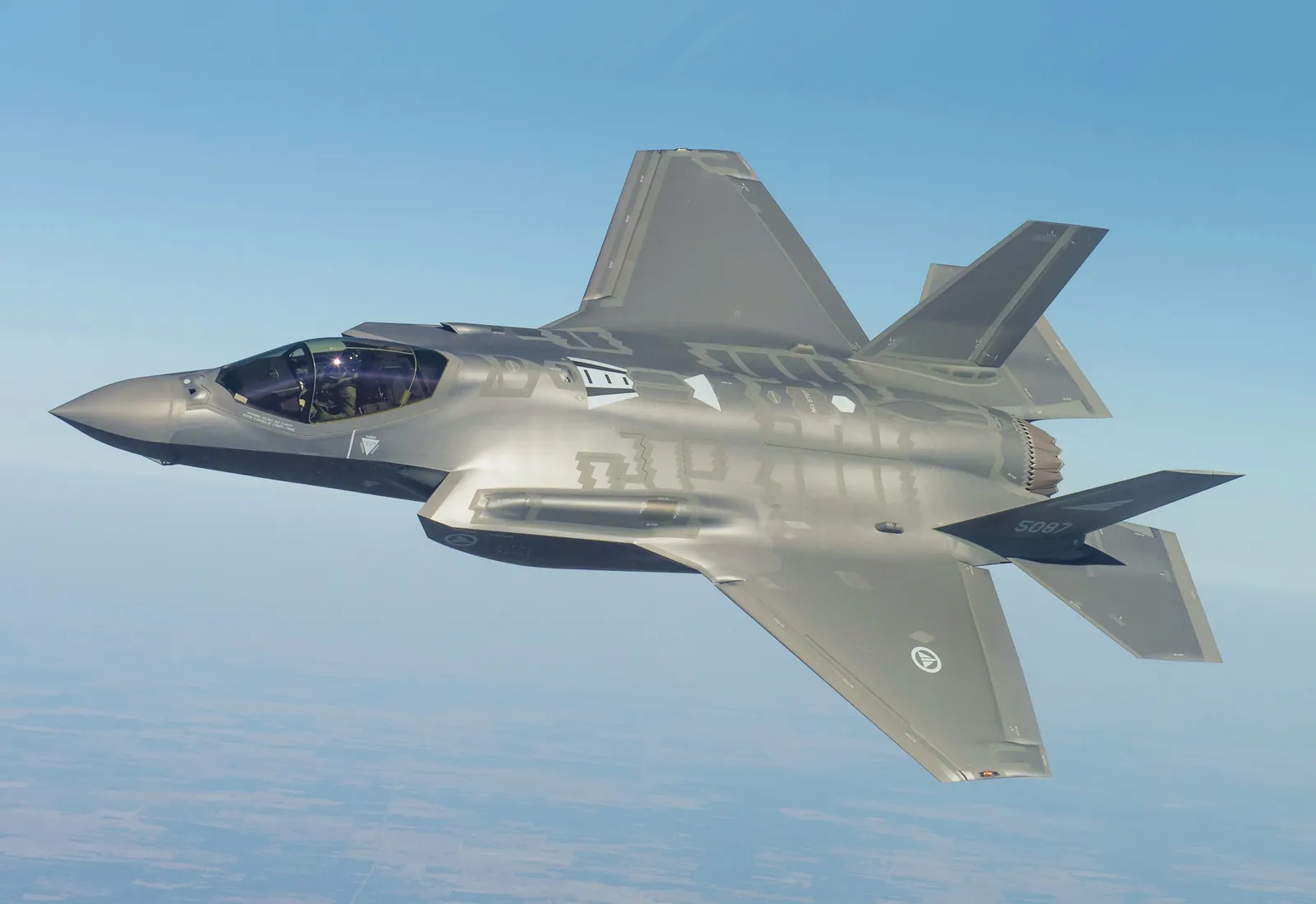
2025 was the busiest year in the F-35’s history. Lockheed Martin handed over 191 aircraft, breaking its own record and lifting the program total to 1,293 jets — 927 F-35As, 238 F-35Bs and 128 F-35Cs. The company’s stated goal is to hold the line above 156 aircraft a year. For scale: Dassault delivered 26 Rafales in 2025 (15 for export, 11 for France), and the Eurofighter line runs at roughly 12–14 jets annually, with the consortium preparing a ramp to 20 and, if demand holds, 30.
Dark bars show 2025 actual deliveries; light bars show officially announced rate targets. Sources: Lockheed Martin and Dassault Aviation official statements, Eurofighter consortium data. Chinese and Russian lines publish no verifiable delivery data and are excluded.
By order book: Dassault’s eight-year queue
The order book is the delivery race seen in a mirror. Lockheed Martin closed 2025 with a backlog of 368 F-35s. Dassault’s Rafale queue stood at 220 aircraft — 45 for France, 175 for export customers — which explains why the company is pushing its rate toward 35 jets a year by 2029-30. The Eurofighter program has logged 761 orders and delivered 613; the 148-aircraft gap, refreshed by Türkiye’s order now in the production plan, has refilled the line through the decade. KAI holds 40 firm KF-21 orders against a national plan that reaches 120 aircraft by 2032. And KAAN’s Indonesian contract adds 48 jets — a pre-commitment signed before serial production began.
The Eurofighter figure is total orders (761) minus deliveries (613). The KAAN row is an export contract signed before serial production; the Turkish program is marked separately.
Verified production, orders and deliveries
| Company | Country | Aircraft | Verified production/order indicator | Data type |
|---|---|---|---|---|
| Lockheed Martin | USA | F-35, F-16 Block 70 | 191 F-35s delivered in 2025 (record); 1,293 total; 368 backlog; target 156+/year. F-16 Block 70/72 line runs separately in Greenville | R |
| Dassault Aviation | France | Rafale | 26 deliveries in 2025 (15 export + 11 France); backlog 220 aircraft (45 FR + 175 export); rate target 35/year by 2029-30 | R |
| Eurofighter (Airbus, BAE, Leonardo) | DE-UK-IT-ES | Typhoon | 761 ordered / 613 delivered; rate rising from 12–14 to 20 (30 potential); Türkiye’s order in the production plan, first delivery 2030 | R |
| Boeing | USA | F-15EX, F/A-18, F-47 | F-15EX deliveries under way; won the US Air Force’s sixth-generation F-47 program in March 2025; F/A-18 line approaching closure | R/T |
| KAI | S. Korea | KF-21, FA-50 | KF-21 development completed July 2026; first serial delivery H2 2026, 47 aircraft by 2028, target 30+/year. FA-50: Poland 48, Malaysia 18, Philippines orders make it one of the most exported light fighters | R |
| Saab | Sweden | Gripen E/F | Sweden 60 and Brazil 36 (with local production) Gripen E programs running; further export talks ongoing | R/T |
| HAL | India | Tejas Mk1A | Two Mk1A orders of 83 + 97 aircraft (180 total); deliveries behind schedule on engine supply delays | R/T |
| TUSAŞ 🇹🇷 | Türkiye | KAAN, HÜRJET | KAAN: first flight February 2024; serial delivery target 2028-29; 48-aircraft contract with Indonesia (deliveries over 120 months). HÜRJET in serial production; F-16 ÖZGÜR modernization ongoing | R |
| AVIC/Chengdu-Shenyang | China | J-20, J-35, J-10C | Production figures not published; J-10C exported to Pakistan | D (domestic) / T (export) |
| UAC/Sukhoi | Russia | Su-57, Su-35, Su-34 | No reliable production data published since sanctions | D |
Data types: R = official/company statement, T = credible industry reporting, D = insufficient data. Modernization programs (such as F-16 ÖZGÜR) are assessed separately from new-build production.
By user countries: the F-16’s base remains unmatched
Approximate figures including countries with orders placed (T label); leases and second-hand transfers excluded. The KAAN row covers Türkiye and contract-holder Indonesia; the Turkish program is marked separately.
The Envanter Medya Composite Index: EM-GDPI
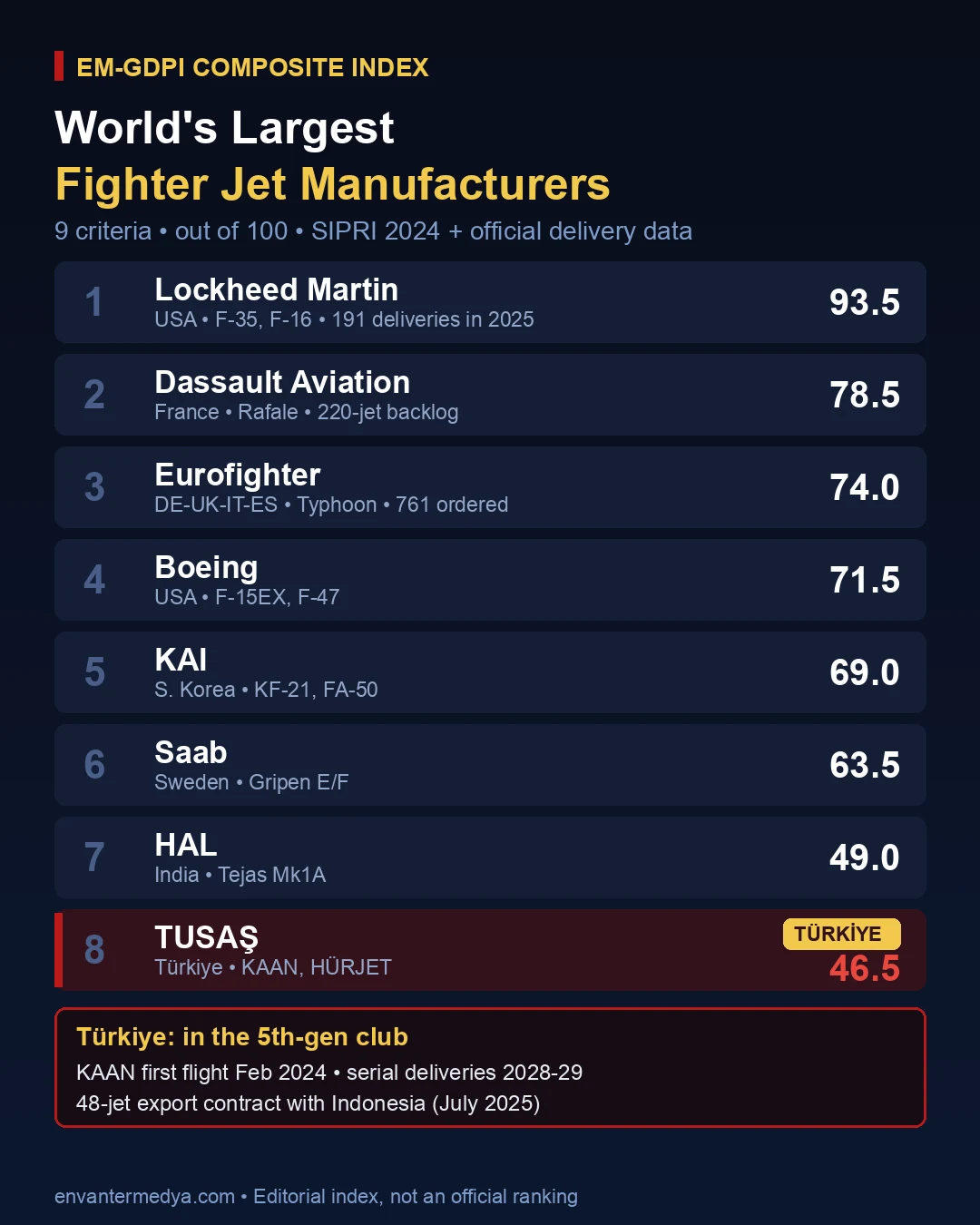
Nine criteria — production 25, revenue 15, exports 15, user countries 10, diversity 10, capacity 10, orders 5, technology 5, growth 5 — feed a 100-point editorial composite. AVIC and UAC were not scored because their production data is not transparent; that does not mean China and Russia build no fighters — no data, no score. Per SIPRI’s December 2025 release, Lockheed Martin is the world’s largest defense company; TUSAŞ ranks 65th at $2.16 billion.
An editorial composite, not an official ranking. AVIC and UAC were not scored for lack of data. The Turkish company is marked separately.
| Company | Production (25) | Revenue (15) | Exports (15) | Users (10) | Other 5 criteria (35) | TOTAL |
|---|---|---|---|---|---|---|
| Lockheed Martin | 25.0 | 15.0 | 13.5 | 10.0 | 30.0 | 93.5 |
| Dassault Aviation | 15.0 | 9.0 | 13.5 | 7.0 | 34.0 | 78.5 |
| Eurofighter cons. | 12.5 | 12.0 | 12.0 | 8.0 | 29.5 | 74.0 |
| Boeing | 15.0 | 13.5 | 10.5 | 6.0 | 26.5 | 71.5 |
| KAI | 15.0 | 6.0 | 12.0 | 6.0 | 30.0 | 69.0 |
| Saab | 12.5 | 7.5 | 9.0 | 5.0 | 29.5 | 63.5 |
| HAL | 10.0 | 7.5 | 3.0 | 2.0 | 26.5 | 49.0 |
| TUSAŞ 🇹🇷 | 5.0 | 4.5 | 4.5 | 2.0 | 30.5 | 46.5 |
What the index says: Lockheed Martin’s lead rests on a delivery tempo that exceeds its rivals combined and a user base stretching from the F-16 to the F-35. Dassault ranks on the depth of its backlog, Eurofighter on its four-nation industrial network and refilled line, KAI on the fastest-maturing new program in the world. TUSAŞ’s 46.5 points are a starting photograph: production and export scores are low because KAAN is not yet in serial production — but the Turkish program scored in the top band for technology (fifth generation), orders (a 48-jet export contract) and growth.
Where does Türkiye stand?
Türkiye is the newest player in the fighter league, and honesty comes first: KAAN is not yet in serial production. The jet flew for the first time in February 2024; serial deliveries are targeted for 2028-29, with prototypes and pre-production aircraft coming together at TUSAŞ’s Ankara-Kahramankazan line. Two data points nevertheless stand out internationally. The first is club membership — fewer than a handful of countries have flown a fifth-generation fighter of their own, and Türkiye is among them. The second is the export: Indonesia turned a June 2025 agreement at Jakarta’s Indo Defence show into a formal 48-aircraft contract signed in Istanbul in July 2025, with deliveries phased over 120 months. A fighter winning an export contract before entering serial production is a measurable indicator of confidence in the program.
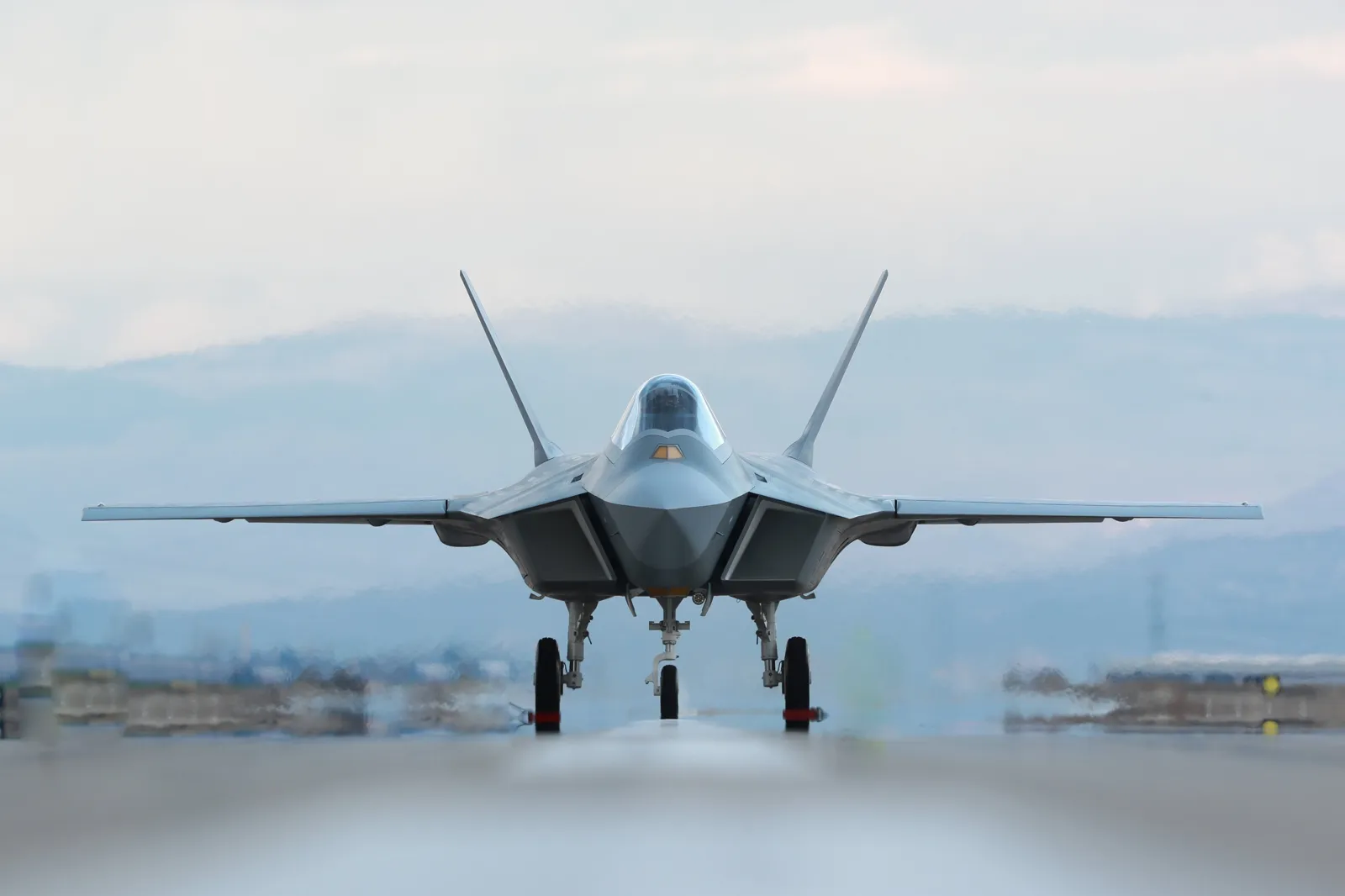
Not just one aircraft: the breadth of the line
TUSAŞ’s combat aviation ecosystem extends beyond a single platform. The HÜRJET jet trainer and light attack aircraft is in serial production with deliveries to the Turkish Air Force under way. The F-16 ÖZGÜR program is refitting the existing fleet with indigenous avionics and an ASELSAN radar. On propulsion, TEI’s TF-6000 and TF-10000 family — and the TF-35000 targeted for KAAN — are the building blocks we detailed in our military engine manufacturers file. ASELSAN’s AESA nose radar and air-launched munitions from TÜBİTAK SAGE and Roketsan complete the domestic chain around the aircraft.
Where is Türkiye behind?
Let the data speak: KAAN’s serial production count today is zero, while Lockheed Martin delivers a fighter roughly every other day. The first serial KAANs will fly on General Electric F110 engines — integrating the domestic TF-35000 is next decade’s work. The user-base gap is just as plain: against the F-16’s ~25 countries and the F-35’s ~20, KAAN’s customers today are Türkiye and Indonesia. Türkiye’s real asset in this table is not time but the chain: high domestic content in airframe, radar, avionics and munitions — a design choice shaped by the experience of exclusion from the F-35 partnership — reduces the program’s dependency risk.
How this research was prepared
Data year: Delivery and order data from official announcements, January 2025 – August 2026; revenue references from SIPRI’s December 2025 release (2024 figures). Scope: Ten groups producing combat aircraft; jet trainers noted only in the context of their combat derivatives. Missing data: AVIC and UAC production counts are not public and were not estimated. EM-GDPI: Nine criteria scored 0-10 and weighted; relative within the group and editorial; companies with insufficient data were not scored.
| Company | Data reliability | Note |
|---|---|---|
| Lockheed Martin, Dassault, Eurofighter, KAI, TUSAŞ | A | Official delivery/contract announcements current |
| Boeing, Saab, HAL | B | Program data partly public; delivery breakdown limited |
| AVIC, UAC | D | No reliable current data; excluded from the index |
Frequently asked questions
Which company is the world’s largest fighter jet manufacturer?
It depends on the measure: Lockheed Martin leads by a wide margin in annual deliveries and user base (191 F-35s in 2025), while Dassault holds the deepest single-company order queue at 220 Rafales. Lockheed Martin tops the Envanter Medya composite index.
How many F-35s were delivered in 2025?
Lockheed Martin delivered 191 F-35s in 2025, a program record, bringing total deliveries to 1,293 aircraft — 927 F-35As, 238 F-35Bs and 128 F-35Cs.
When will KAAN enter serial production?
TUSAŞ targets first serial deliveries (Block 10) to the Turkish Air Force in 2028-29. First flight took place in February 2024; prototype and pre-serial production continues.
How many KAAN fighters will Indonesia buy?
Indonesia signed a formal contract in Istanbul in July 2025 for 48 KAAN fighters, with deliveries phased over 120 months. It is the program’s first export contract.
How large is the Rafale backlog?
Per Dassault’s official end-2025 figures, 220 aircraft: 45 for France and 175 for export customers. The company plans to reach 35 jets a year by 2029-30.
Is Türkiye buying the Eurofighter?
Türkiye’s Typhoon order has entered the consortium’s production plan, with first deliveries expected in 2030 — taking the type’s user countries to ten.
Where does the KF-21 stand?
South Korea’s KF-21 Boramae formally completed development in July 2026; first serial jets are being delivered in the second half of 2026, with 47 aircraft planned by 2028. Firm orders stand at 40 against a long-term plan of 120.
Which countries build fifth-generation fighters?
Countries that have flown their own fifth-generation designs are the United States (F-22, F-35), China (J-20, J-35), Russia (Su-57) and Türkiye (KAAN), with South Korea’s KF-21 generally classed at 4.5 generation; classifications vary by source.
How many countries fly the F-16?
Roughly 25 countries operate the F-16 family — the world’s most widespread fighter. Türkiye is both a major F-16 operator and is modernizing its fleet with indigenous avionics under the ÖZGÜR program.
Is HÜRJET a fighter?
HÜRJET is primarily a jet trainer with a light attack derivative in development. It is in serial production with deliveries to the Turkish Air Force under way — a different class from KAAN.
How many fighters do Russia and China build a year?
No reliable public data exists. This research declines to publish unverifiable figures; AVIC and UAC were excluded from the index for that reason.
Does KAAN have a domestic engine?
The first serial aircraft will fly on General Electric F110 engines; TEI’s TF-35000 turbofan is targeted for later blocks. See our engine manufacturers file, and the Defense Atlas for more.
Sources and methodology notes
This study is an editorial research product prepared by Envanter Medya by cross-checking publicly available official company data, institutional reports, contract and delivery records and industry sources. Principal sources:
- Lockheed Martin official release (January 2026) — 191 F-35 deliveries in 2025, 1,293 total, rate target
- Dassault Aviation official data (December 31, 2025) — 26 Rafale deliveries, 220-aircraft backlog
- Türkiye Today — Eurofighter production data (761/613), Türkiye’s order and 2030 delivery plan
- UPI — KF-21 development completion and serial production schedule
- TUSAŞ official announcement — 48-aircraft KAAN contract with Indonesia
- Defense News — scope and timeline of the KAAN-Indonesia agreement
- SIPRI Top 100 Fact Sheet (December 2025) — 2024 defense revenues
Last updated: August 24, 2026. This is a living research page, updated as delivery and contract announcements arrive. The next file in the series examines the world’s largest military helicopter manufacturers. For the full series, see the 2026 Global Defense Industry Report.