America Just Handed Its Artillery Future to South Korea: Wheeled K9 Wins $233M Prototype Deal
The US Army has finally made a call on the artillery programme it has been unable to close out for more than twenty years: Hanwha Defense USA’s wheeled K9 howitzer has been selected to build prototypes for the Mobile Tactical Cannon (MTC) effort. The agreement covers the accelerated delivery of six prototype systems with an option for twelve more, and a total value that could reach $233 million. To get there, the Army passed over a line-up that included Rheinmetall, BAE Systems, KNDS and an Elbit America team.
AT A GLANCE
- What happened: The US Army selected Hanwha Defense USA’s wheeled K9 to build prototypes for the Mobile Tactical Cannon programme.
- How many, how much: Six prototypes on an accelerated schedule, an option for 12 more, up to $233 million in total.
- Replacing what: The towed M777 and the tracked M109A7 Paladin – a family whose design roots run back to the 1960s.
- Who lost: SIGMA from Elbit America, Anduril and Oshkosh; a CAESAR variant from Leonardo DRS and KNDS; Rheinmetall’s RCH 155; BAE Systems’ Archer.
- Built where: At the integration and test facility Hanwha is standing up in Opelika, Alabama.
- Wider read: Korean industry is no longer selling into the US market – it is building a manufacturing footprint inside it.
Twenty-four years of false starts, ended by a Korean gun
US Army artillery modernisation has become a case study in how not to run a programme. The XM2001 Crusader was cancelled in 2002. The Non-Line-of-Sight Cannon that followed went nowhere. And in 2024 the Extended Range Cannon Artillery effort, which promised a longer barrel and dramatically longer reach, was halted over technical problems. Billions were spent; the guns in the field stayed the same.
Which is why the Army still fights with the M109A7 Paladin – the latest branch of a family first fielded in the 1960s – and with the towed M777 that entered service in the early 2000s. Ukraine has been merciless about exposing what that costs. A towed howitzer needs minutes to emplace and minutes to displace, and in the age of counter-battery radar and cheap surveillance drones, minutes are lethal.
MTC is the Army’s answer, and the striking thing about it is the change in method. Rather than develop something new, the service went shopping among platforms that already exist and are already in production. The request for information went out to industry roughly eleven months ago, in September 2025. The decision landed this week. By the standards of US defence acquisition, that is a sprint.
The symbolism is hard to miss. The country with the largest defence industrial base on earth has chosen an Asian supplier to build the backbone of its future field artillery. A decade ago that sentence would have been difficult to write.
Inside the deal: six prototypes, twelve options, $233 million
The award covers “the accelerated delivery of six prototype MTC systems, with an option for an additional 12.” Exercise every option and the value reaches $233 million. That works out to roughly $13 million a system, but the figure should not be read as a production price: at prototype stage, engineering, integration and test costs are buried in the unit cost.
The guns are going to soldiers. The Army says troops “will use these platforms in a series of operational experiments to assess performance, reliability, and supportability in realistic combat conditions.” That third word – supportability – is the one that usually decides these programmes. A howitzer can shoot beautifully and still fail if the spares chain and battalion-level maintainability do not hold up.
Those experiments will inform a later fielding decision. Open-source reporting has pointed to prototype evaluation through 2026, soldier testing in 2027, and a final selection later that year. The end state is not small: a fleet of more than 400 modern artillery systems.
One caveat worth stating plainly. Winning the prototype award is not the same as winning the programme. Hanwha won the right to put metal in soldiers’ hands first; production is a separate decision, and some of the losing bidders may resurface at that stage. But the company generating the field data starts with a real advantage.
The losing field was, essentially, all of Western artillery
The scale of this decision is best measured by who did not win. SIGMA, developed jointly by Elbit America, Anduril and Oshkosh Defense. A CAESAR variant offered by Leonardo DRS with KNDS. Rheinmetall’s RCH 155, mounted on the Boxer hull. And BAE Systems’ Swedish-designed Archer. That list is close to the entire Western wheeled-artillery catalogue.
CAESAR and Archer have both been fired in anger in Ukraine and carry genuine combat records. RCH 155 was arguably the most technically ambitious entrant, with its claim of firing on the move. That the Army went to Korea anyway suggests the decision turned on variables beyond raw ballistics: production capacity, delivery schedule, a commitment to build in the United States, and cost.
For European primes this is another hard lesson about the American market. European order books have been full since 2022 thanks to Ukraine-driven demand – but a full order book is precisely what makes it difficult to promise an American customer an early delivery date.
Korean industry sits in the opposite position. Hanwha has built hundreds of guns in the K9 family and has the capacity to build more. The scale of its Polish deliveries has already demonstrated exactly that.
Why wheels? Ukraine rewrote the rules of gunnery
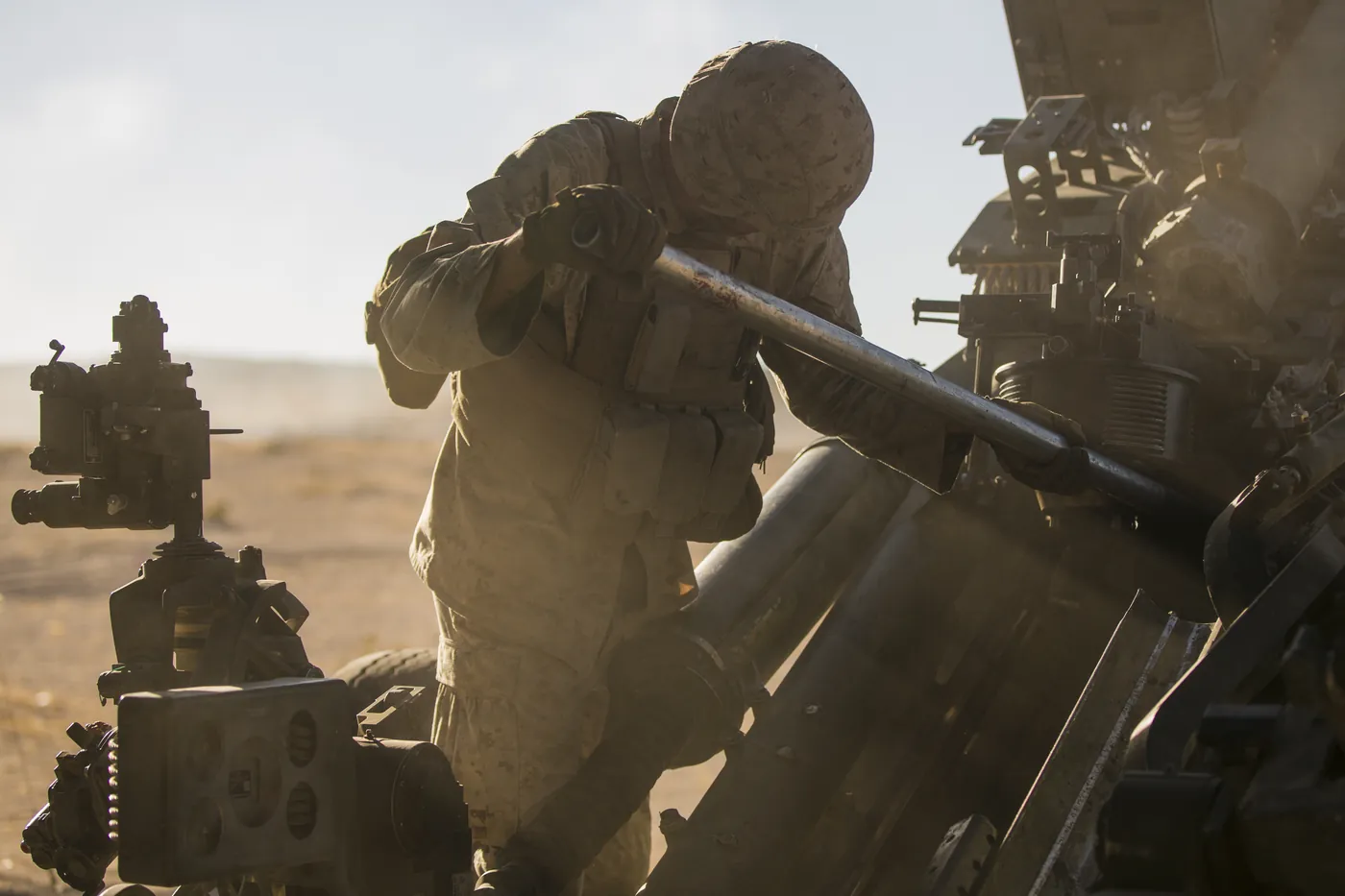
For decades, tracks were treated as the natural form of heavy artillery. Tracks give cross-country mobility and armour protection. They are also slow, thirsty, maintenance-heavy and expensive to move strategically. Ukraine broke that equation.
On today’s battlefield, the deadliest threat to a gun line is not an incoming shell but elapsed time. Counter-battery radars and surveillance drones locate a firing position within seconds; counter-fire or a loitering munition arrives within minutes. Modern gunnery has therefore collapsed into shoot-and-scoot: fire the mission, clear the position inside a minute.
That is where wheels win. A wheeled gun moves at roughly twice the road speed of its tracked equivalent, clears a firing position far faster, drags a lighter logistics tail behind it and fits more easily into a transport aircraft. It carries less armour – but the operating logic being validated in the field is simple enough: a vehicle that is not hit does not need armour.
MTC is written around exactly that logic: a gun that can be moved island to island across the Indo-Pacific, that can reposition rapidly along European road networks, and that never lingers in one firing position. Hanwha’s wheeled offering was shaped to that requirement.
A 58-calibre barrel and the 70-kilometre claim
The variant Hanwha offered the Army is built around the turret and fire-control suite of the K9A2, Korea’s most recent tracked howitzer. The company describes the vehicle as “truck-agnostic”: the gun module can be mounted on different truck chassis, which lets a customer use trucks already in its own logistics chain. In export terms, that is a serious selling point.
The headline technical claim is barrel length. Open sources describe a 58-calibre tube of roughly nine metres. Calibre here does not mean bore diameter but the ratio of barrel length to bore: on a 155 mm gun, 52 calibres is about 8.06 metres, while 58 calibres is about nine. A longer tube keeps propellant gas pushing the shell for longer, which raises muzzle velocity and extends range.
Hanwha has pointed to a target of more than 70 kilometres with suitable ammunition. Set against the roughly 40-kilometre band that NATO-standard 52-calibre guns achieve with conventional rounds, that would be a substantial jump – if it is validated. Caution is warranted: ERCA also began life as a longer-barrel, longer-range promise and was ultimately stopped by barrel wear and fire-control problems.
So the real examination in the MTC trials will not be a range record. It will be whether that reach can be delivered repeatedly, by ordinary crews, with acceptable tube life and a sustainable maintenance burden.
The contenders, side by side
| System | Manufacturer | Platform | Barrel | Max range (approx.) |
|---|---|---|---|---|
| Wheeled K9 (selected) | Hanwha Defense USA | Wheeled, truck-agnostic | 155 mm / 58 cal | 70+ km claimed, suitable ammunition |
| SIGMA | Elbit America + Anduril + Oshkosh | Tactical truck | 155 mm / 52 cal | 40 km band |
| CAESAR variant | Leonardo DRS + KNDS | 6×6 / 8×8 truck | 155 mm / 52 cal | 40 km band |
| RCH 155 | Rheinmetall | Boxer 8×8 | 155 mm / 52 cal | up to 54 km, specialist rounds |
| Archer | BAE Systems | 6×6 truck | 155 mm / 52 cal | up to 50 km, guided rounds |
| Incumbent: M109A7 Paladin | BAE Systems | Tracked | 155 mm / 39 cal | 24 km band |
Range figures follow open-source manufacturer statements and vary with ammunition type and conditions.
What the K9 actually is – Korea’s most exported land system
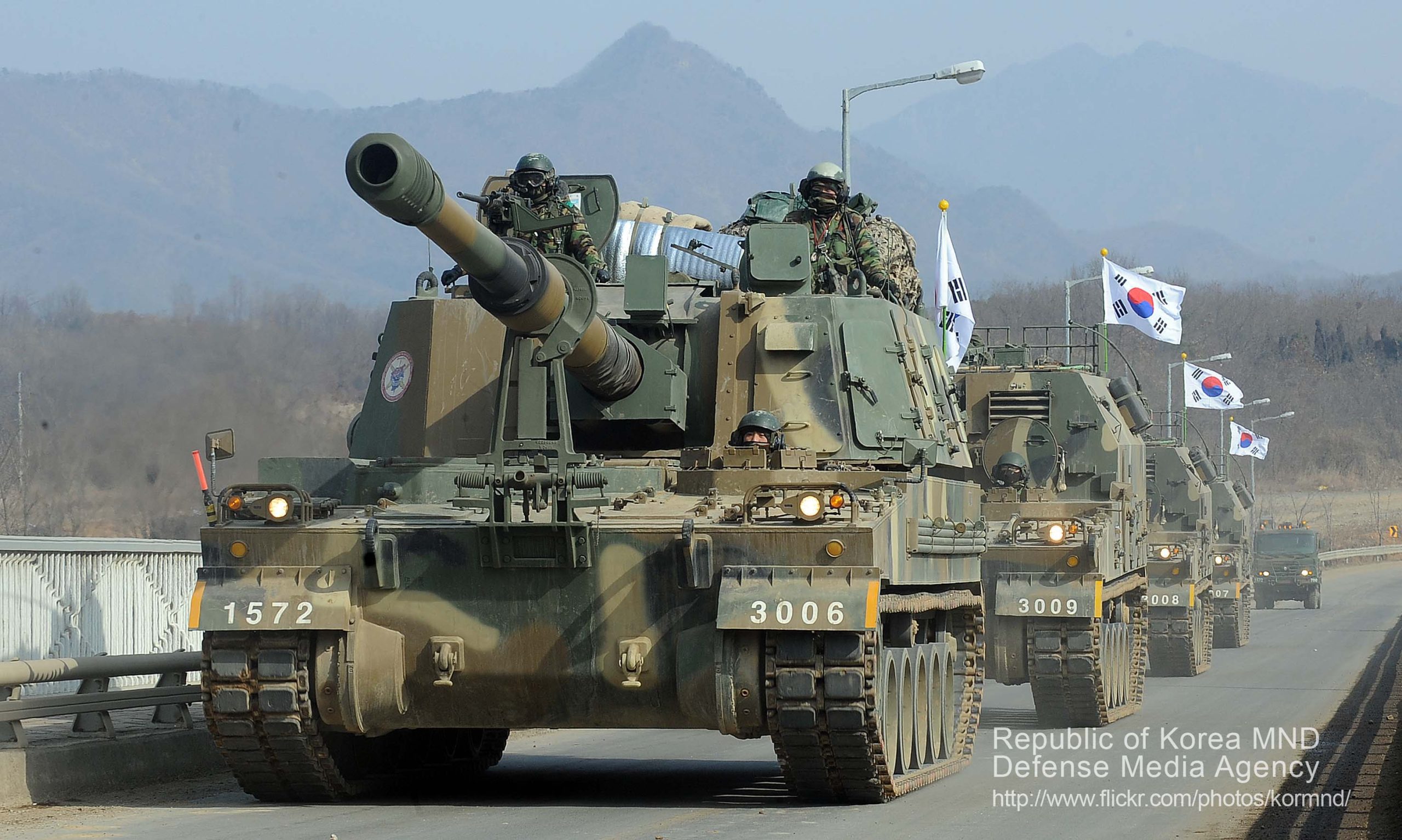
The K9 Thunder is a 155 mm/52-calibre tracked self-propelled howitzer developed by South Korean industry in the 1990s. It entered Republic of Korea Army service in 1999 and has been the backbone of Korean field artillery ever since. Its design brief was shaped by geography and threat: mountainous terrain, and a North Korean artillery park that makes rapid displacement a survival requirement.
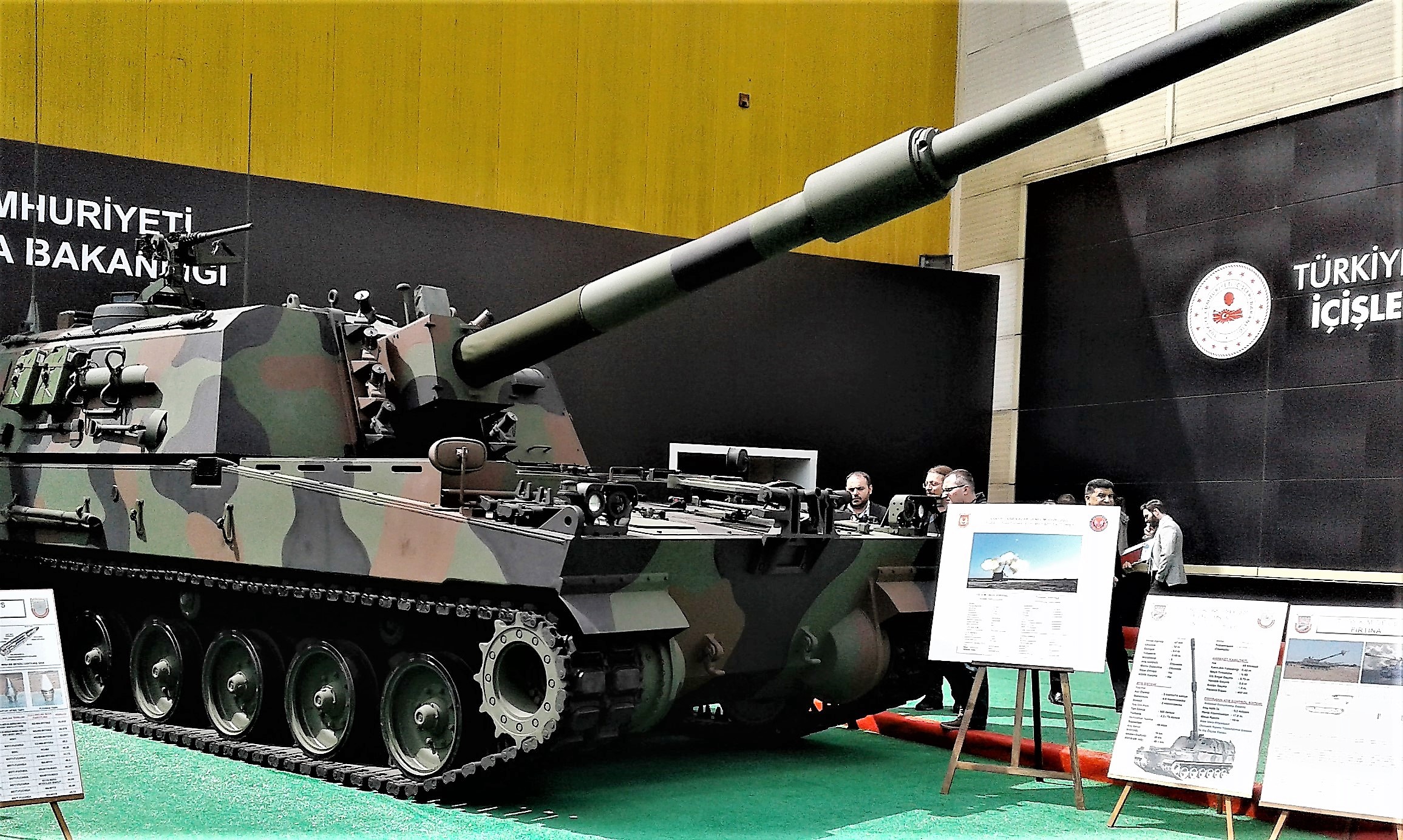
Its export record is the clearest single indicator of Korea’s rise as an arms exporter. Turkey built the T-155 Fırtına under a technology transfer arrangement. Poland put the K9 hull under its own Krab howitzer and then ordered K9A1s directly in large numbers. Finland, Estonia, Norway and India (as the K9 Vajra-T) took it into service. Australia localised it as the AS9 Huntsman, and Egypt signed a production agreement.
The current K9A2 adds an automated ammunition handling system and a digitised turret, aiming to cut crew numbers while raising rate of fire. Hanwha is also developing a GPS-guided course-correcting fuze for K9 ammunition – a low-cost route to precision that upgrades existing shells rather than replacing them.
In short, the Army has not bought a clean-sheet design. It has bought the newest branch of a family that has been in service with multiple armies for more than two decades. After ERCA, that risk posture is entirely coherent.
The Opelika bet: building inside the American market, not selling into it
Hanwha Defense USA put Opelika, Alabama at the centre of its MTC pitch. The company is standing up an assembly, integration and test facility there, expanding its supplier network and building a local workforce. That is a direct answer to the unwritten but unbending rule of American defence procurement: if you want to sell to the US Army over the long term, you build on US soil.
Nor is the investment isolated. Hanwha had already committed $1.3 billion to a munitions plant in Arkansas. Read together, the picture is unambiguous – Korean industry is not exporting product to the United States so much as constructing an industrial footprint inside it. That is the most durable protection against political weather and buy-American rules.
The approach mirrors what Hanwha has done everywhere else in the past five years: local production in Poland, a factory in Australia, licensed manufacture in Egypt, bids in Romania. The company enters major markets as a local partner rather than a vendor, pairing price with delivery speed and a technology-sharing offer. That combination is precisely what is squeezing the traditional European export model.
For the Army, Opelika offsets part of the risk: the prototypes will not arrive as boxed imports but as systems integrated in the United States and tied into a US supply chain. How much domestic content survives into production, however, will be one of the first questions Congress asks.
Sources
- Breaking Defense – “Army picks Hanwha’s wheeled K9 for self-propelled howitzer prototypes”, 18 August 2026
- Army Recognition – reporting on the Hanwha K9 bid for the US Army MTC programme and its Alabama production plan, 2026
- Defence Industry Europe – “South Korea’s Hanwha begins production of wheeled K9 howitzer”, 2025
- National Defense Magazine – “Wheeled Howitzer in Production as Hanwha Aims to Fill Army Needs”, October 2025
- Hanwha Defense USA corporate statements and programme briefings
Related Coverage
- South Korea Is Teaching the K9’s Shells to Think: GPS Fuze to Cut Dispersion
- Which Country Has the Most Self-Propelled Artillery? The 2026 Ranking
- World’s Largest Ammunition Manufacturers: The 155 mm Race, Capacity and Exports