South Korea Is Teaching the K9’s Shells to Think: GPS Fuze to Cut Dispersion Sixfold

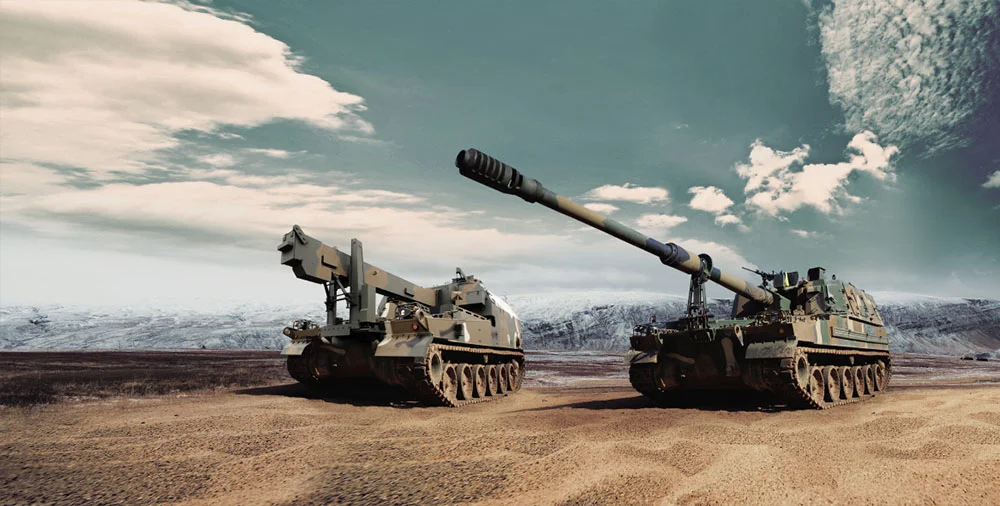
South Korea’s arms procurement agency DAPA has picked Hanwha Aerospace as preferred bidder for a program that could quietly transform the country’s artillery: a GPS-based course correction fuze (CCF) for 155 mm ammunition. Valued at KRW 164.2 billion (about $116 million) and running through 2032, the effort aims to shrink the K9 Thunder’s impact dispersion to roughly one-sixth of its current level.
The clever part is what the program does not require: new shells. The fuze — the nose-mounted device that detonates the round — is replaced with a smart module carrying a GPS receiver and miniaturized avionics. After the shell leaves the barrel, the module measures the trajectory against satellite data and steers the round toward the aim point with small aerodynamic surfaces. Existing 155 mm stockpiles gain near-precision accuracy through a simple fuze swap.
The CCF program at a glance
- Program: Course correction fuze for 155 mm ammunition
- Contractor: Hanwha Aerospace (preferred bidder)
- Value: KRW 164.2 billion (~$116 million)
- Timeline: development through 2032
- Goal: sixfold reduction in impact dispersion
- Method: retrofit to existing shells via fuze replacement
Why it matters: from area weapon to point weapon
A conventional 155 mm shell lands with a CEP — circular error probable, the radius within which half of all rounds fall — of some 200-300 meters at medium range. Unguided artillery is, in truth, an area weapon. Cut that dispersion sixfold and a fire mission that once demanded dozens of rounds needs a handful: fewer shells means fewer logistics convoys, longer barrel life, and shorter fire missions that give counter-battery radars less to work with.
Ukraine made that arithmetic visible to everyone, with monthly consumption running into the hundreds of thousands of rounds. Precision has become the cheapest way to multiply a stockpile. The same war added a caveat that will shape Hanwha’s work through 2032: in dense electronic-warfare environments, resistance to GPS jamming matters as much as the accuracy figure itself.
Where the rest of the world stands
Korea is not inventing this race — it is joining its most crowded league. The field splits into two schools: fuze kits that upgrade existing shells, and purpose-built fully guided projectiles.
| System | Country / Maker | Approach | Accuracy & cost |
|---|---|---|---|
| M1156 PGK | USA / Northrop Grumman | GPS fuze kit | Spec ≤50 m, ~10 m in tests; ~$13,500 each |
| M982 Excalibur | USA / Raytheon-BAE | Fully guided shell | ~4 m CEP; ~$112,000 each |
| TopGun | Israel / IAI | GPS fuze kit | 10-20 m CEP; in IDF service |
| Vulcano GLR / KATANA | Italy / France | Fully guided shell | Metric-class accuracy, extended range |
| Krasnopol | Russia / KBP | Laser-guided shell | Requires a designator on the target |
The economics explain the choice. A fully guided round in the Excalibur class costs more than eight times a PGK-class fuze, which is why the US Army runs both lines and Israel chose to smarten its standard stockpile with TopGun fuzes. Hanwha’s sixfold target puts the Korean fuze squarely in that kit league — turning 200-300 meters into a few tens of meters. What Korea brings that others cannot is scale: this fuze has a potential market across the world’s largest K9 fleet and thousands of allied barrels.
The K9 empire: 11 nations, one partnership model — and Türkiye was first
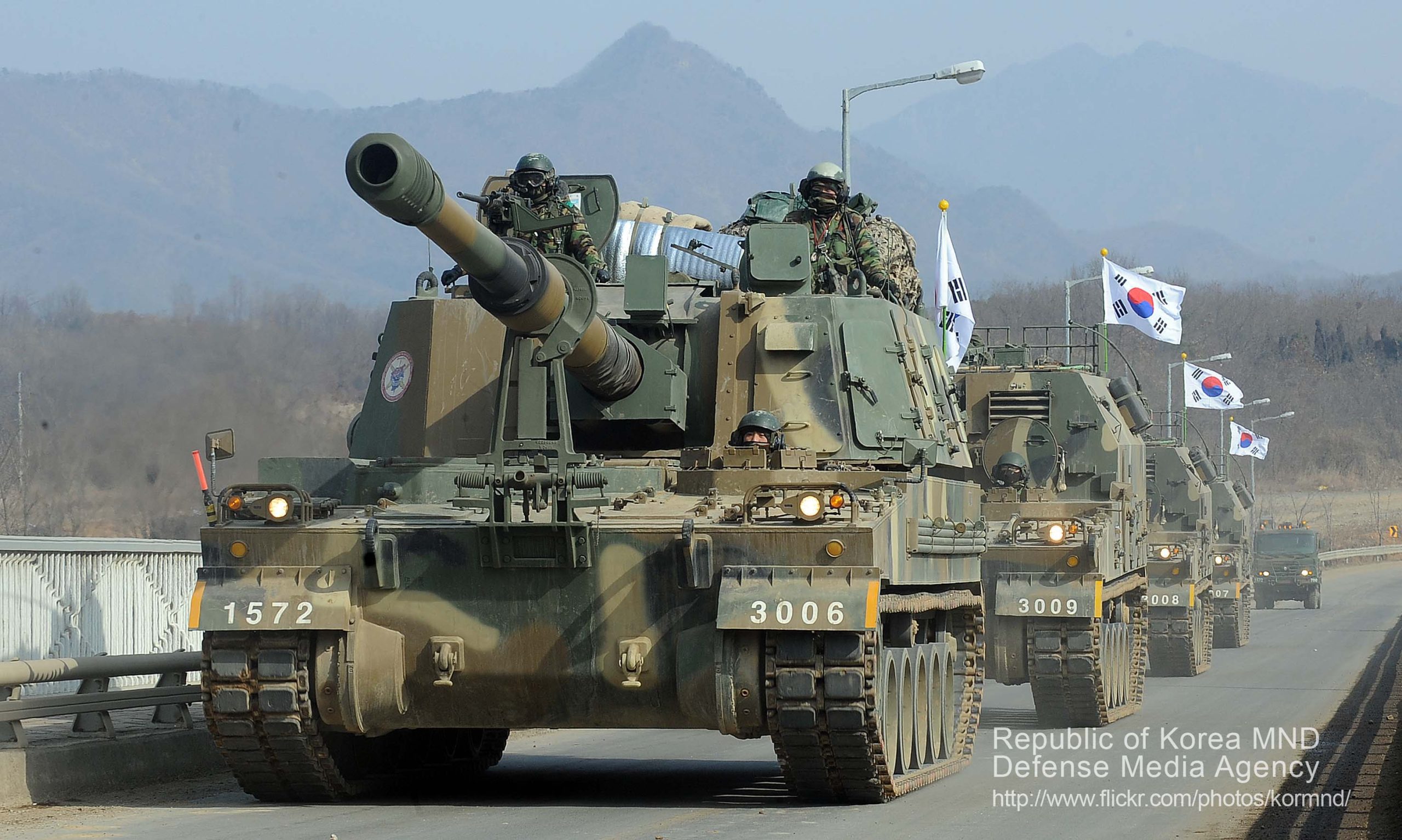
The strategic weight of the CCF program comes from the K9’s footprint. The most exported tracked howitzer in the world is in service or on order with 11 nations, and the secret has less to do with the gun than with the business model: Seoul shares technology and production lines.
Poland is the largest foreign operator, with a framework covering up to 672 units, the first Polish-tailored K9PLs shipped in July 2026, and K9A2 production planned at Huta Stalowa Wola. India builds the K9 Vajra locally with Larsen & Toubro, added 100 more units in December 2024, and has proven the vehicle at 4,500 meters in Ladakh. Egypt, Australia and Romania secured local assembly — Australia’s version is the AS9 Huntsman — while Norway, Finland and Estonia anchor the type on NATO’s northern flank.
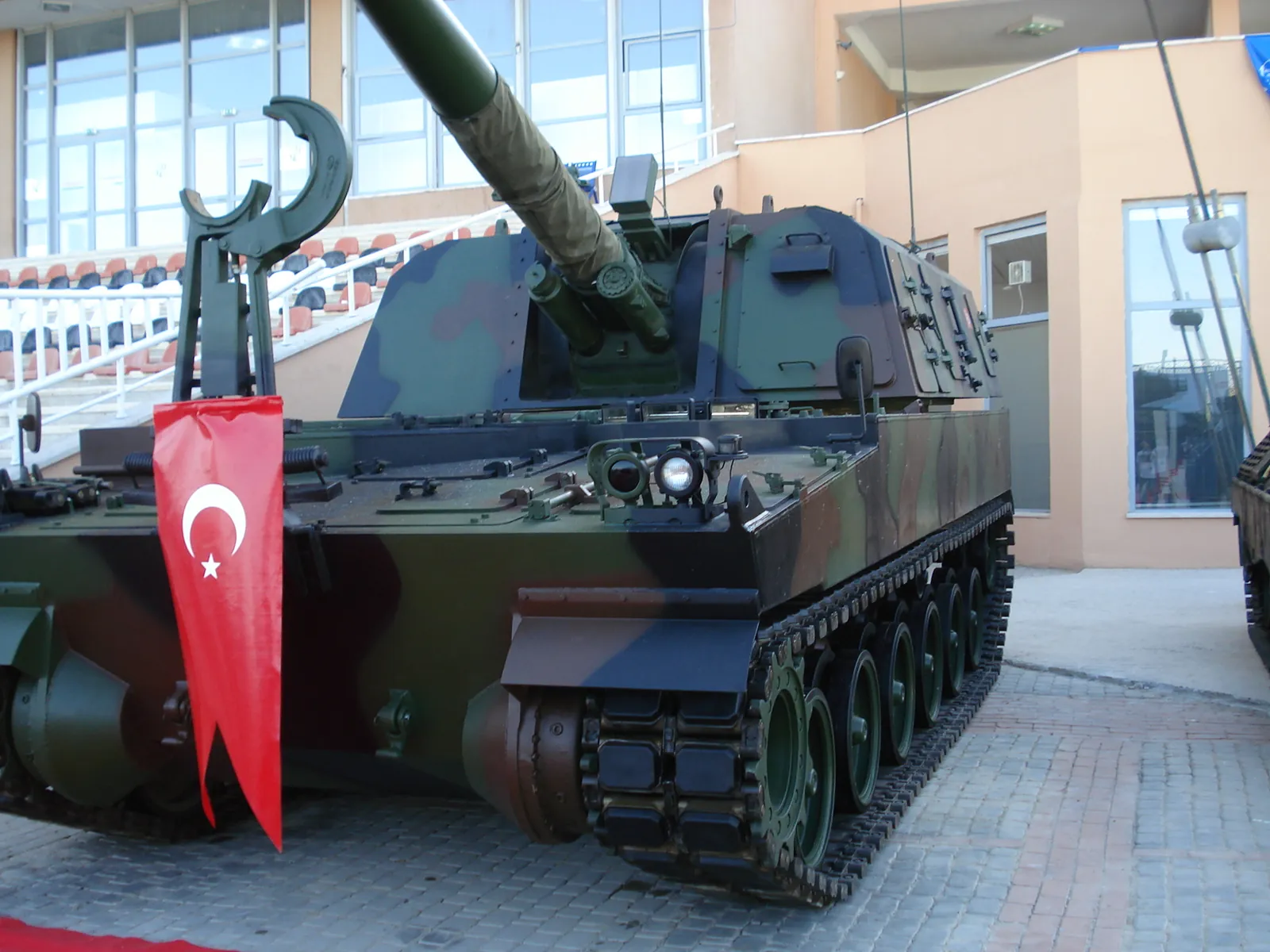
The first link in that chain was forged in Türkiye a quarter-century ago. Born of a full technology transfer deal signed in 2001, the T-155 Fırtına matured on the K9 chassis with a locally developed autoloader and Turkish electronics, built in Türkiye’s own plants — an early proof that the K9 partnership model works. Today the Turkish gun ranks among the world’s strongest land systems, and when Romania ran its 2024 howitzer competition, the final came down to the K9, Germany’s PzH2000 — and Türkiye’s Fırtına-2. The K9 family logic extends further back in the supply chain too, down to dedicated ammunition resupply vehicles like the K10 ARV.
The professor of the precision age: the Bayraktar effect
While Korea aims to finish teaching its shells to think by 2032, the doctrine itself — that smart and accurate beats massed and blind — was proven to the world by Türkiye. From Karabakh to Ukraine to Libya, Baykar’s Bayraktar TB2 paired with Roketsan’s MAM smart micro-munitions wrote the “one munition, one target” playbook that today’s artillery world is scrambling to copy into every shell. Armies drew a one-line conclusion from those strike videos: precision can substitute for mass; mass cannot substitute for precision.
Baykar has crowned that head start with numbers. The company closed 2025 with a record $2.2 billion in exports, holding the title of the world’s largest armed-drone exporter for the third consecutive year, with 88 percent of revenue coming from abroad. Export agreements now span 37 countries — 36 for the TB2, 16 for the Akıncı. The Akıncı fleet has passed 100,000 flight hours; the carrier-capable TB3 went three-for-three with MAM-L munitions in November 2025 live-fire trials; and the jet-powered KIZILELMA scored a direct hit on its first missile shot and enters inventory in 2026.
Nor is the Turkish precision ecosystem airborne only: Roketsan’s MAM family and laser-guided TRLG-230 artillery rocket, and TÜBİTAK SAGE’s guidance kits, moved “bolting a brain onto munitions” into serial production years ago. Seen from that angle, Hanwha’s fuze is the artillery world’s answer to a paradigm Türkiye’s drone industry proved first — and it would be natural to expect the Fırtına family, which shares the K9’s DNA, to meet a similar smart-fuze layer in the years ahead.
What comes next
Hanwha plans to complete CCF development by 2032 and fold it into the K9’s broader modernization roadmap, which stretches from extended-range ammunition to the K9A2 upgrades shown through 2025 and the next-generation K9A3 concept. If the schedule holds, the K9 batteries of the 2030s will get far more decisive effects from far fewer rounds — the same barrels, thinking shells.
And in the race to teach munitions to think, Türkiye is not watching from the stands: with Bayraktar’s battle-proven record and an industrial base running from the Fırtına to the MAM family, it is one of the countries setting the standard.
Sources
- Defence Industry Europe – “Hanwha to develop GPS-guided fuze for K9 artillery, targeting sixfold reduction in 155mm shell impact dispersion by 2032” – 14 August 2026. Used for program scope, budget, timeline and technical goals. Link: https://defence-industry.eu/hanwha-to-develop-gps-guided-fuze-for-k9-artillery-targeting-sixfold-reduction-in-155mm-shell-impact-dispersion-by-2032/
- Defensehere – “South Korea selects Hanwha Aerospace for new K9 precision fuze program” – August 2026. Used for the dollar value and the DAPA selection process. Link: https://defensehere.com/en/hanwha-selected-for-new-k9-precision-fuze-prgm/
- 19FortyFive – “South Korea’s K9 Thunder Is Outselling America and Germany in Artillery” – July 2026. Used for the K9’s export footprint and local-production partnerships. Link: https://www.19fortyfive.com/2026/07/south-koreas-k9-thunder-is-outselling-america-and-germany-in-artillery-the-reason-isnt-the-gun/
- KED Global – “India to acquire 100 units of Hanwha Aerospace’s K9 howitzers via L&T” – December 2024. Link: https://www.kedglobal.com/aerospace-defense/newsView/ked202412300006
- Defense News / Israel Defense – accuracy figures and IDF service status of IAI’s TopGun course correction fuze. Link: https://www.defensenews.com/breaking-news/2016/07/20/israeli-army-taps-iais-topgun-for-precision-artillery-project/
- Türkiye Today / Baykar – “Baykar sets $2.2B export record; Kizilelma to enter inventory in 2026”. Used for Baykar’s 2025 export record and program milestones. Link: https://www.turkiyetoday.com/nation/baykar-sets-22b-export-record-kizilelma-to-enter-inventory-in-2026-3213966
Note: accuracy and cost figures for the M1156 PGK and M982 Excalibur are compiled from open sources reporting US Army procurement data (Military Aerospace, Militarnyi); values vary by variant and firing conditions.