Self-propelled artillery is the backbone of modern land warfare — mobile, protected, and capable of delivering devastating indirect fire without the crew ever leaving the armored cab. As armies restructure for high-intensity peer conflict, these systems have returned to the center of defense investment. GlobalFirepower’s 2026 dataset reveals exactly where each major military stands — and the gap between the top and the rest is wider than most analysts expected.
Poland sits at tenth place with 500 self-propelled artillery systems, but that number tells only part of a much more ambitious story. Since Russia’s full-scale invasion of Ukraine in 2022, Warsaw has accelerated military spending at a pace unmatched anywhere in NATO, committing to 4% of GDP — roughly double the alliance average. The Polish army operates the domestically-developed Krab 155 mm howitzer, built on a South Korean K9 chassis and produced under license in Poland, alongside the older Soviet-era 2S1 Gvozdika. Crucially, Poland signed a landmark agreement for 672 additional K9 Thunder systems from South Korea, which will more than double its inventory over the next five years. The strategic rationale is clear: Poland shares a border with the Kaliningrad exclave and Belarus, placing it on NATO’s most exposed eastern flank. Artillery modernization here is not a peacetime procurement exercise — it is an operational imperative. Poland’s geography, combined with the largest land army in Western Europe by headcount, makes it a serious continental force multiplier.
| Metric | Detail |
|---|
| Current inventory | 500 systems |
| Key platform | Krab 155 mm SPH |
| On order | 672 × K9 Thunder (South Korea) |
| NATO rank (artillery) | Among top 3 in Europe |
Poland’s rearmament sprint is impressive — but nine countries still outgun it. At #9, a nation fighting for its survival has forged a battlefield artillery doctrine the world is still learning from.
▼ ▼ ▼
Ukraine enters the rankings at ninth with 750 self-propelled artillery units — a figure that carries extraordinary weight given that this inventory is actively engaged in the most artillery-intensive land war since World War II. Kyiv’s forces operate a unique hybrid mix: Soviet-era 2S1, 2S3, and 2S19 platforms inherited from the Cold War, alongside Western systems donated or supplied since 2022, including the French Caesar (wheeled), German Panzerhaubitze 2000, US M109 Paladin, and Polish Krab. This interoperability challenge — maintaining logistical chains across a dozen different systems — has itself become a case study in NATO rapid adaptation. Ukrainian crews have also pioneered the use of counter-battery radar networks, drone-coordinated fire, and precision-guided 155 mm munitions in ways that are reshaping doctrine globally. The operational tempo has been punishing: systems that would normally fire a few hundred rounds over their service life are cycling through thousands of rounds per year. Western nations have pledged continued resupply, but Ukraine’s true artillery strength lies less in numbers than in the hardened, combat-tested human capital behind every gun.
| Metric | Detail |
|---|
| Current inventory | 750 systems |
| Western platforms | PzH 2000, M109, Krab, Caesar |
| Context | Active high-intensity combat |
| Notable innovation | Drone-artillery coordination |
Ukraine’s artillery story is defined by combat necessity. At #8 sits a NATO candidate whose homegrown howitzers are rapidly changing regional power calculations across three continents.
▼ ▼ ▼
Turkey claims eighth place with 850 self-propelled artillery systems and, unlike most nations in this ranking, it manufactures the most capable of them domestically. The T-155 Fırtına (Storm) — a 155 mm/52-caliber tracked howitzer developed jointly by Roketsan and MKEK — forms the cornerstone of the Turkish Army’s indirect fire capability, with a maximum range exceeding 40 km using base-bleed munitions and a fully automated loading system capable of eight rounds per minute. Turkey has exported the Fırtına and its wheeled successor platforms to operators including Saudi Arabia and Azerbaijan, generating hard foreign exchange while validating the design under operational conditions. The broader Turkish defense-industrial surge amplifies the artillery picture: the Altay third-generation main battle tank is entering serial production, the KIRPI and Cobra II MRAP families provide protected mobility for forward observers, and the KAAN fifth-generation fighter adds air superiority depth to ground operations. The Bayraktar TB2 drone ecosystem, proven in Libya, Nagorno-Karabakh, and Ukraine, also ties directly into artillery targeting loops. Ankara operates across four potential theaters — the Aegean, Syria, Iraq, and the Caucasus — and its artillery inventory reflects genuine multi-front deterrence planning rather than static positional defense.
| Metric | Detail |
|---|
| Current inventory | 850 systems |
| Flagship platform | T-155 Fırtına (domestic) |
| Export clients | Saudi Arabia, Azerbaijan |
| Complementary programs | Altay MBT, KIRPI, KAAN, TB2 |
Turkey’s self-sufficiency makes its 850 units punch well above their weight. But at #7, a subcontinent giant with nine times Turkey’s population has assembled an arsenal shaped by two unresolved nuclear-armed rivalries.
▼ ▼ ▼
India fields 900 self-propelled artillery pieces and is in the midst of the most consequential restructuring of its land forces in decades. The Indian Army’s artillery modernization is driven by a blunt strategic reality: it must be prepared for simultaneous contingencies along the Line of Actual Control with China in the high-altitude Himalayas and the Line of Control with Pakistan in the plains and mountains of Kashmir — two of the most demanding operational environments on Earth. The K9 Vajra-T, an indigenized version of South Korea’s K9 Thunder optimized for Indian conditions (including cold-start capability at altitude), is the cornerstone of new acquisitions, with 100 systems already delivered and a follow-on order under negotiation. India also retains a large fleet of Soviet-era 2S1 systems and is developing the DRDO Sharang, a domestically upgraded 130 mm platform. The Make in India defense initiative is transforming procurement timelines, pushing more production into domestic facilities. For China, which maintains forward-deployed artillery in Tibet, India’s Vajra-T deployments along mountain passes represent a credible counter-battery deterrent at altitudes above 4,000 meters — a capability few global armies can match.
| Metric | Detail |
|---|
| Current inventory | 900 systems |
| Key platform | K9 Vajra-T (India-built) |
| Strategic theaters | China LAC + Pakistan LOC |
| Altitude capability | Operational above 4,000 m |
India’s dual-front posture demands every barrel it can deploy. At #6, a divided nation at the heart of Europe surprised the world by rebuilding a Cold War-era artillery tradition with thoroughly 21st-century systems.
▼ ▼ ▼
Germany stands at sixth with 980 self-propelled artillery systems and, uniquely in this ranking, its primary platform is the gold standard by which all others are measured. The Panzerhaubitze 2000 (PzH 2000), manufactured by Krauss-Maffei Wegmann and Rheinmetall, is widely considered the most accurate and most capable 155 mm wheeled howitzer in operational service. Its automatic loading system delivers three rounds in under ten seconds and sustains eight rounds per minute; its crew of five can displace within 30 seconds of firing — critical for survivability against modern counter-battery systems. Germany’s post-Cold War “peace dividend” saw its Bundeswehr shrink dramatically, but the Zeitenwende (turning-point) policy announced after the 2022 invasion of Ukraine reversed that trajectory with a €100 billion special defense fund. Berlin has committed to purchasing the Skyranger-based air-defense variants to protect artillery formations, while the MARS II multiple-launch rocket system provides longer-range fires that complement the PzH 2000. Germany also donated PzH 2000 systems to Ukraine, where their combat performance generated international orders and vindicated every design choice made during development. As NATO’s largest economy, Germany’s artillery posture matters strategically for the entire eastern flank.
| Metric | Detail |
|---|
| Current inventory | 980 systems |
| Flagship platform | Panzerhaubitze 2000 (PzH 2000) |
| Complementary system | MARS II MLRS |
| Export combat proof | Donated to Ukraine, combat-validated |
German engineering precision is globally respected — but quantity has its own quality. At #5, a reclusive state maintains an artillery inventory that dwarfs Germany’s and operates under almost complete secrecy.
▼ ▼ ▼
North Korea reaches fifth place with 1,300 self-propelled artillery systems — a figure that demands careful contextual reading. Pyongyang’s military doctrine is built on mass fires as the primary coercive instrument: the Korean People’s Army maintains one of the largest artillery forces on Earth in absolute terms, positioned specifically to hold Seoul and its surrounding 26-million-person metropolitan area at risk within minutes of any outbreak of hostilities. The self-propelled inventory includes domestically produced variants of Soviet-era designs, including the M-1978 Koksan 170 mm gun and the M-1989 tracked 122 mm multiple-rocket launcher, alongside newer developments showcased in periodic military parades. Verification of actual operational readiness is nearly impossible, and western intelligence assessments routinely note degraded maintenance and fuel shortages affecting readiness rates. What changed the calculus dramatically in 2023-2024 was the documented transfer of North Korean 152 mm artillery shells to Russia for use in Ukraine — effectively turning the KPA’s industrial base into an active supplier for a major land war in Europe. This relationship has brought technology transfers, satellite imagery access, and hard currency back into Pyongyang, potentially improving the very readiness rates analysts had questioned. North Korea’s artillery is a strategic hostage-taking instrument as much as a warfighting tool.
| Metric | Detail |
|---|
| Current inventory | 1,300 systems |
| Primary doctrine | Mass fires / strategic deterrence |
| Notable platform | M-1978 Koksan 170 mm |
| 2024 development | Shell exports to Russia confirmed |
North Korea’s numbers are formidable by any measure. At #4, the world’s most powerful democracy maintains a modernized but deliberately lean arsenal — optimized for precision over mass.
▼ ▼ ▼
The United States holds fourth place with 1,521 self-propelled artillery systems, a figure that understates actual land-fires power when the full inventory of MLRS and HIMARS systems is considered. The backbone of the US self-propelled fleet remains the M109A6/A7 Paladin, a 155 mm tracked howitzer currently being upgraded to the M109A7 Paladin Integrated Management (PIM) standard with a new hull, improved digital fire control, and expanded ammunition compatibility. The M109 family has been in continuous service since 1963, a testament to both its adaptability and — critics argue — the Pentagon’s chronic underinvestment in artillery modernization relative to air power. What the US brings that no other nation in this ranking can match is precision: the Excalibur GPS-guided shell, the Copperhead laser-guided round, and the emerging XM1155 Extended Range Cannon Artillery (ERCA) program promise to extend lethal range to 70+ km. The US also donates and pre-positions equipment globally — M109 systems are operated by allies across NATO, the Middle East, and Asia-Pacific. Strategically, the US military’s doctrine of multi-domain operations means artillery does not operate in isolation but as part of a joint fires network that includes air, naval, space, and cyber. The number 1,521 describes the ground footprint of a system designed for global power projection.
| Metric | Detail |
|---|
| Current inventory | 1,521 systems |
| Primary platform | M109A7 Paladin |
| Precision munition | Excalibur GPS-guided (40+ km) |
| Future program | ERCA (70+ km range) |
American precision is the envy of the world — but the next three nations on this list have chosen volume as their answer to lethality. At #3, a peninsula nation has forged the most modern mass-artillery force in Asia.
▼ ▼ ▼
South Korea’s 2,780 self-propelled artillery systems earn it third place in the global ranking — and the number reflects a very specific strategic equation. Seoul sits just 40 kilometers from the Demilitarized Zone, and the city of 10 million people has always been the central variable in Korean Peninsula deterrence calculations. The K9 Thunder 155 mm self-propelled howitzer, developed by Hanwha Defense, is one of the most commercially successful artillery platforms of the 21st century: exported to Australia, Egypt, Estonia, Finland, India, Norway, Poland, and Turkey. Its digital fire control, automated loading, and cold-start performance at sub-zero temperatures have made it the reference design for Western-aligned armies. Alongside the K9, South Korea operates the K55A1 (a modernized M109) and is fielding the AS21 Redback infantry fighting vehicle in supporting roles. Seoul’s artillery stockpiles are deliberately kept massive because Korean Peninsula warfare scenarios involve near-instantaneous high-tempo exchanges: planners calculate that the first 72 hours would see more artillery rounds fired than in months of conflict elsewhere. South Korea’s defense industry — now one of the top five global arms exporters — has turned this domestic necessity into a commercial advantage, funding next-generation R&D through export revenues.
| Metric | Detail |
|---|
| Current inventory | 2,780 systems |
| Flagship platform | K9 Thunder (Hanwha Defense) |
| Export clients | 8 countries including Poland, India, Australia |
| Strategic driver | 40 km Seoul-DMZ proximity |
South Korea’s 2,780 guns make it a genuine global artillery power — yet the next two nations have numbers that dwarf even that. At #2, a rising superpower has quietly built an artillery force to match its continental ambitions.
▼ ▼ ▼
China holds second place with 2,940 self-propelled artillery systems, and the qualitative trajectory of this inventory is as significant as the quantity. The People’s Liberation Army Ground Force (PLAGF) has systematically retired Soviet-era Type 54 and Type 83 platforms and replaced them with the PLZ-05 and PLZ-04A 155 mm self-propelled howitzers — systems that rival the best Western designs in digital integration, automated loading, and precision munitions compatibility. The PLZ-05A, in particular, features a 155 mm/52-caliber gun, an autoloader cycling at 8 rounds per minute, and network-centric fire-control integration with reconnaissance drones and satellite systems. China’s artillery doctrine has evolved from Soviet-influenced “fire preparation” mass bombardment toward a joint fires model that emphasizes precision, speed of displacement, and integration with the Rocket Force’s medium-range missile inventory. The strategic applications span three plausible contingencies: Taiwan Strait amphibious operations (where artillery provides fire support on landing beaches), the Sino-Indian Himalayan border (where the PLZ-05 operates at altitude), and deterrence posture against US allies in the First Island Chain. China’s defense industrial base — the largest in the world by output — can produce and upgrade artillery systems at a pace no Western nation can currently match, making the 2,940 figure a floor rather than a ceiling.
| Metric | Detail |
|---|
| Current inventory | 2,940 systems |
| Flagship platform | PLZ-05A 155 mm SPH |
| Production capacity | Largest defense industrial base globally |
| Strategic theaters | Taiwan Strait, Himalayas, First Island Chain |
China’s 2,940 systems represent enormous firepower — yet one nation has built an inventory that surpasses even this by more than 650 guns. The answer, for students of military history, will come as no surprise at all.
▼ ▼ ▼
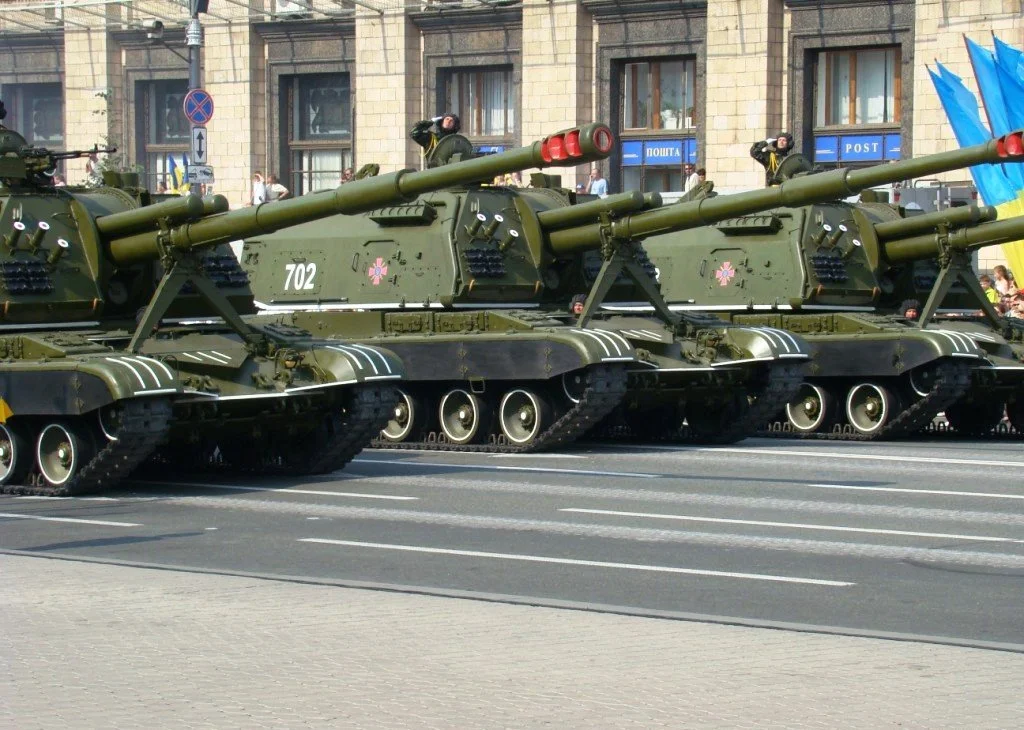
Russia holds the top position with 3,603 self-propelled artillery systems — the largest inventory of any nation on Earth, and by a substantial margin. This is not an accident of history but the direct product of a military doctrine that has placed artillery at the absolute center of land warfare since the Second World War, a tradition codified in the Soviet concept of “the God of War.” The Russian inventory spans an extraordinary range of generations: from the Cold War-era 2S1 Gvozdika (122 mm) and 2S3 Akatsiya (152 mm) to the modern 2S19 Msta-S (152 mm), and the cutting-edge 2S35 Koalitsiya-SV — a fully automated 152 mm howitzer capable of 16 rounds per minute with a 70 km range using extended-range munitions, a rate of fire that exceeds any Western system currently in service. The Koalitsiya-SV represents arguably the most capable self-propelled artillery platform in operational deployment anywhere in the world. Russia’s experience in Ukraine since 2022 has been simultaneously validating and costly for its artillery arm: the sheer density of fires has been decisive in attritional warfare, but the loss rate of self-propelled systems to Ukrainian counter-battery operations, drone strikes, and Western-supplied precision munitions has been significant — estimated by multiple open-source analysts at several hundred systems across four years of conflict. Russia’s industrial response — accelerated production at the Ural Transport Factory and the Uraltransmash facility — has compensated for battlefield losses and suggests the 3,603 figure remains close to accurate despite attrition. For any land army considering a conventional confrontation with Russia, the artillery differential alone defines the strategic problem.
| Metric | Detail |
|---|
| Current inventory | 3,603 systems |
| Flagship modern platform | 2S35 Koalitsiya-SV 152 mm |
| Rate of fire (Koalitsiya) | Up to 16 rounds/min |
| Range (extended munitions) | ~70 km |
| Doctrine | “God of War” — artillery-centric land war |
Russia’s 3,603 self-propelled guns represent a century of institutional commitment to artillery primacy — and the gap to second place is not closing anytime soon.
The Big Picture: What the Numbers Actually Mean
The 2026 self-propelled artillery rankings reveal three distinct tiers of global land-fires power, each defined by a different strategic logic.
The continental mass tier — Russia, China, and South Korea — reflects the logic of territorial scale, industrial capacity, and proximity to peer adversaries. Russia’s 3,603 systems are the product of a doctrine that has never deviated from the belief that artillery wins conventional wars. Every conflict the Soviet Union and Russia fought in the 20th and 21st centuries — from Finland to Afghanistan to Chechnya to Syria to Ukraine — was prosecuted primarily through fires. China’s 2,940 systems reflect a similar philosophy, adapted to the requirements of a military that must project power across mountainous borders, maritime straits, and vast interior lines of communication simultaneously. South Korea’s 2,780 guns are the most concentrated per-kilometer-of-border of any nation in this ranking, tailored to a single theater where the opening hours of a conflict would require more steel downrange, faster, than almost any scenario planners elsewhere have modeled.
The precision-over-mass tier — the United States and Germany — reflects a different strategic inheritance. NATO’s air-land battle doctrine, developed through the 1980s and tested in the Gulf Wars and the Balkans, emphasized joint fires integration, deep strikes, and the use of precision munitions to substitute for mass. A single Excalibur round striking a command post is worth, tactically, a hundred conventional shells landing nearby. This logic drove both Washington and Berlin to accept smaller inventories in exchange for qualitative dominance. Ukraine’s brutal lesson in 2022-2024 — where precision was insufficient to substitute for volume when facing Russian fires density — has forced a reassessment, and both the US and Germany are investing in industrial capacity expansion alongside continued precision development.
The modernization-in-progress tier — Turkey, India, and Poland — may represent the most dynamic segment of this ranking over the next decade. All three are investing heavily in domestic production, all three face credible peer or near-peer adversaries, and all three are acquiring or developing systems specifically optimized for their operational environments. Turkey’s Fırtına has already achieved export success and combat validation; India’s Vajra-T is rewriting the rules for high-altitude artillery operations; Poland’s K9 order is the largest single artillery procurement in NATO history.
Ukraine at ninth occupies a unique category: an active combatant whose real-time experience is generating doctrine, testing equipment, and demonstrating capabilities (and limitations) that will define artillery development globally for the next generation. The integration of commercial drones into fire-direction loops, the vulnerabilities of static systems to counter-battery radar, and the extraordinary ammunition consumption rates of high-intensity warfare are all lessons being learned — often at enormous cost — by Ukraine’s artillery crews today.
The overarching conclusion is that self-propelled artillery has not been made obsolete by precision air power, long-range missiles, or drone warfare. If anything, Ukraine has demonstrated that it remains the decisive instrument of attritional land warfare at the operational level. Nations that allowed their artillery to atrophy during the “wars amongst the people” of the early 21st century are now scrambling to rebuild — and the industrial timelines involved mean that the rankings seen here in 2026 will likely define the balance of land-fires power well into the 2030s.
Complete 2026 Rankings — Self-Propelled Artillery
| Rank | Country | SP Artillery Units | Flagship Platform | Primary Doctrine | Notable Trend |
|---|
| #1 | Russia | 3,603 | 2S35 Koalitsiya-SV | Artillery-centric land war | Active combat; production maintained |
| #2 | China | 2,940 | PLZ-05A | Joint fires / multi-theater | Rapid modernization underway |
| #3 | South Korea | 2,780 | K9 Thunder | Mass fires / DMZ deterrence | Top global exporter |
| #4 | United States | 1,521 | M109A7 Paladin | Precision fires / multi-domain | ERCA long-range program |
| #5 | North Korea | 1,300 | M-1978 Koksan | Hostage deterrence / mass fires | Shell exports to Russia |
| #6 | Germany | 980 | Panzerhaubitze 2000 | Precision / NATO integration | Zeitenwende expansion |
| #7 | India | 900 | K9 Vajra-T | Dual-front / altitude ops | Domestic production scaling |
| #8 | Turkey | 850 | T-155 Fırtına | Multi-theater / export-grade | Altay + KAAN integration |
| #9 | Ukraine | 750 | PzH 2000 / M109 / Krab | Hybrid Western/Soviet | Active combat, drone integration |
| #10 | Poland | 500 | Krab 155 mm | NATO eastern flank | 672 K9 on order |
Follow Our Global Defense Rankings Series
Every week, Envanter Medya publishes in-depth military capability analyses across all domains — land, air, sea, and strategic forces. Stay ahead of the global defense balance.
Explore All Rankings
Frequently Asked Questions
What is self-propelled artillery and how does it differ from towed artillery?
Self-propelled artillery (SPA) integrates the gun and its propulsion system into a single armored vehicle, allowing the crew to drive to a firing position, shoot, and move quickly without external towing vehicles. Towed artillery, by contrast, requires a separate truck or armored vehicle to haul the gun to position. SPA offers dramatically faster “shoot and scoot” capability, better crew protection, and greater mobility — crucial for surviving modern counter-battery radar systems that can locate a firing position within seconds of the first round leaving the barrel.
Why does Russia have so many more self-propelled artillery systems than any other country?
Russia inherited the Soviet Union’s doctrine and industrial base, both of which treated artillery as the primary arm of land warfare — earning it the title “God of War” in Soviet military culture. Decades of investment in artillery production, combined with the massive Soviet-era stockpiles transferred to the Russian Federation in 1991, created an inventory unmatched in scale. Unlike the United States, which shifted strategic emphasis to air power and precision munitions, Russia maintained and expanded its artillery park as the centerpiece of conventional deterrence. Active production and combat operations in Ukraine have maintained the inventory near its 2022 levels despite significant losses.
Which self-propelled artillery system is considered the most advanced in 2026?
By most technical benchmarks, the field’s frontrunners are Russia’s 2S35 Koalitsiya-SV (16 rounds/minute, ~70 km range with extended munitions, full automation) and Germany’s Panzerhaubitze 2000 (8 rounds/minute, exceptional accuracy, combat-proven in Ukraine). South Korea’s K9 Thunder earns recognition as the best balance of performance, reliability, and exportability. The United States’ M109A7 Paladin, while older in concept, is supported by the most advanced precision munitions ecosystem — including the Excalibur GPS-guided shell — making it arguably the most effective platform in counter-insurgency and precision-strike roles.
How has the war in Ukraine changed global self-propelled artillery procurement?
Ukraine has produced the most consequential artillery lessons since the Second World War. The conflict demonstrated that high-intensity land warfare consumes ammunition at rates that overwhelmed Western production assumptions, that drone-directed counter-battery fire can neutralize expensive SPA systems in minutes, and that volume of fires matters as much as precision in attritional warfare. The result has been a wave of procurement across NATO: Poland ordered 672 K9 systems, Germany accelerated PzH 2000 production, and the United States fast-tracked the Extended Range Cannon Artillery (ERCA) program. Multiple nations are also investing in artillery ammunition industrial capacity after stockpiles proved inadequate to sustain even proxy commitments to Ukraine.
What is Turkey’s T-155 Fırtına and why is it significant?
The T-155 Fırtına (Turkish for “Storm”) is a 155 mm/52-caliber self-propelled howitzer developed jointly by Turkish defense firms Roketsan and MKEK, using a South Korean K9 chassis as the base. It fires standard NATO 155 mm ammunition with a maximum range exceeding 40 km using base-bleed projectiles, and its automated loading system achieves eight rounds per minute. Significance comes on three levels: it demonstrates Turkey’s ability to develop and produce a frontline artillery system domestically; it has been exported to Saudi Arabia and Azerbaijan, validating the design commercially; and it integrates into Turkey’s broader defense ecosystem alongside Bayraktar TB2 drones (for targeting), the Altay main battle tank, and KIRPI protected vehicles — creating an indigenous combined-arms capability that places Turkey among the world’s serious defense-industrial powers.
Data source: GlobalFirepower.com — 2026 Military Strength Rankings. All figures represent active inventory estimates as published. Actual operational readiness rates may vary.