
Russia Commissions Submarine Perm, First Yasen-M Built to Carry Zircon as Standard

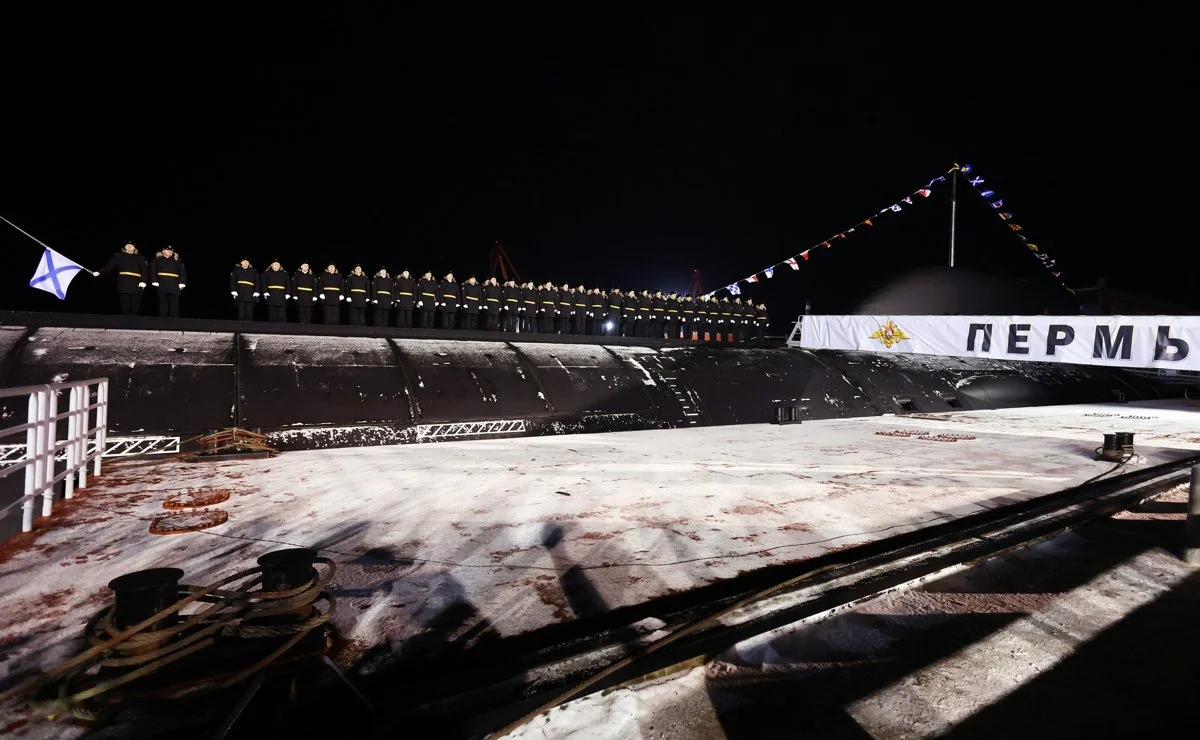
Russia commissioned the nuclear-powered submarine Perm (K-572) on 27 November 2026, when Vladimir Putin attended the raising of the naval ensign at the Sevmash shipyard in Severodvinsk. The Kremlin says Perm is the first Yasen-M class boat equipped with the Zircon hypersonic cruise missile as a standard feature, and that it will join the Pacific Fleet.
The ceremony marks the official entry of the submarine into the Russian Navy. Perm is the fifth Yasen-M submarine delivered in six years, according to Putin’s speech published by the Kremlin.
What was announced on 27 November
The Kremlin published two records of the day: the flag-raising speech and the opening remarks of a meeting on the Navy’s multipurpose nuclear submarine force held afterwards. The main points:
- Status: commissioned. The raising of the St Andrew’s flag marks the formal entry into service.
- Weapon: the Kremlin calls Perm the first submarine fitted with Zircon “as a standard feature”.
- Assignment: Perm will join the Pacific Fleet “in the near future”, Putin said.
- Next boats: five missile-carrying submarines, three of them Yasen-M, are scheduled for delivery by 2030.
- Construction now: two more Borei-A ballistic missile submarines, five Yasen-M boats and four diesel-electric submarines are being built, Putin told the follow-up meeting.
- Last eight years: the Navy received five Borei-A, five Yasen-M and eight diesel-electric submarines, according to the same remarks.
Claim vs. independent verification
The Zircon line comes from the Russian government. There is no independent public confirmation that Perm has fired Zircon or what load it carries. Zircon itself is not new to the Yasen family: the lead boat, Severodvinsk, carried out surface and submerged Zircon test launches in October 2021, as reported by TASS at the time. What Moscow is claiming now is different: that Perm was built and delivered with the missile as part of its standard fit, rather than tested from a converted boat.
Speed claims for Zircon, often quoted at Mach 8 or above, also come from Russian sources and have not been independently measured in public. We explain why such figures are hard to check in our guide to the world’s fastest missiles and what makes hypersonic missiles different.
The Yasen and Yasen-M boats so far
Dates below come from open-source records of Russian announcements. Severodvinsk is the original Project 885 design; the rest are the modernised Project 885M.
| Boat | Commissioned | Fleet |
|---|---|---|
| K-560 Severodvinsk (885) | 2014 (flag raised) | Northern |
| K-561 Kazan | May 2021 | Northern |
| K-573 Novosibirsk | December 2021 | Pacific |
| K-571 Krasnoyarsk | December 2023 | Pacific |
| K-564 Arkhangelsk | December 2024 | Northern |
| K-572 Perm | 27 November 2026 | Pacific (announced) |
Perm’s keel was laid in July 2016 and the boat was launched in March 2025, according to the same open-source records. The next boat, Ulyanovsk, was launched in July 2026.
What a Yasen-M is
The Yasen class (NATO name: Severodvinsk) is Russia’s newest multipurpose nuclear-powered attack submarine, designed by the Malakhit bureau and built by Sevmash. It combines the hunter-killer role with vertically launched cruise missiles, a mission that older Russian navies split between attack submarines and Oscar II cruise-missile boats. Open sources give a submerged displacement of about 13,800 tonnes and a length of about 130 metres for the Yasen-M version.
Putin said Yasen-M boats can use “all types” of submarine-launched cruise missiles. In practice that means Kalibr and Oniks as well as Zircon; see our Kalibr explainer. For how a nuclear boat stays submerged for months, read how nuclear submarines work.
What it means
- Pacific weight: if Perm goes east as announced, the Pacific Fleet will operate three Yasen-M boats, against two in the Northern Fleet. That shifts part of Russia’s newest submarine strike capacity toward Japan, the US West Coast approaches and the North Pacific.
- A slow but steady line: Kremlin figures put Yasen-M deliveries at five in six years. Three more are promised by 2030, which would require a faster pace than Perm’s own ten years from keel to commissioning.
- Zircon at sea: Russia has so far shown Zircon mainly on surface ships such as the frigate Admiral Golovko, which Spain’s navy recently tracked (our report). A Zircon-armed submarine would be harder to monitor, which is why the claim matters even before it is confirmed.
- Industrial message: Putin used the follow-up meeting to press shipyards and suppliers on capacity, components and better anti-ship missiles, a sign that schedules remain a concern.
For the wider picture, see Russia’s military inventory and Europe’s most powerful navies in 2026.
FAQ
When was the submarine Perm commissioned?
On 27 November 2026, with a flag-raising ceremony at Sevmash in Severodvinsk attended by Vladimir Putin.
Is Perm the first submarine with Zircon missiles?
The Kremlin says it is the first to carry Zircon as a standard feature. Severodvinsk test-fired Zircon in 2021. Independent confirmation of Perm’s armament is not available.
Where will Perm be based?
Putin said it will join the Pacific Fleet in the near future. Reports cite 2027.
How many Yasen-class submarines does Russia have?
With Perm, Russia has commissioned six Yasen-family boats: Severodvinsk and five Yasen-M. Putin said five more Yasen-M are under construction.
Sources
- Kremlin: Flag-raising ceremony aboard nuclear-powered submarine Perm (27 November 2026)
- Kremlin: Meeting on developing multipurpose nuclear-powered submarine grouping (27 November 2026)
- TASS: Severodvinsk carries out underwater launch of Tsirkon missile (October 2021)
Last verified: 29 November 2026.