





Navantia’s F-110 Flight II Quadruples the Missile Count

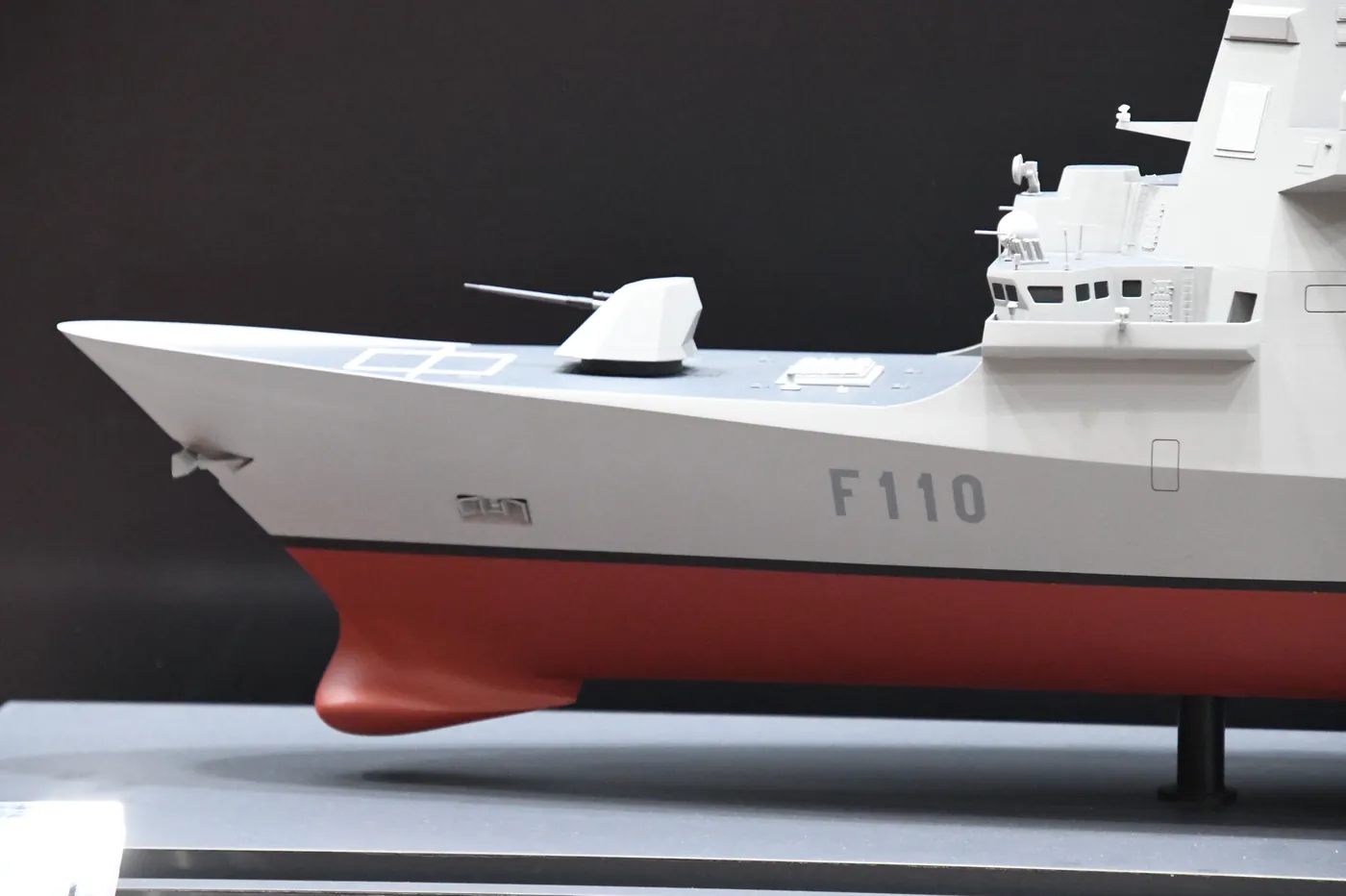
Spain’s state shipbuilder Navantia has unveiled an integrated air and missile defence version of its F-110 frigate. The headline number is the one that matters: vertical launch cells go from 16 on the baseline ship to 64 on the F-110 Flight II.
Two launchers, two lengths
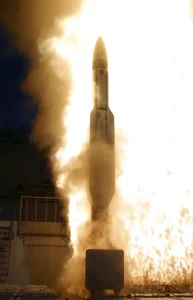
The configuration splits across two installations. Forward of the bridge sits a 48-cell Mk 41 Strike Length VLS. A second 16-cell Mk 41 Tactical Length module is enclosed within the superstructure, ahead of the helicopter hangar. Together they can accommodate up to 64 SM-2 family surface-to-air missiles.
The split is not arbitrary. Strike Length cells are deep enough for longer rounds — extended-range interceptors and land-attack cruise missiles among them — while Tactical Length handles shorter munitions. Carrying both gives a commander room to tailor the load to the mission rather than the magazine.
A bigger hull to carry it
Flight II is roughly five metres longer than the baseline design, displaces about 6,700 tonnes and is designed for up to 29 knots. Its principal sensor is a more capable configuration of Lockheed Martin’s AN/SPY-7 active electronically scanned array.
SPY-7 uses gallium nitride transmit-receive modules and a subarray architecture that scales with the ship carrying it. Beyond Spain, the family is destined for Japan’s Aegis System Equipped Vessels and Canada’s River-class destroyers. A more powerful array translates directly into detection and tracking at greater range — the difference between point defence and something approaching ballistic missile defence work.
The gun is a Leonardo OTO 127/64 LW. Close-in defence rests on two Escribano E&M Sentinel 30 30mm remote weapon stations, four Sentinel 2.0 12.7mm stations and additional heavy machine guns.
Where the programme stands
The F-110 Bonifaz class replaces the Spanish Navy’s Santa Maria-class frigates. Construction runs at Navantia’s Ferrol yard, where the first ship, F-111 Bonifaz, has been launched and several hulls are in build concurrently — the keel for F-113 was laid ahead of schedule.
The original F-110 was conceived as a general-purpose ship with strong anti-submarine credentials and air defence sufficient to protect itself and its immediate surroundings. Flight II asks the same hull to do fleet air defence. That is a deliberate choice: grow a mature design rather than open a new destroyer programme from a blank sheet, with everything that implies for cost and schedule.
Europe rediscovers magazine depth
The unveiling lands in the middle of a broader European rethink. Cell count has moved from a technical footnote to the centre of warship design, driven by two uncomfortable demonstrations: the war in Ukraine and the missile and drone campaign in the Red Sea.
The lesson was blunt. However good a ship’s radar, once it has fired its interceptors it must leave station to reload, and reloading VLS cells at sea remains an unsolved problem for most navies. Germany’s F127, French and Italian destroyer studies, Dutch and Belgian air defence frigate programmes and Britain’s Type 83 work all reflect the same arithmetic. Navantia’s jump from 16 to 64 is that arithmetic applied to an existing hull.
Set against Turkiye’s TF-2000
Turkiye’s equivalent effort is the TF-2000 air defence destroyer, run under the Presidency of Defence Industries. The ship is built around the CAFRAD radar family and the Siper long-range air defence system, with the indigenous MIDLAS vertical launcher carrying Turkish munitions.
The contrast is in sourcing rather than ambition. Spain buys its radar and launcher from mature American product lines and develops the hull and the SCOMBA combat management system domestically. Turkiye chose to develop radar, launcher, combat management system and missiles at home. The first route buys quick access to proven components with guaranteed allied interoperability. The second removes export-licence and supply-chain risk entirely, and puts systems integration in one set of hands.
With Istanbul-class frigates in serial production and TF-2000’s design maturing, Turkish naval platforms are approaching a comparable capability threshold on a parallel timeline. Navantia’s move is a useful reference point for how that threshold is being defined in Europe right now.
Sources
- Navantia F-110 programme communications and press releases (navantia.es)
- Lockheed Martin AN/SPY-7 product information
- DALO 2026 exhibition data