Is Cirit’s Anti-Drone Version Headed to Spain? Roketsan-EM&E Talks Continue

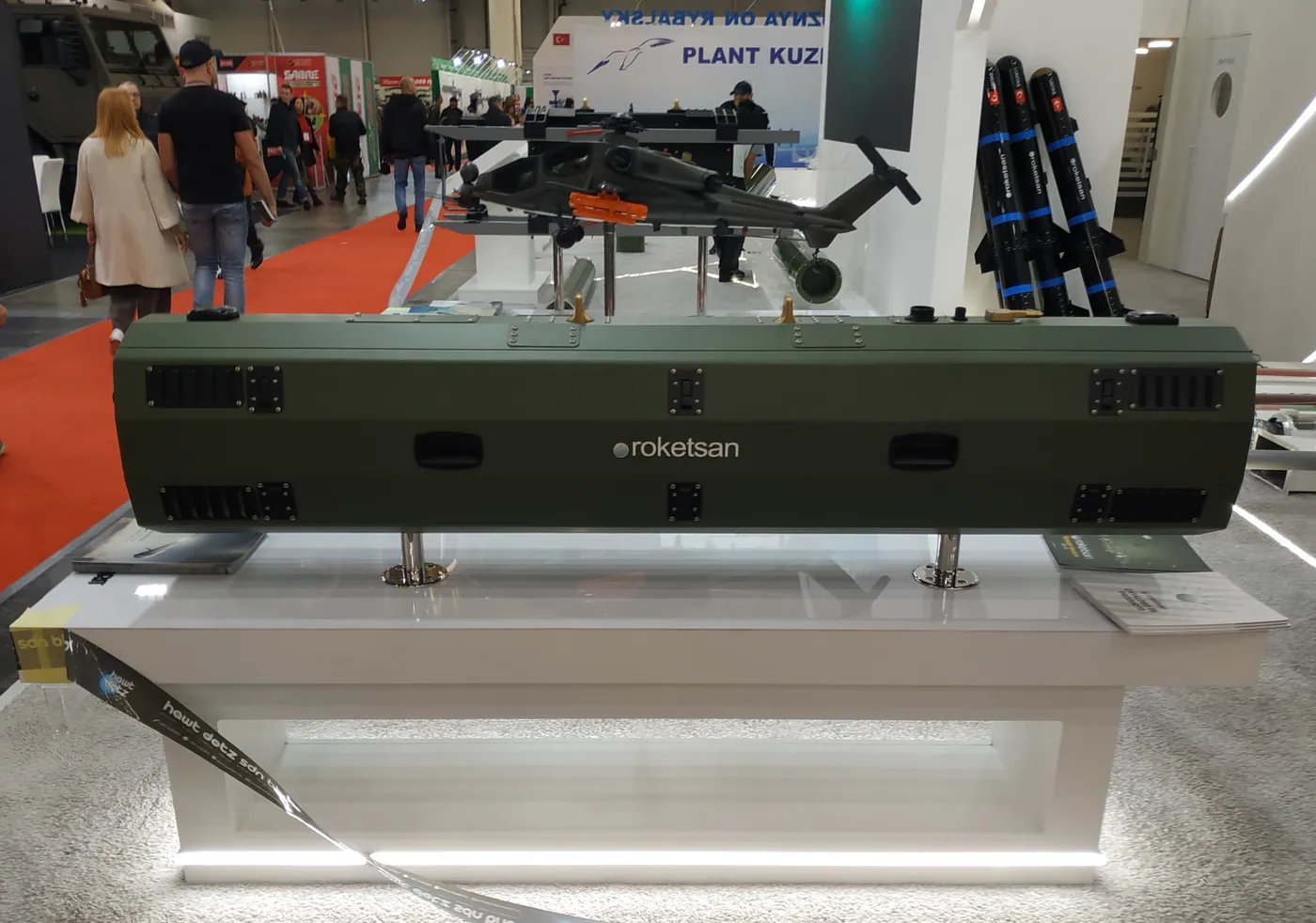
Roketsan is continuing technical talks with Spanish defence firm EM&E Group on integrating a counter-drone (C-UAS) version of its Cirit missile into EM&E’s remote weapon stations, four months after the two companies signed a memorandum of understanding at the Eurosatory 2026 exhibition in Paris. The update comes from Infodefensa, which visited Roketsan’s production facility near Ankara and spoke with company representatives who said engineers from both sides are holding working-level meetings and that Roketsan wants to expand its footprint in the Spanish market.
The June memorandum was signed in front of EM&E’s ODIN 6×6 system, which the company unveiled at the same show, but neither firm has formally confirmed that the Cirit variant will end up on that specific platform. Infodefensa describes ODIN 6×6 as the “strongest candidate,” while the agreement itself refers more broadly to EM&E’s remote weapon stations. At Eurosatory, Roketsan CEO Murat İkinci described the show as an important platform for exploring new cooperation with friendly and allied nations in Europe.
Cirit in its current form is a 70 mm, laser-guided missile weighing roughly 15 kilograms, with a range of about 8 to 15 kilometers and a semi-active laser seeker paired with an inertial measurement unit. The C-UAS variant under discussion adds three changes: a radio-frequency proximity fuze, a dedicated warhead tuned for small unmanned aircraft, and revised guidance and control algorithms meant to improve the odds of hitting low, slow-flying drones. Because the missile remains laser-guided rather than radar-guided, how it performs against small, maneuvering targets will depend on real-world testing that has not yet taken place.
ODIN 6×6, built on EM&E’s FEROX armoured vehicle, pairs four radars for three-dimensional detection with an electronic-warfare jamming suite, a 30 mm cannon mounted on a GUARDIAN 2.0 Pro remote weapon station, two optically guided interceptor drones, and a launcher for laser-guided rockets. Adding Cirit to that mix would give the system a lower-cost intermediate layer between jamming, interceptor drones and the cannon — useful against the kind of small commercial drones that have proven hard to counter cheaply in recent conflicts.
None of the engineering work needed to make that happen is finished. Sensor and target-designation compatibility, mechanical and electrical interfaces, fire-control integration and safety certification all still have to be worked through, and neither company has set a timeline for completing them. The June memorandum, in other words, reads less like a firm supply deal and more like a framework for exploring whether the two systems are worth marrying.
Roketsan is not alone in this niche. The US Army fields a similar 70 mm laser-guided rocket, APKWS, built by BAE Systems, while Lockheed Martin produces a comparable system called DAGR. Roketsan’s pitch to EM&E rests partly on the fact that Cirit has been in Turkish army service for years and already has a mature production line, which could lower the cost of qualifying it for a new platform compared with developing something from scratch.
For Turkey’s defence industry, Spain has become more than a one-off customer. Turkish Aerospace’s joint production arrangement with Airbus Defence and Space for the Hürjet trainer, and various Turkish suppliers’ work with Navantia, point to a broader relationship that spans several programmes rather than a single contract. If the Roketsan-EM&E talks eventually produce a product, it would extend that relationship into ground-based counter-drone systems, an area where European militaries are still working out which combination of sensors and effectors offers the best value against cheap, mass-produced drones.
Sources
– Infodefensa, “Así es el Cirit C-UAS: Infodefensa visita en Ankara la fábrica de Roketsan…,” 19 October 2026, https://www.infodefensa.com/texto-diario/mostrar/6056092/asi-cirit-c-uas-infodefensa-visita-ankara-fabrica-roketsan-produce-misil-escribano-quiere-integrar-estaciones-remotas — primary source for the facility visit and current state of talks.
– Donanım Haber, “CİRİT Anti-İHA Füzesi İspanyol Sistemine Entegre Edilecek,” 17 June 2026, https://www.donanimhaber.com/cirit-anti-iha-fuzesi-ispanyol-sistemine-entegre-edilecek–206974 — used for the original announcement of the June MoU and technical modifications.
– EDR Magazine, “EM&E Group presents the ODIN 6×6 at Eurosatory,” Jules Roukoz, 16 June 2026, https://www.edrmagazine.eu/eme-group-presents-the-odin-6×6-at-eurosatory-its-new-mobile-layered-defense-c-uas-capability — used for ODIN 6×6 technical specifications.
– Roketsan, “Roketsan Showcases Its Advanced Defence Systems at Eurosatory,” 22 June 2026, https://roketsan.com.tr/en/media/news/roketsan-showcases-its-advanced-defence-systems-eurosatory — used for the CEO quote and company’s own account of its Eurosatory presence.