ATMACA Anti-Ship Missile: ROKETSAN’s Indigenous Cruise Weapon

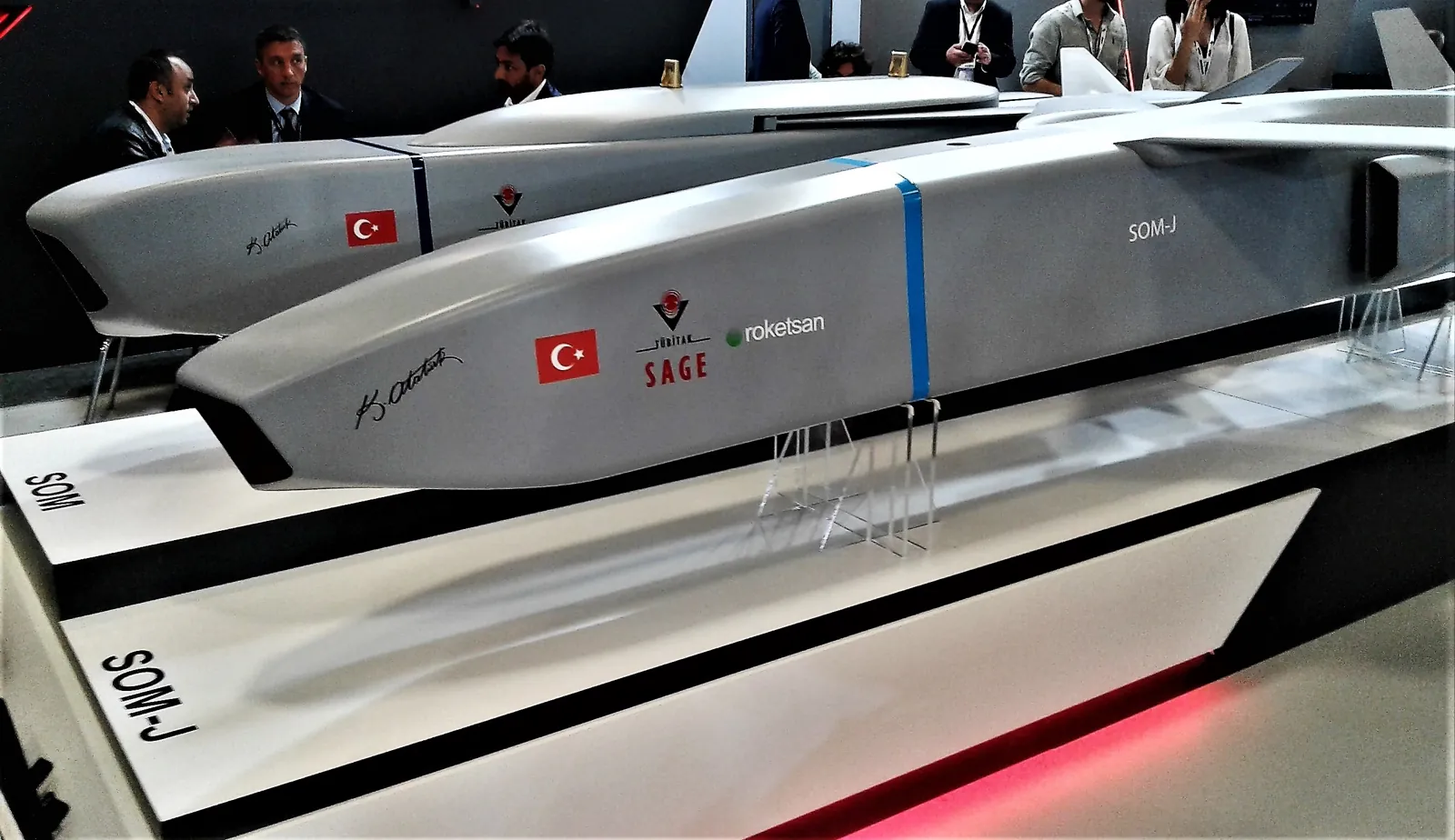
ATMACA is the indigenous anti-ship cruise missile developed by ROKETSAN for the Turkish Navy. It has a range of roughly 250 km, a subsonic cruise speed of Mach 0.85-0.90, and terminal active-radar homing. Entering service in 2022, it is progressively replacing the American-built Harpoon aboard Turkish warships.
| ATMACA — At a Glance | |
|---|---|
| Category | Anti-ship cruise missile |
| Developer | ROKETSAN |
| In service | 2022 (Turkish Navy) |
| Range | ~250 km (sea); Land ATMACA 400+ km |
| Speed | Mach 0.85-0.90 (subsonic) |
| Weight | ~750 kg (sea) / ~890 kg (land) |
| Length / diameter | ~4.8-5.2 m / 350 mm |
| Warhead | Semi-armour-piercing HE, ~220-250 kg |
| Guidance | INS/GPS + radar altimeter + data link + terminal active radar |
| Propulsion | Turbojet (Kale KTJ; early Microturbo TRI-40) |
| Flight profile | Sea-skimming |
| Platforms | Frigate, corvette, fast attack craft, coastal battery, submarine (tested), USV |
| Operator | Turkish Armed Forces |
What is ATMACA?
ATMACA (Turkish for “hawk”) is the indigenous anti-ship cruise missile that ROKETSAN developed for the Turkish Navy. Its mission is to strike enemy surface combatants at long range while ending Turkey’s decades-long reliance on the US-built Harpoon missile that its warships had carried since the Cold War.
The missile officially entered service in 2022 and has been integrated onto frigates, corvettes and fast attack craft as serial deliveries proceed. ATMACA has grown into a modular family: beyond ship-launched variants, it can be fired from coastal defence batteries and unmanned surface vehicles (USVs), and a submarine-launched configuration has been tested. A dedicated land-attack version, Land ATMACA, reportedly exceeded 400 km in a 2025 test, widening the weapon’s reach.
ATMACA is one of the flagship products in ROKETSAN’s cruise-missile line and a concrete example of the indigenous design capability Turkey has built in missile technology.
How does ATMACA work? Technical breakdown
ATMACA is a subsonic cruise missile flying at roughly Mach 0.85-0.90. It is not a hypersonic ballistic weapon but a low-flying, intelligent guided munition. Once launched, a turbojet engine (the Kale KTJ family; early rounds used the French Microturbo TRI-40) sustains flight all the way to the target, delivering long range and fuel-efficient cruise.
Guidance is layered. During cruise, inertial navigation (INS) works alongside GPS, while a radar altimeter keeps the missile skimming just above the sea surface, below the radar horizon (sea-skimming). This low profile makes it hard for the target ship to detect the missile until the final seconds. A two-way data link allows target updates in flight, mission abort, or re-tasking. In the terminal phase, an active radar seeker in the nose locks onto the target on its own and homes in despite countermeasures.
The warhead is a semi-armour-piercing high-explosive (SAP-HE) type, designed to penetrate a ship’s hull and detonate inside; its mass is reported at around 220-250 kg, enough to inflict serious damage on medium and large surface combatants.
ATMACA sits in the subsonic sea-skimming anti-ship cruise missile class and is broadly comparable to leading Western equivalents in range, guidance and warhead. ROKETSAN’s aim is to fill the role held for decades by foreign systems in the Turkish fleet with a wholly indigenous solution.
Platforms, operators and exports
ATMACA is positioned as a multi-platform anti-ship family. Its primary carriers are surface combatants – frigates (such as the ADA-class corvettes and the İ-class frigates), corvettes and fast attack craft. Beyond ships, a land version arms coastal defence batteries, integration work is under way for unmanned surface vehicles (USVs), and a submarine-launched capability has been tested.
The only known operational operator today is the Turkish Armed Forces, specifically the Turkish Navy, where the missile is gradually replacing Harpoon aboard TCG-designated vessels.
On the export front the picture is less settled. Open-source reports mention interest and talks with Indonesia, Malaysia and Algeria, but firm contract status is variable and independent confirmation is limited. Claims that these countries are confirmed customers should therefore be treated with caution.
Place in Turkey’s defence industry – advantages and limits
ATMACA marks a symbolic and strategic threshold in Turkey’s indigenous missile programme: a NATO member replacing the foreign anti-ship missiles its navy had used for decades with its own product is a critical step in reducing external dependence. For ROKETSAN, ATMACA – together with the ÇAKIR cruise missile – forms the core of its naval and cruise-missile family.
Advantages: freedom from export or end-use restrictions thanks to indigenous design; multi-platform flexibility (ship, land, submarine, USV); in-flight re-tasking via data link; and low detectability through its sea-skimming profile. Land ATMACA’s 400+ km reach adds depth to coastal defence.
Limits: ATMACA is subsonic, so its time-to-target is longer than supersonic or hypersonic anti-ship missiles and it faces a relatively higher risk of interception by modern air-defence systems. Some figures – range, warhead mass – also vary between sources, and ROKETSAN has not officially disclosed every detail.
ATMACA figures for range (~250 km), warhead mass (~220-250 kg), length (~4.8-5.2 m) and weight rest on open sources and can vary between them. The 400+ km Land ATMACA range is based on a 2025 test statement. Export reports (Indonesia, Malaysia, Algeria) are not tied to firm contracts and have limited independent confirmation. ROKETSAN has not officially disclosed some technical details.
Frequently Asked Questions
What is the range of ATMACA?
The standard sea-launched ATMACA has a range of about 250 km. The land-attack Land ATMACA variant reportedly exceeded 400 km in a 2025 test.
Who operates ATMACA?
The only known operational operator is the Turkish Armed Forces, specifically the Turkish Navy, where it is replacing Harpoon aboard warships.
What platforms launch ATMACA?
It is fired from surface combatants such as frigates, corvettes and fast attack craft, and can also be launched from coastal defence batteries, unmanned surface vehicles (USVs) and, in testing, submarines.
What are ATMACA’s equivalents?
Its main equivalents are the American Harpoon, the Norwegian Naval Strike Missile (NSM) and the French Exocet MM40 anti-ship missiles.
Has ATMACA been exported?
Open sources report interest and talks with Indonesia, Malaysia and Algeria, but firm contract status is variable and independent confirmation is limited.
When did ATMACA enter service?
ATMACA officially entered Turkish Navy service in 2022.
Sources
- ROKETSAN official — roketsan.com.tr
- Turkish Naval Forces Command press releases (2022 induction)
- Wikipedia — ATMACA (missile) and open-source defence reporting