AKSUNGUR vs AKINCI: Key Differences and Specs Compared (2026)

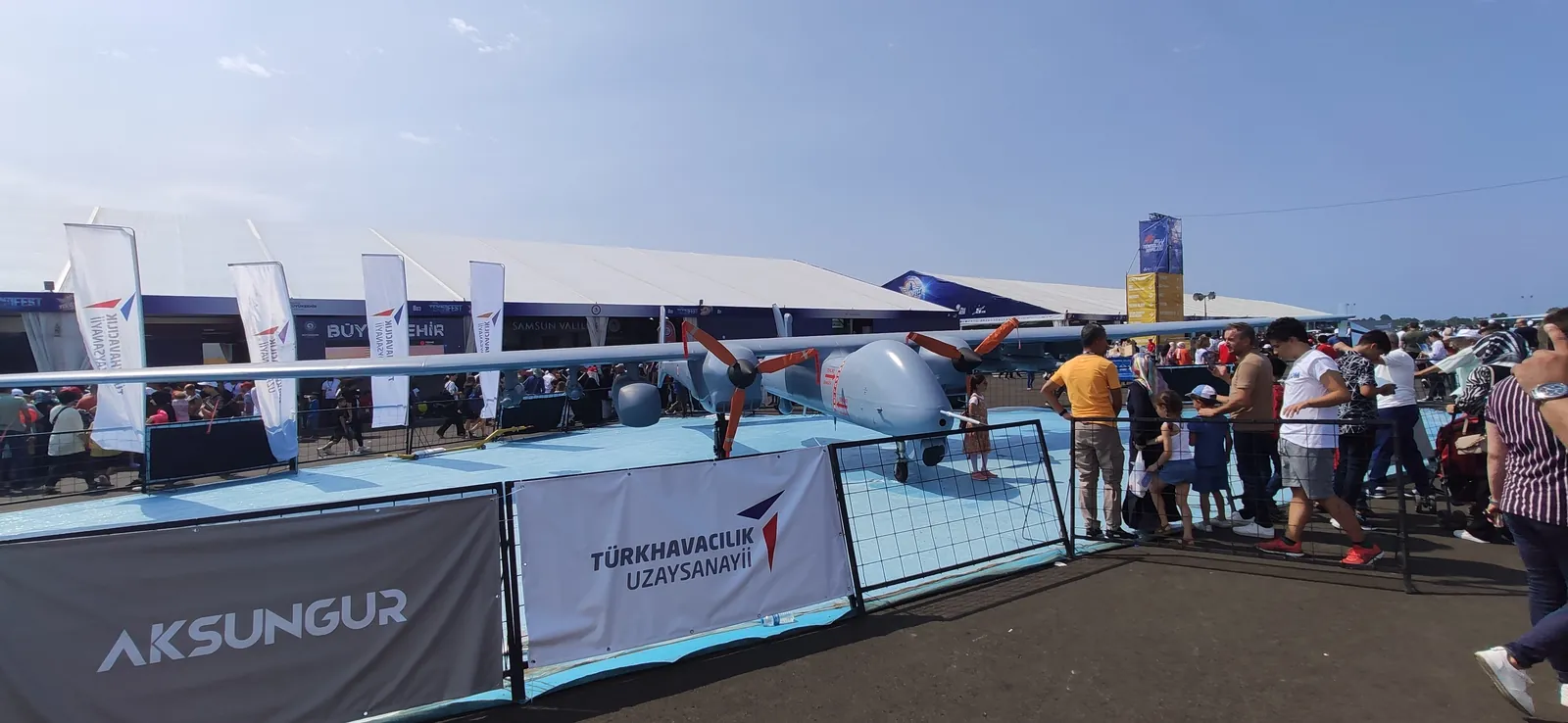
AKSUNGUR and AKINCI are both twin-engine unmanned aircraft developed in Türkiye, but they come from different companies and were designed for different jobs. Turkish Aerospace’s AKSUNGUR (3,300 kg MTOW, domestic PD170 diesel engines) is optimised for endurance and surveillance. Baykar’s AKINCI, at 6,000 kg and with a 1,500 kg payload, sits in the heavy strike class. As of 2026, both serve side by side in the Turkish Armed Forces.
| AKSUNGUR vs AKINCI — At a Glance | |
|---|---|
| Systems compared | AKSUNGUR and Bayraktar AKINCI |
| Manufacturers | Turkish Aerospace (TUSAŞ/TAI) for AKSUNGUR; Baykar for AKINCI; two separate companies |
| Class | AKSUNGUR: multi-role MALE UAV · AKINCI: unmanned combat aerial vehicle (UCAV), heavy class |
| Engines | AKSUNGUR: 2x PD170 diesel (TEI), 2 x 170 hp · AKINCI: 2x turboprop, 2 x 450/750/850 hp |
| MTOW | AKSUNGUR 3,300 kg · AKINCI 6,000 kg |
| Payload | AKSUNGUR up to 750 kg (external) · AKINCI 1,500 kg |
| Endurance | AKSUNGUR up to 40 hours · AKINCI 20+ hours |
| Common ground | Both are domestically developed twin-engine platforms |
| Status | Both in service with the Turkish Armed Forces; exports reported for both |
What are AKSUNGUR and AKINCI, and who builds them?
AKSUNGUR is a twin-engine, multi-role medium-altitude long-endurance (MALE) UAV developed by Turkish Aerospace (TUSAŞ/TAI), a largely state-linked company whose shareholders are the Turkish Armed Forces Foundation (TSKGV), the Presidency of Defense Industries (SSB) and the Turkish Aeronautical Association (THK). It flies on two domestic PD170 twin-turbo diesel engines produced by TEI, a TUSAŞ subsidiary. The Turkish Naval Forces took delivery of their first AKSUNGUR on October 20, 2021.
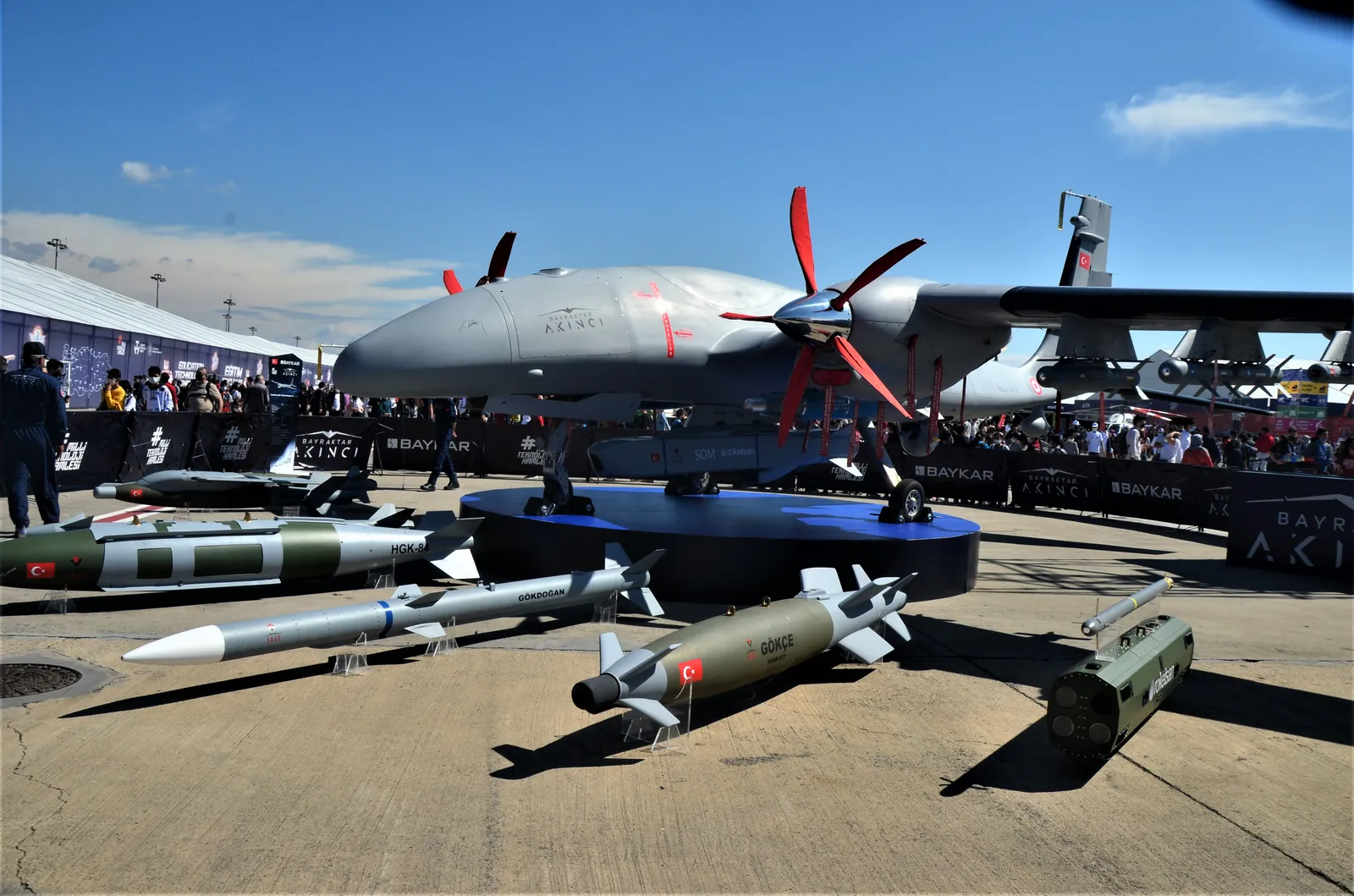
The Bayraktar AKINCI is an unmanned combat aerial vehicle built by Baykar, a privately owned company. Powered by two turboprops, it has a 6,000 kg maximum takeoff weight according to Baykar’s official specifications, which places it in a heavier category above the typical MALE class. Baykar says the aircraft first flew on December 6, 2019, and open sources report that deliveries to the Turkish Armed Forces began in August 2021. The two aircraft therefore entered the inventory at roughly the same time, yet they reflect quite different design priorities.
The core difference: endurance or heavy strike?
What separates the two is the trade-off each design makes, and the numbers show it clearly:
- AKSUNGUR is built for endurance: its wider 24 m wing and fuel-efficient diesel engines give it up to 40 hours aloft on the TUSAŞ data board, and the SIGINT configuration flies for 24 hours at 35,000 ft with 150 kg of payload.
- AKINCI is built for payload and speed: a 1,500 kg payload, a cruise-to-maximum speed range of 150–240 KTAS, a 40,000 ft service ceiling and a 45,118 ft altitude record point to a heavy strike role.
- The mission kit differs: AKSUNGUR’s typical loads are SIGINT, maritime patrol, communications relay and sonobuoys, while AKINCI is associated with a national multi-mode AESA radar, cruise missiles and air-to-air missiles.
- Common ground: both have two engines, both can fly armed and maritime patrol missions, and both rely on domestically produced munitions and subsystems.
The table sets the mission profiles of the two aircraft side by side. AKSUNGUR figures come from the TUSAŞ data board and AKINCI figures from Baykar’s official technical specifications. Roles that the manufacturers do not list separately are flagged rather than assumed.
The table summarises users and export reports for both aircraft. Everything outside Türkiye is based on open sources, quantities and contract values have not been officially disclosed, and a contract is not treated as a delivery.
Engine difference: domestic PD170 diesel versus the turboprop class
Propulsion goes a long way towards explaining how the two aircraft behave. AKSUNGUR uses two PD170 twin-turbo diesel engines designed and built in Türkiye by TEI, each producing 170 hp at sea level. The low fuel burn of a diesel is one of the main reasons the aircraft can stay up for as long as 40 hours. During the TÜRNAS-26 exercise in October 2026, an AKSUNGUR on TEI-PD170 engines was flown via satellite control from Ankara.
AKINCI uses turboprops, and Baykar’s specifications list three power classes depending on the variant: 2 x 450 hp, 2 x 750 hp and 2 x 850 hp. That power supports the 6,000 kg takeoff weight, the 1,500 kg payload and speeds of up to 240 KTAS. The official specifications do not name the engine supplier; open sources report that the aircraft uses engines from the Ukrainian-origin AI-450 family. Which engine is fitted to which variant has not been officially disclosed.
Which one for which mission? Two systems that complement each other
There is no single answer to whether AKSUNGUR or AKINCI is better, because the two were not designed to do the same work. In missions that require staying over one area for many hours, such as long-range maritime surveillance, signals intelligence and submarine search, AKSUNGUR’s endurance is the deciding factor. For precision strikes with heavy munitions from high altitude, cruise missile employment and air-to-air tasks, AKINCI’s payload and speed carry more weight.
Operating both in the same inventory is therefore a division of labour rather than duplication. Developed separately by Turkish Aerospace and Baykar, the two platforms show that Türkiye can field domestic solutions across more than one class of unmanned aircraft and offer export customers several distinct options.
Technical figures on this page come from the official TUSAŞ AKSUNGUR data board and Baykar’s official AKINCI specifications. Anything not confirmed by the manufacturers is labelled “according to open sources”. AKSUNGUR’s speed and AKINCI’s engine supplier do not appear in the manufacturer data and are not officially disclosed. AKSUNGUR’s length varies between roughly 11.6 and 12 m across sources. Export quantities and values have not been disclosed.
Frequently Asked Questions
What is the difference between AKSUNGUR and AKINCI?
AKSUNGUR is Turkish Aerospace’s twin-engine MALE UAV, focused on endurance and surveillance, with up to 40 hours aloft on its data board. AKINCI is Baykar’s unmanned combat aerial vehicle, focused on heavy strike, with a 1,500 kg payload, a 40,000 ft service ceiling and speeds of up to 240 KTAS. One is built around endurance, the other around payload and speed, and the two complement each other.
Which is bigger, AKSUNGUR or AKINCI?
AKSUNGUR has the wider wing, at 24 m against 20 m. AKINCI is considerably heavier, however, with a maximum takeoff weight of 6,000 kg compared with 3,300 kg for AKSUNGUR. Their lengths are similar: AKINCI measures 12.2 m, and AKSUNGUR is about 12 m according to open sources, a figure that has not been officially confirmed.
Which one can stay airborne longer?
AKSUNGUR. The TUSAŞ data board gives up to 40 hours of endurance, with 24 hours in the SIGINT configuration and 12 hours when carrying 750 kg of external load. Baykar lists 20+ hours for AKINCI. The gap comes largely from AKSUNGUR’s fuel-efficient diesel engines and its long, wide wing.
Which one carries more weapons?
AKINCI. Baykar’s specifications give a 1,500 kg payload, and the aircraft can carry laser-guided munitions such as MAM-L and MAM-C as well as cruise, stand-off and air-to-air missiles. AKSUNGUR carries up to 750 kg of external load; open sources report three weapon stations per wing, and a first firing test with the ASELSAN TOLUN munition was reported in October 2026.
What engines do AKSUNGUR and AKINCI use?
AKSUNGUR flies on two PD170 twin-turbo diesel engines built by TEI, each rated at 170 hp, and the powerplant is fully domestic. AKINCI uses two turboprops, with Baykar listing power classes of 2 x 450, 2 x 750 and 2 x 850 hp depending on the variant. The manufacturer does not name the engine supplier; open sources report Ukrainian-origin AI-450 family engines.
Are AKSUNGUR and AKINCI made by the same company?
No. AKSUNGUR is a product of Turkish Aerospace (TUSAŞ), a largely state-linked company whose shareholders include TSKGV, SSB and THK. AKINCI is designed and built by Baykar, a privately owned company. Both are domestically developed Turkish systems, but their design teams, production lines and supply chains are separate.
Have AKSUNGUR and AKINCI been exported?
Yes, exports have been reported for both. According to open sources, AKSUNGUR deliveries have been reported to Kyrgyzstan and Chad and an order to Algeria. Baykar’s official website says AKINCI is actively used by several countries, and open sources name Azerbaijan and Pakistan among them. In July 2023 Baykar signed its largest export deal up to that point with Saudi Arabia.
Sources
- Turkish Aerospace (TUSAŞ/TAI) — official AKSUNGUR page and data board, tusas.com
- Baykar — official Bayraktar AKINCI technical specifications, baykartech.com (November 2026)
- Shephard Media and Janes — Naval Forces delivery of the first AKSUNGUR (October 2021)
- Baykar — statement on the Saudi Arabia export agreement (July 2023)
- Presidency of Defense Industries (SSB) — weekly summary, October 2026 (AKSUNGUR TOLUN firing test)
- ENVANTER MEDYA — AKSUNGUR TÜRNAS-26 aselBUOY mission and AKINCI coverage