What Is AKSUNGUR? TUSAŞ Twin-Engine MALE UAV Explained (2026)

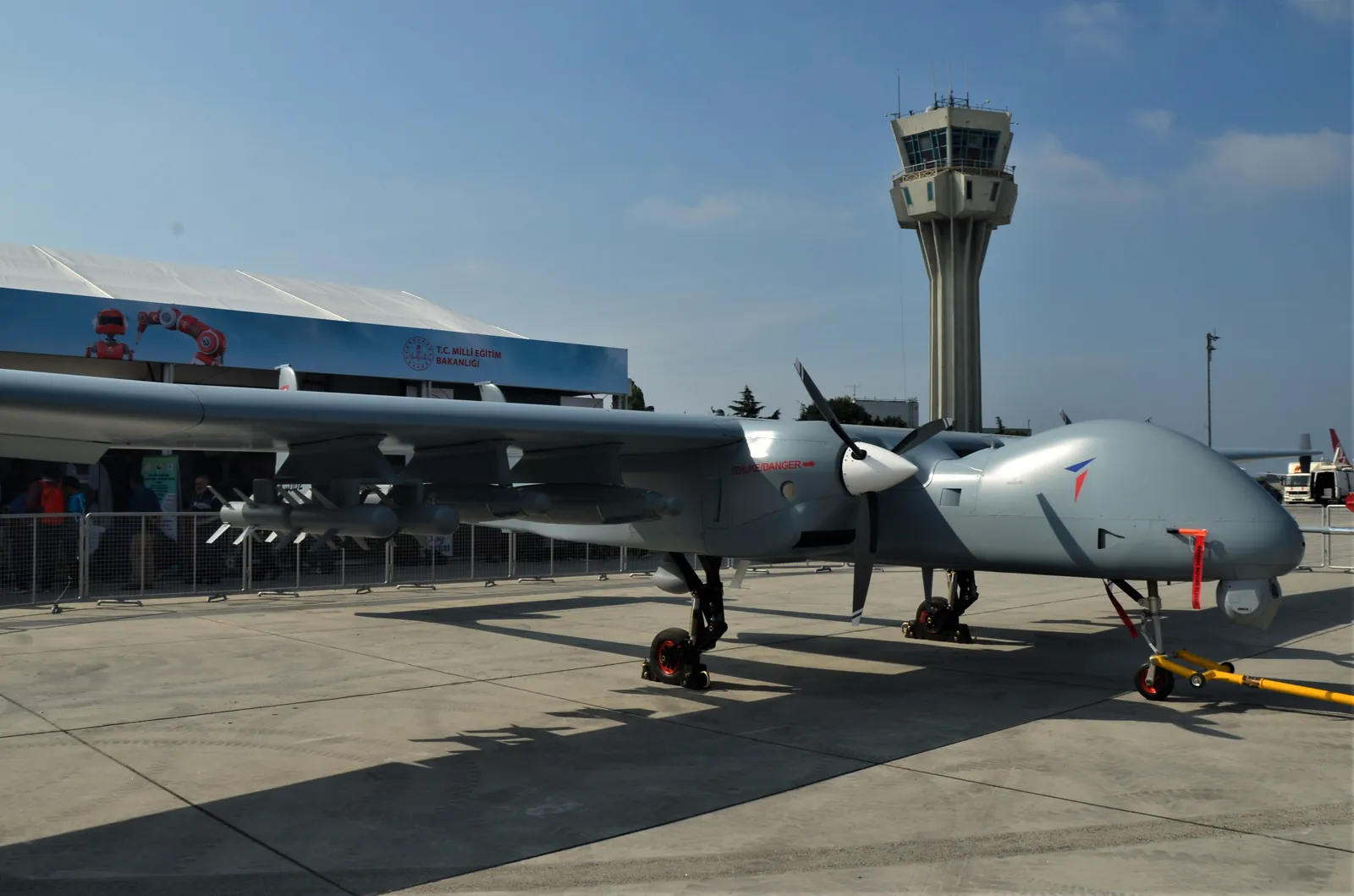
AKSUNGUR is a twin-engine medium-altitude long-endurance (MALE) armed and reconnaissance UAV developed by Turkish Aerospace (TUSAŞ/TAI). It is powered by two PD170 turbo-diesel engines from TEI, has a 24 m wingspan and a 3,300 kg maximum takeoff weight, and carries sensors, communications equipment or weapons depending on the mission. The Naval Forces took delivery of the first domestically built aircraft on October 20, 2021, and in 2026 the platform continues to add new roles.
| AKSUNGUR — Fact Sheet | |
|---|---|
| Type | Twin-engine medium-altitude long-endurance (MALE) armed and reconnaissance UAV |
| Manufacturer | Turkish Aerospace (TUSAŞ/TAI) |
| Engines | 2x PD170 twin-turbo diesel, 2 x 170 hp at sea level (ISA); produced by TEI (TUSAŞ Engine Industries) |
| Wingspan | 24 m |
| Length | Roughly 11.6-12 m; sources differ and the figure is not officially confirmed |
| MTOW | 3,300 kg |
| Payload | 150 kg internal payload (SIGINT configuration); up to 750 kg external payload (strike and maritime patrol configuration) |
| Endurance | Data board lists 24 hours (SIGINT) and 12 hours (strike); the English board states up to 40 hours |
| Users | Turkish Naval Forces and Air Force (according to open sources); export reports are listed in the table below |
| Status | In service; first domestically built aircraft delivered to the Naval Forces on October 20, 2021 |
What is AKSUNGUR?
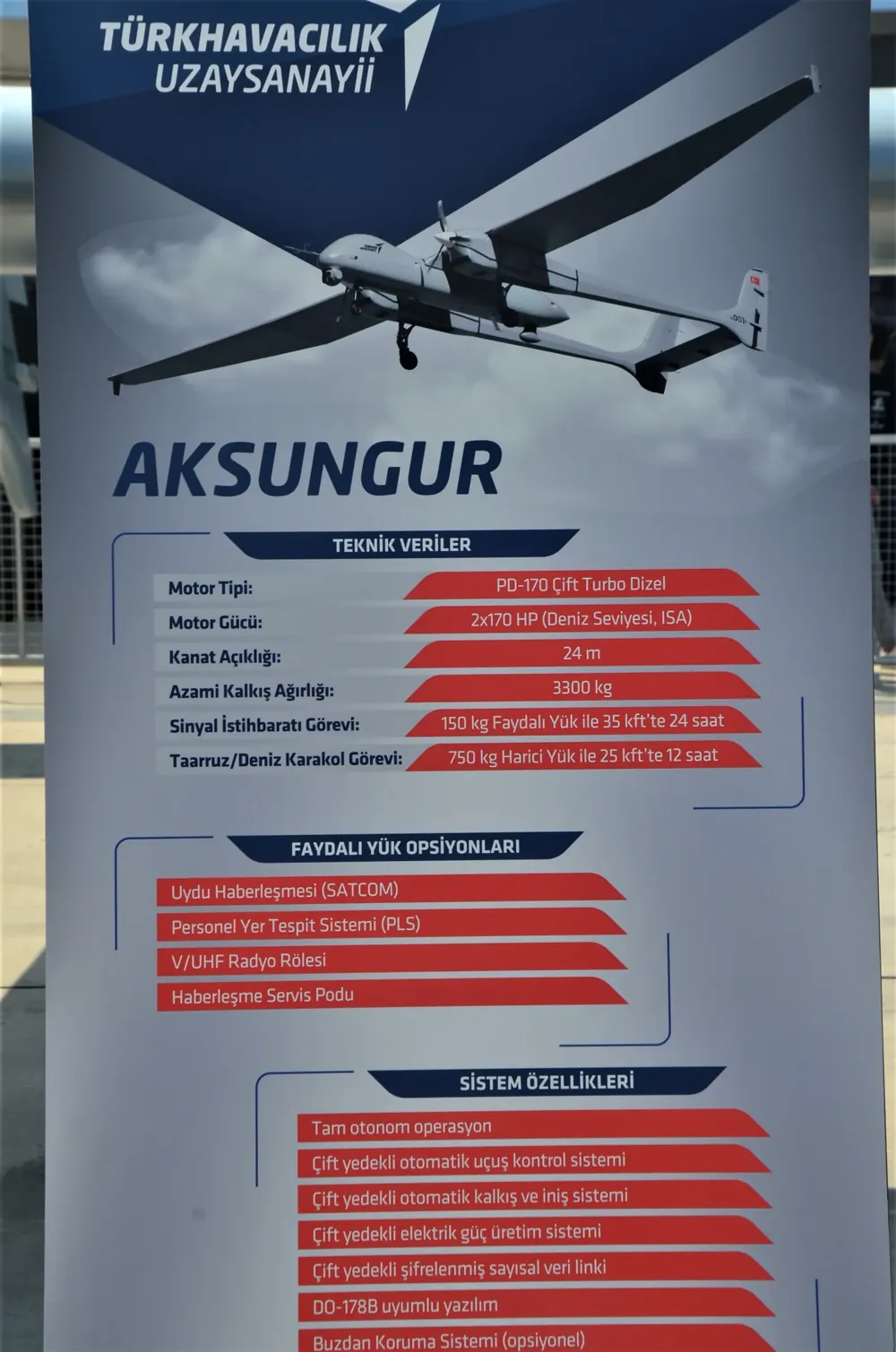
AKSUNGUR is TUSAŞ’s twin-engine MALE UAV, a class of unmanned aircraft designed to fly for many hours at medium altitude while carrying sensors, communications payloads or weapons. Its distinguishing feature is the pair of PD170 turbo-diesel engines, which give the aircraft a much larger payload than a single-engine platform. According to the official TUSAŞ data board, the aircraft has a 24 m wingspan and a 3,300 kg maximum takeoff weight, and its engines were developed and produced by TEI, a TUSAŞ company.
The systems are built around redundancy: the board lists fully autonomous operation, a dual-redundant automatic flight control system, dual-redundant automatic takeoff and landing, dual-redundant electrical power generation, a dual-redundant encrypted digital data link, DO-178B-compliant software and optional de-icing. This architecture is a positive indicator of the maturity of the national UAV industry. The first-flight date is not given on this page because no officially confirmed date has been verified.
The Naval Forces received the first domestically built AKSUNGUR on October 20, 2021, as reported by Shephard and Janes. Open sources also name the Air Force as a user; the total number of aircraft delivered has not been officially disclosed. A report of “10 aircraft” circulates without a date, so no figure is stated here.
What does AKSUNGUR do? Mission types
The aircraft is a multi-role platform, and the mission is set by the payload fitted for each sortie. The main task types are:
- Signals intelligence (SIGINT): 150 kg of payload at 35,000 ft for 24 hours, according to the official data board.
- Maritime patrol and sonobuoy missions: broad-area sea surveillance, and in October 2026 the first release of sonobuoys from a UAV for submarine detection.
- Strike: up to 750 kg of external payload at 25,000 ft for 12 hours; open sources report three weapon stations under each wing (500, 300 and 150 kg).
- Communications relay: satellite communications (SATCOM), V/UHF radio relay, a communications service pod and a personnel locator system (PLS).
Munitions integration involves products from ROKETSAN, ASELSAN and TÜBİTAK SAGE, according to open sources; a report of a flight longer than one day carrying 12 missiles has also appeared in open sources and is not an official figure.
The table lists the mission configurations shown on the official TUSAŞ data board. Values belong to the specific configuration and should not be mixed between rows.
The table below lists the users and export reports. All export entries are according to open sources; none has been officially confirmed or detailed, and a contract is not a delivery.
How AKSUNGUR differs from ANKA and other MALE UAVs
AKSUNGUR and ANKA are both TUSAŞ medium-altitude long-endurance UAVs, but they are different aircraft. The ANKA-S is a single-engine platform with a 17.5 m wingspan and a 1,700 kg MTOW, while AKSUNGUR is a twin-engine aircraft with a 24 m wingspan and a 3,300 kg MTOW, which allows a larger payload and heavier external loads. ANKA-3 is a separate jet-powered flying-wing platform, and the ANKA-B and ANKA-S names should not be confused with AKSUNGUR.
AKINCI belongs to a different company, Baykar, and is not a TUSAŞ product. A comparison between the two platforms is covered as a separate subject. Official figures differ between datasheets and over time, so this page cites the TUSAŞ data board wherever possible.
Recent developments: TÜRNAS-26 aselBUOY and TOLUN
In October 2026, during the TÜRNAS-26 exercise, an AKSUNGUR dropped ASELSAN aselBUOY 100P sonobuoys for the first time from a UAV to detect a submarine, according to a TUSAŞ statement. The aircraft, powered by TEI-PD170 engines, was controlled by satellite from Ankara and listened for about four hours off the coast of Antalya.
In the same month, the weekly summary from the Presidency of Defense Industries (SSB) reported the first firing test of the ASELSAN TOLUN bunker-penetrating munition from an AKSUNGUR; the date, range and hit result were not disclosed. Both developments show the platform’s expansion from reconnaissance into anti-submarine and strike roles with domestic payloads.
The figures in the technical tables come from the official TUSAŞ data board shown at Teknofest 2019. Values such as 50 hours of endurance, 49 hours in a test or a 40,000 ft altitude record come from open sources and are not official. Export entries are labelled “according to open sources”, a contract is not a delivery, and no unit price has been officially disclosed. The first-flight date is not given on this page because no officially confirmed date has been verified.
Frequently Asked Questions
What is AKSUNGUR?
AKSUNGUR is a twin-engine medium-altitude long-endurance (MALE) armed and reconnaissance UAV developed by Turkish Aerospace (TUSAŞ). It can carry signals intelligence payloads, maritime patrol equipment, communications relays or external weapons, and the Turkish Naval Forces took delivery of the first domestically built aircraft on October 20, 2021.
What engines does AKSUNGUR use?
AKSUNGUR is powered by two PD170 twin-turbo diesel engines, each rated at 170 hp at sea level under ISA conditions. The engines are produced by TEI (TUSAŞ Engine Industries), and in the October 2026 TÜRNAS-26 sonobuoy mission the aircraft was reported to fly on TEI-PD170 engines.
What are AKSUNGUR’s wingspan and weight?
According to the official TUSAŞ data board, the wingspan is 24 m and the maximum takeoff weight (MTOW) is 3,300 kg. Length is reported as roughly 11.6-12 m depending on the source, but this figure has not been officially confirmed.
How long can AKSUNGUR stay airborne?
The Turkish data board lists 24 hours for the signals intelligence configuration at 35,000 ft with 150 kg of payload, and 12 hours for the strike and maritime patrol configuration at 25,000 ft with 750 kg of external payload. The English board states up to 40 hours. Higher figures such as 50 hours appear in open sources and are not official.
Is AKSUNGUR armed?
Yes, the strike and maritime patrol configuration carries up to 750 kg of external payload. According to open sources, there are three weapon stations under each wing, rated 500, 300 and 150 kg, and munitions from ROKETSAN, ASELSAN and TÜBİTAK SAGE have been integrated. In October 2026 a first firing test with the ASELSAN TOLUN munition was reported, without disclosed details.
What is the difference between AKSUNGUR and ANKA?
Both are TUSAŞ MALE UAVs. ANKA-S is a single-engine aircraft with a 17.5 m wingspan and 1,700 kg MTOW, while AKSUNGUR has two engines, a 24 m wingspan and a 3,300 kg MTOW, allowing heavier payloads. ANKA-3 is a separate jet-powered flying-wing platform.
Has AKSUNGUR been exported?
According to open sources, deliveries have been reported to the Kyrgyz Border Guard Service and Chad, an order of about 6 aircraft has been reported for Algeria, and a purchase by Angola was reported in 2023. None of these has been officially confirmed or detailed, a contract is not a delivery, and no unit price has been disclosed. Uzbekistan’s reported aircraft is the ANKA, not AKSUNGUR.
Sources
- Turkish Aerospace (TUSAŞ/TAI) — official AKSUNGUR page and data board, tusas.com
- Shephard Media — Naval Forces delivery of the first domestically built AKSUNGUR (October 20, 2021)
- Janes — AKSUNGUR platform and delivery reporting
- haber.aero — AKSUNGUR technical and programme reporting
- Presidency of Defense Industries (SSB) — weekly summary, October 2026 (TOLUN firing test)
- ENVANTER MEDYA — AKSUNGUR and TOLUN news coverage