AKSUNGUR Fires TOLUN Munition for the First Time, Adding Strike Capability to Turkey’s Drone Fleet

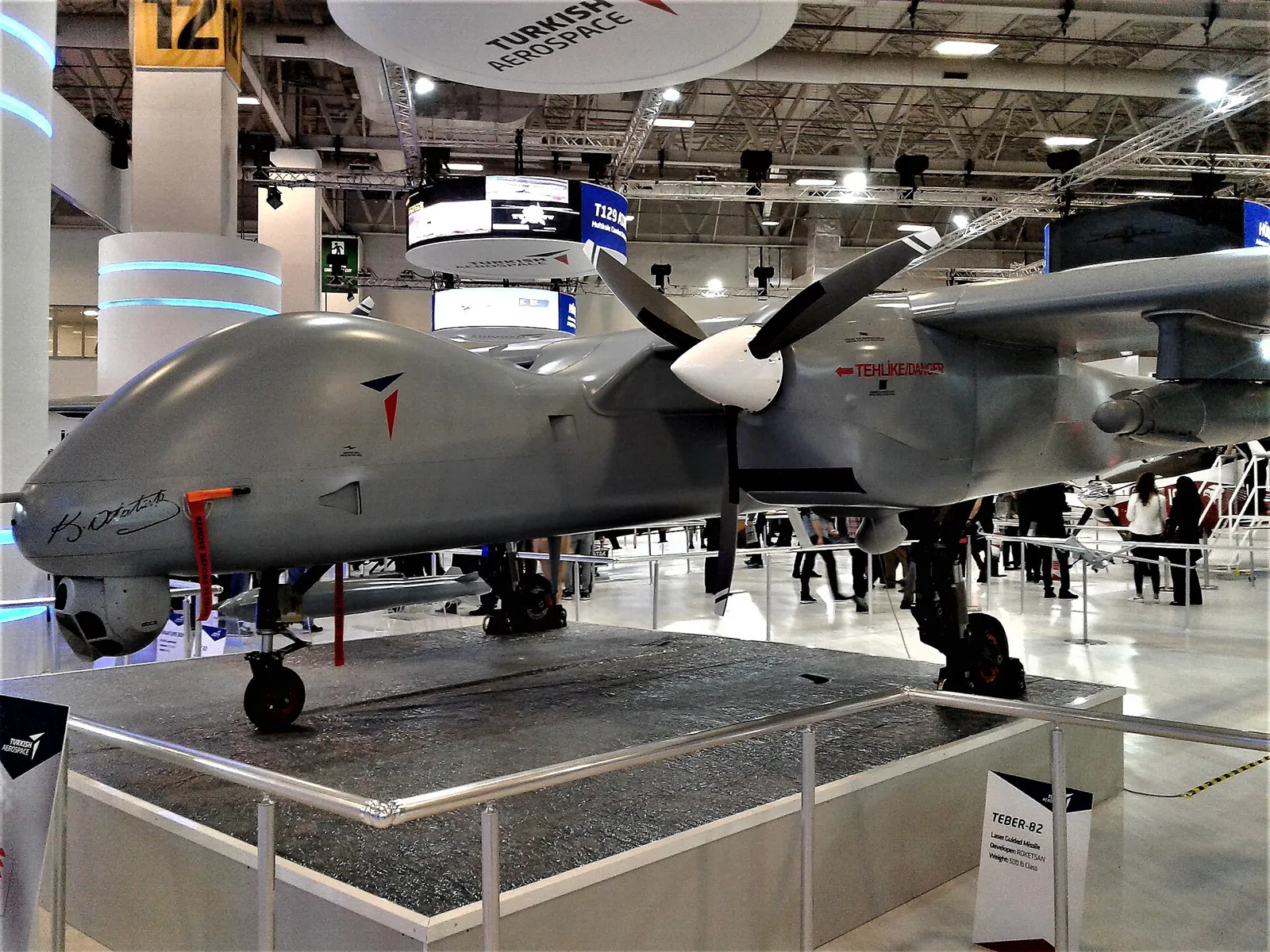
Turkey’s Presidency of Defence Industries (SSB) says ASELSAN’s bunker-penetrating TOLUN munition has been fired from a TUSAŞ AKSUNGUR drone for the first time, extending the weapon beyond the Bayraktar AKINCI and giving the twin-engine platform a direct strike role.
SSB disclosed the milestone in its weekly activity summary covering 12-18 October, published on 19 October. The agency did not release the test date, firing distance, or hit outcome, limiting what can be independently verified about the event’s performance.
TOLUN is the penetrator variant in ASELSAN’s family of GPS/INS-guided, fire-and-forget mini munitions. According to the company’s public specifications, it is designed to defeat roughly one metre of reinforced concrete, with underground bunkers, command posts and hardened hangars named as its intended target set. A version fitted with an imaging infrared seeker adds a man-in-the-loop capability, letting the operator retarget after release. The munition can be carried four at a time on a single station using the SADAK-4T multiple-carriage rack, allowing a single sortie to engage up to eight separate targets.
The TOLUN family had already drawn attention before this week’s test. ASELSAN reported in 2024 that the munition hit its target during trials at Konya Karapınar under heavy GPS jamming, and it has since scored hits when released from the Bayraktar AKINCI. What makes this week’s test notable is that it marks the first time TOLUN has flown on a platform other than AKINCI — TUSAŞ’s twin-engine AKSUNGUR.
AKSUNGUR is a MALE-class drone known for carrying a heavier payload than the smaller ANKA, and it already serves Turkish Naval Forces in maritime patrol and surveillance roles. Integrating TOLUN pushes the platform beyond its established intelligence, surveillance and reconnaissance (ISR) niche and into direct strike missions — a shift in mission profile that becomes more significant when read alongside the rest of SSB’s weekly disclosures.
The same SSB summary noted that ASELSAN’s DRAGONEYE 2 electro-optical sensor family remains in serial production and delivery, that inspection and acceptance work was completed on SUNGUR missiles and their trigger units, and that a similar process wrapped up for the OMTAS medium-range anti-tank missile. SOM-B1T and SOM-AT munitions were also added to inventory during the same period. SSB additionally said a supply contract for the ÇAKIR cruise missile was signed in a ceremony that week, though it did not disclose the counterparty or contract value.
Fitting one munition family across multiple drone types reflects a deliberate modularity strategy Turkey’s defence industry has pursued for years: the same weapon adapted to different carriers. For the armed forces, that flexibility means munitions stock and training are not tied to a single airframe. For export customers, it means ASELSAN and TUSAŞ can offer a munition that already has a multi-platform track record rather than one validated on a single aircraft — a meaningful selling point as both companies compete for drone and precision-munition contracts abroad.
SSB’s statement stops short of confirming whether the TOLUN round actually struck its target during the AKSUNGUR test, so a full performance assessment is not yet possible from the available disclosure. What is clear is that the integration itself broadens AKSUNGUR’s role beyond surveillance, and reinforces TOLUN’s standing as a munition designed for use across Turkey’s drone fleet rather than for one aircraft alone. Whether SSB or ASELSAN will release further test details, including the strike outcome, remains unannounced.
Sources:
- Presidency of Defence Industries (SSB), “What Happened in Turkey’s Defence Industry This Week?”, 19 October 2026, https://www.ssb.gov.tr/haber/turk-savunma-sanayiinde-bu-hafta-neler-oldu-2026-10-19 — Primary source and official confirmation of the AKSUNGUR-TOLUN test.