





ASELSAN in Africa: Nigeria Office, South Africa Roots (2026)

ASELSAN in Africa: From a Cape Town Workshop to a Nigeria Office (2026)
ASELSAN, Türkiye’s largest defence electronics company, has built its African footprint in two stages: a South African subsidiary opened in 2011 that grew into a hub for electro-optical engineering, and a Nigeria office formalised in June 2025 that puts the company on the ground in West Africa. Equipment linked to ASELSAN is reported in service in more than 20 African states, though publicly confirmed details vary widely by country — this guide separates what is documented from what is only reported. ASELSAN’s push follows a pattern other Turkish defence firms have set on the continent, from confirmed Bayraktar TB2 operators across Africa to the more selective list of confirmed AKINCI operators.
What Is ASELSAN?
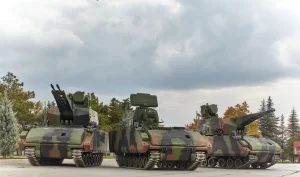
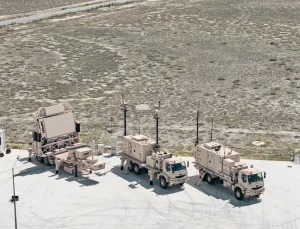
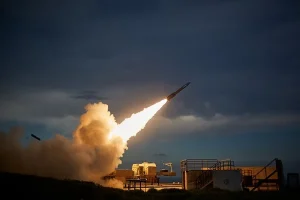
ASELSAN was founded in Ankara in 1975, in the aftermath of a US arms embargo imposed on Türkiye following the 1974 Cyprus intervention. The company was set up specifically to cut Turkish reliance on foreign military electronics, and today its principal shareholder is the Foundation for Strengthening the Turkish Armed Forces (TSKGV), which holds roughly 74% of ASELSAN’s shares; the remainder trades on Borsa Istanbul. ASELSAN’s core lines span radar, electronic warfare and jammers, air defence systems (HİSAR, SİPER, GÖKDENİZ), communications and radios, electro-optical and thermal-imaging systems, and unmanned surface vehicles such as TUFAN.
Revenue, Backlog and Workforce (2025–2026)
ASELSAN closed 2025 with inflation-adjusted revenue of 180.4 billion Turkish lira (about $4.1 billion), up 15% in real terms on 2024, and a workforce of roughly 16,000 people. New export contracts signed in 2025 totalled $2.1 billion, more than double the prior year, taking the company’s order backlog to a reported $20.4 billion — of which 272 contracts across 58 countries made up the export share, as ASELSAN detailed separately (see our global export breakdown). In the first half of 2026, ASELSAN reported new contract volume up 72% year-on-year to $4.9 billion, with backlog rising to $23.2 billion. Africa is not broken out as a separate line in these disclosures, so the continent’s exact share of that backlog is not publicly disclosed.
ASELSAN South Africa: The Continent’s Entry Point
ASELSAN’s presence in Africa predates its recent expansion by well over a decade. In 2011, the company opened ASELSAN South Africa after acquiring a local engineering firm that had been developing electro-optical systems for airborne military use. The subsidiary specialises in high-performance airborne thermal imagers, multi-spectral airborne sensors, in-flight boresighting systems, and targeting electro-optical payloads — work that also feeds ASELSAN’s broader position as one of the world’s larger electro-optical system manufacturers.
South Africa’s defence-procurement rules have shaped how ASELSAN operates there. A 2016/17 National Treasury instruction note pushed for the localisation of two-way radio production after officials flagged heavy spending on imported sets; when local industry could not fully meet demand, agencies including the SANDF and Department of Correctional Services relied on exemptions. Against that backdrop, ASELSAN signed an agreement with South African firm Pamodzi Group — finalised in May 2025 and formally signed on 22 July 2025 at IDEF in Istanbul — to produce the ASTELA 3710 handheld two-way radio locally. Manufacturing runs through Pamodzi BMG Electronic Communications, a joint venture split 60/40 between Pamodzi Aviation and Defence Systems and the Black-owned BM Global Defence Systems; semi-knockdown kits are shipped from Türkiye for local assembly, testing and, notably, technology transfer that ASELSAN has described as its first in Africa, enabling local encryption for security and sovereignty reasons.
ASELSAN Nigeria: The 2025 Abuja Office
ASELSAN formalised a business incorporation in Nigeria in June 2025, opening a permanent office in Abuja focused on sales, maintenance and training. The company has framed the move as addressing “local security needs, from countering insurgencies to enhancing air and naval capabilities,” language consistent with Nigeria’s long-running counter-insurgency operations in the northeast and the Gulf of Guinea. In May 2026, Nigeria’s Ministry of Defence recorded a courtesy visit in which the Permanent Secretary received ASELSAN Nigeria’s managing director — a step typical of a company introducing itself to a government customer rather than evidence of a specific new contract. Separately, Nigerian outlets have reported cooperation between the Nigerian Air Force and ASELSAN on radar and air-defence capability discussions; as with the ministry visit, this is reported engagement rather than a confirmed, priced contract, and readers should treat it as such until Nigeria’s official channels publish contract details.
Products Linked to ASELSAN’s African Activity
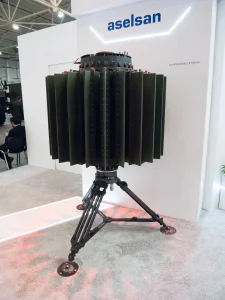
At the 2024 Africa Aerospace and Defence (AAD) exhibition, ASELSAN presented a product set aimed squarely at African border-security and counter-drone requirements: the ASELFLIR-500 surveillance and targeting system, the İHTAR counter mini/micro-UAV system, the KANGAL jammer subsystem, MİDAS fibre-optic perimeter detection, ACAR-K ground-surveillance radar, the DORUK-120 handheld electro-optical device, the GÖZDE laser-guidance kit, and the TOLUN guided munition. ASELSAN’s CEO said at the time that equipment linked to the company was in service in 21 African countries and that the company aimed to “help African countries develop their own defence industries and enhance their national security.” That is a company-sourced figure rather than an independently audited list, and it does not specify which systems are in which country — treat it as ASELSAN’s own claim of footprint, not a confirmed operator list.
Separately reported, unverified sourcing (not ASELSAN’s own disclosure) has named Nigeria, Angola, Algeria, Morocco, Chad and Burkina Faso as African states where ASELSAN-linked systems are described as in service; none of these should be read as confirmed government-to-government contracts without an official source, and this article does not claim confirmation for any of them beyond South Africa and Nigeria, where ASELSAN’s own corporate presence is documented above.
| Year | Event | Detail |
|---|---|---|
| 2011 | ASELSAN South Africa established | Formed after acquiring a local electro-optical engineering firm; focus on airborne thermal imaging and targeting payloads |
| 2024 | AAD exhibition, South Africa | ASELSAN presents border-security and counter-drone product line for African markets; CEO cites presence in 21 African countries |
| May–Jul 2025 | Pamodzi Group agreement | Local production of ASTELA 3710 radios in South Africa via a 60/40 Pamodzi–BM Global joint venture; ASELSAN’s first African technology transfer |
| Jun 2025 | ASELSAN Nigeria incorporated | Permanent Abuja office for sales, maintenance and training |
| May 2026 | Nigeria MoD courtesy visit | Permanent Secretary receives ASELSAN Nigeria’s managing director; introductory engagement, not a confirmed contract |
Who Else Is Competing for the Same Contracts
ASELSAN is not alone in courting African defence-electronics buyers. South Africa’s own Denel and Reutech compete in radar, electro-optics and artillery systems and benefit from local-content rules similar to those that shaped the Pamodzi deal. European suppliers (including French and Italian radar and EO houses) and Chinese electronics manufacturers are active across the continent, often on price, financing terms or existing platform relationships. ASELSAN’s pitch — as reflected in the Pamodzi structure — has leaned on local assembly, technology transfer and long-term partnership commitments rather than lowest-price competition, mirroring the approach Turkish firms like Baykar have used with drone sales in Africa (see our Turkish armoured vehicles in Africa guide and Turkish vs Chinese drones in the Sahel comparison for how that plays out in unmanned systems).
FAQ
Does ASELSAN have a factory in Africa?
Not a full manufacturing plant. ASELSAN South Africa does engineering and systems work on electro-optical payloads, and the 2025 Pamodzi agreement adds local assembly of ASTELA 3710 radios in South Africa via semi-knockdown kits — short of a standalone ASELSAN factory.
Is ASELSAN’s Nigeria office a manufacturing site?
No. It is a sales, maintenance and training office in Abuja, incorporated in June 2025.
Which African countries confirmed use ASELSAN systems?
Only South Africa (since 2011) and Nigeria (corporate presence since 2025) are documented through ASELSAN’s own confirmed subsidiaries/offices. Other countries — including Angola, Algeria, Morocco, Chad and Burkina Faso — appear in secondary reporting as having ASELSAN-linked equipment, but this is not independently confirmed to government-contract level.
Is the “21 African countries” figure official government data?
It is a figure ASELSAN’s own CEO stated at a 2024 industry exhibition, not data from SIPRI, IISS or any African government — treat it as a company claim.
What products does ASELSAN market for African border security?
At AAD 2024, ASELSAN highlighted ASELFLIR-500, İHTAR counter-UAV, KANGAL jamming, MİDAS perimeter detection, ACAR-K radar, DORUK-120 and GÖZDE guidance kits — aimed at border monitoring and counter-drone missions rather than offensive strike roles.
Sources
- DefenceWeb — “ASELSAN posts record 2025 results as African ambitions come into focus”
- DefenceWeb — “Aselsan signs landmark agreement with Pamodzi to produce radios in South Africa”
- DefenceWeb — “Africa an important market for ASELSAN”
- DefenceWeb — “Aselsan seeking to grow South African business”
- Military Africa — “Aselsan opens Nigerian office, expanding African presence”
- Nigeria Ministry of Defence — official notice on ASELSAN Nigeria managing director’s courtesy visit
- Breaking Defense — ASELSAN 2025 revenue results
- Wikipedia — ASELSAN corporate overview (founding, ownership)
- Envanter Medya — ASELSAN’s global export growth, 2025
Last updated: 2 September 2026.