Leonardo M-346 Master: Italy’s Lead-In Fighter Trainer and the Hürjet Challenger, Explained

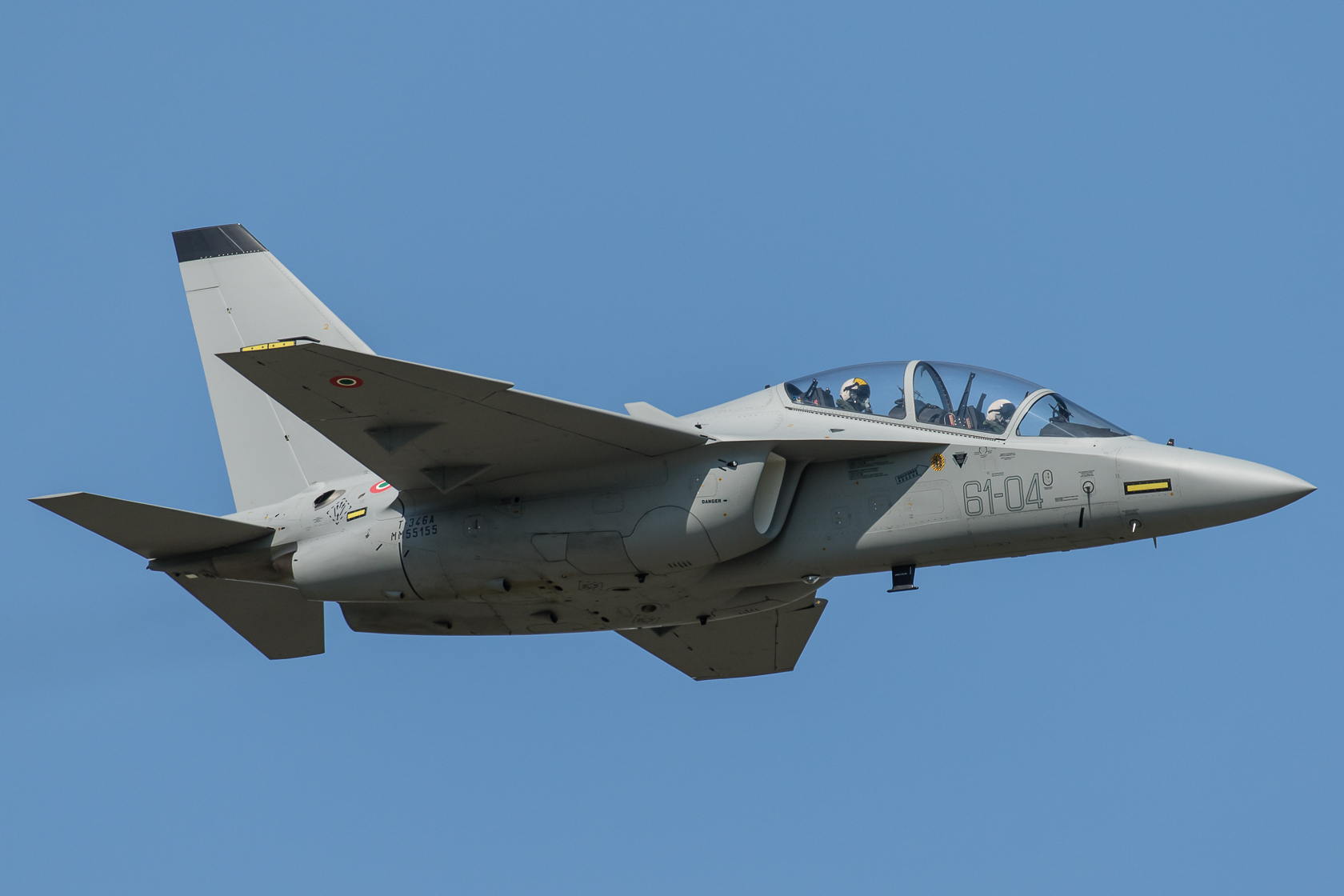
NATO is busy training fifth-generation fighter pilots, and only a handful of aircraft can carry the syllabus all the way from primary jet to F-35 cockpit. Italy’s Leonardo M-346 Master sits in that exclusive club alongside South Korea’s KAI T-50 Golden Eagle and the Boeing-Saab T-7A Red Hawk. Türkiye is now putting its own contender on the same shelf — the TUSAŞ Hürjet. This explainer walks through what the M-346 actually is, how it earns its keep, who has bought it and at what price, and why Türkiye’s homegrown answer is more than a regional curiosity.
What Is the M-346 Master?
The M-346 Master is Leonardo’s (formerly Alenia Aermacchi) twin-engine, tandem-seat advanced jet trainer. The program started in the late 1990s as a joint Italian-Russian venture with Yakovlev — the Yak/AEM-130 — but the partners parted ways in 2000 on industrial-property terms. Italy carried the design forward, replacing the airframe systems with fully NATO-compliant kit and a quadruplex digital fly-by-wire flight control system (commands move through redundant electronic channels rather than rods and cables). The result is a single platform that prepares pilots transitioning to fourth-generation, fourth-and-a-half-generation and fifth-generation fighters.
Two main variants are on the market:
- M-346 AJT — the pure Advanced Jet Trainer.
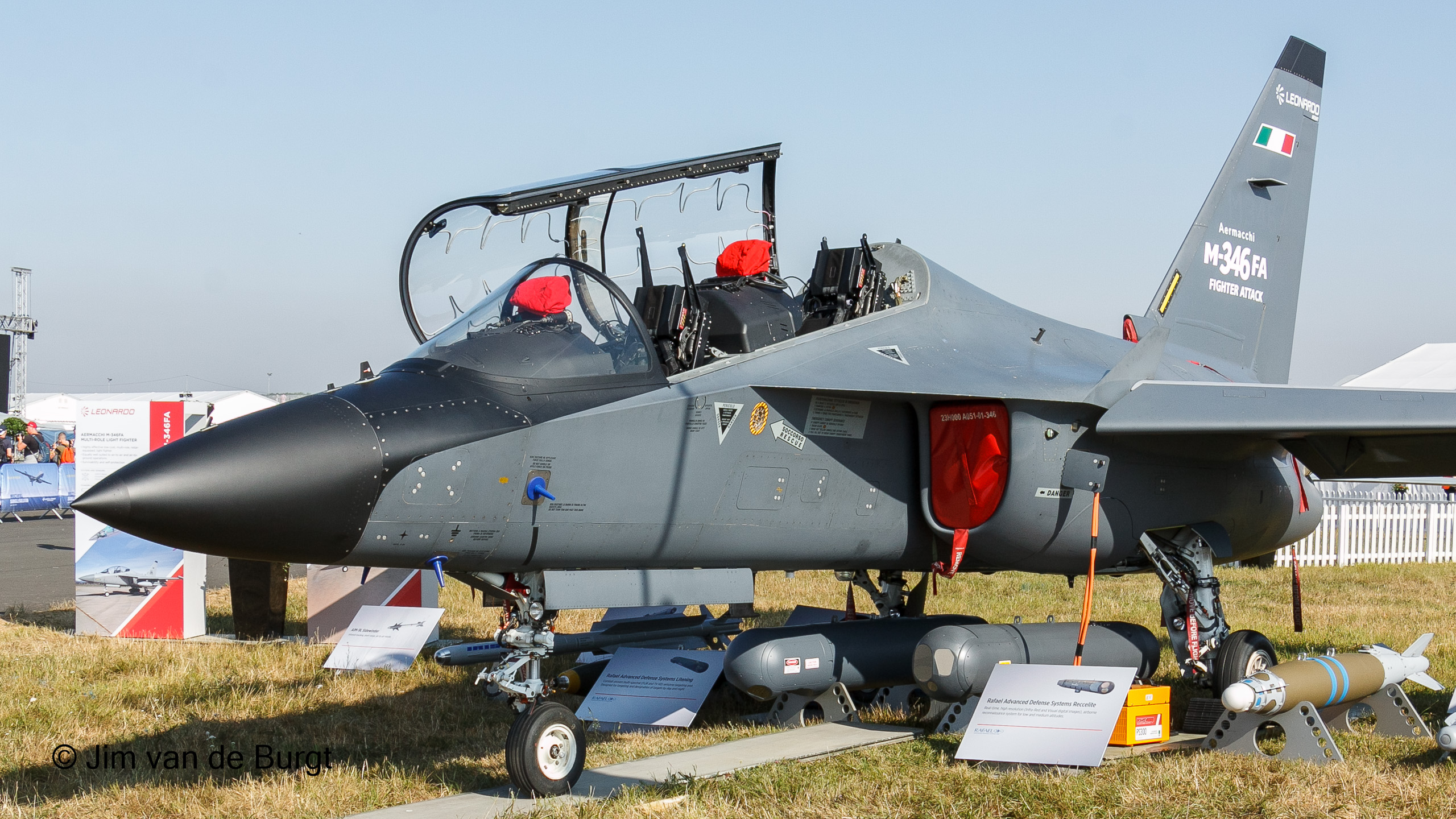
- M-346FA / M-346F — the Fighter Attack version with operational light-strike and air-policing capability, certified with Leonardo’s Grifo-346 X-band AESA radar (an active electronically scanned array — beam steered electronically rather than mechanically).
What Does It Actually Do?
- Train pilots. M-346 takes over after the turboprop phase (typically a T-6 Texan II or similar) and runs the NATO “Phase IV” jet syllabus.
- Run the Embedded Tactical Training System (ETTS). Simulated radar, electronic-warfare threats, virtual adversaries and synthetic weapons are injected directly into the cockpit avionics. A student can fly an F-35-style mission profile against simulated targets without burning a single round of real ammunition. ETTS is the single biggest reason the platform has done so well in export — it slashes hourly operating costs compared with running the same training sortie on an actual fifth-gen jet.
- Fight light. The M-346FA carries up to 3,000 kg across seven hardpoints — AIM-9L/M and IRIS-T short-range air-to-air missiles, Marte ER anti-ship missiles, and laser- or GPS-guided bombs.
Technical Specifications
| Spec | Value |
|---|---|
| Crew | 2 (instructor + student, tandem) |
| Length | 11.49 m |
| Wingspan | 9.72 m |
| Empty weight | 4,610 kg |
| Max take-off weight | 9,500 kg |
| Engines | 2 × Honeywell ITEC F124-GA-200 turbofan (28.0 kN each) |
| Top speed | Mach 1.15 (low-altitude dive) |
| Service ceiling | 13,715 m (45,000 ft) |
| Ferry range | ~1,890 km (with external tanks) |
| g limits | +8 / -3 g |
| Hardpoints | 7 (6 underwing + 1 centerline) |
| External stores | 3,000 kg (M-346FA) |
| Radar (FA variant) | Leonardo Grifo-346 X-band AESA |
| Flight controls | Quadruplex digital fly-by-wire |
Operators and Contracts: Who Bought, How Much
The M-346 family has crossed the 100-airframe mark, spread across nine customers — a strong export performance for a European trainer.
| Operator | Qty | Value / Year |
|---|---|---|
| Italy (AMI) | 18 + 4 option | ~EUR 700M / 2009 |
| Singapore (RSAF) | 12 | ~USD 250M / 2010 |
| Israel (M-346I “Lavi”) | 30 | ~USD 1B / 2012 |
| Poland | 16 (+32 option in talks) | ~EUR 280M / 2014 |
| Greece | 10 (+10 option) | ~USD 655M / 2024 |
| Azerbaijan | 4 | Undisclosed / 2019 |
| Turkmenistan | ~6 (M-346FA) | Undisclosed / 2023 |
| Qatar | 6 (M-346FA) | Undisclosed / 2024 |
| Nigeria | 24 (in negotiation) | ~USD 1B planned / 2024 |
Flyaway is in the USD 30-35 million range; bundle in the embedded simulators, spares and logistics package and the operator’s total bill clears USD 50 million per copy.
Why It Matters for Turkey — The Hürjet Challenger
TUSAŞ flew the Hürjet for the first time on 25 April 2023 with service entry targeted for 2027. It competes in the same export pool as M-346, but with a different engineering philosophy.
| Criterion | M-346 Master | TUSAŞ Hürjet |
|---|---|---|
| Engines | 2 × F124 (28 kN each) | 1 × GE F404 (78 kN with afterburner) |
| Speed | Mach 1.15 (dive only) | Mach 1.4 (level supersonic) |
| Ceiling | 13,715 m | ~13,700 m (parity) |
| First flight | 2004 | 2023 |
| Domestic design | Italian (Yak-130 co-start) | 100% indigenous design |
| Supersonic envelope | Dive-only | Level flight |
| Export maturity | 100+ airframes / 9 operators | Turkish Air Force lead customer; Malaysia in advanced talks |
| Avionics path | Leonardo + integration | ASELSAN AESA roadmap, MİLDAR optional |
Hürjet looks similar from the outside, but the single-engine supersonic configuration puts it closer philosophically to the KAI T-50 Golden Eagle than to M-346. For the air force preparing pilots for the indigenous KAAN fifth-generation fighter, Hürjet is the natural step: same training mission, more modern aerodynamics, a national engine roadmap and locally integrated avionics. That changes the export math too — for any partner buying KAAN, Hürjet is the obvious complementary trainer.
Global Counterparts
- KAI T-50 Golden Eagle (South Korea): Single-engine F404, supersonic. Co-developed with Lockheed Martin; the FA-50 light combat variant has more than 200 export orders. The closest philosophical relative of Hürjet.
- Boeing-Saab T-7A Red Hawk (USA): The U.S. Air Force’s chosen T-38 replacement; 351-aircraft contract worth roughly USD 9.2 billion.
- Hongdu L-15 Falcon (China): A close visual cousin of M-346. The supersonic variant is offered to export markets China can reach.
- Yakovlev Yak-130 (Russia): The other half of the original joint project. Algeria, Belarus and Syria are among its operators.
Frequently Asked Questions
Not in level flight. It only reaches Mach 1.15 in low-altitude dive maneuvers. Single-engine rivals like Hürjet and T-7A reach Mach 1.4 in level flight.
No active negotiations. Turkish Air Force LIFT requirements are entirely covered by Hürjet, with first delivery targeted for 2027.
Yes. The ETTS embedded simulation lets the M-346 cockpit re-create F-35 radar tracks, electronic-warfare threats and sensor-fusion cues synthetically. Italy and Israel currently produce F-35 pilots through this pipeline.
Flyaway is USD 30-35 million; with the training system and logistics it exceeds USD 50 million per copy.
No. The two share a common starting point but split in 2000. The Yak-130 uses Russian avionics and metric standards; the M-346 is NATO-standard with fly-by-wire and different engines.
AIM-9L/M, IRIS-T, Marte ER anti-ship missile, GBU-12/16/49 laser- and GPS-guided bombs — up to 3,000 kg across seven hardpoints.
Bottom Line
The M-346 Master is a mature NATO-standard LIFT platform with a clean export record. But the single-engine, level-supersonic and fully indigenous Hürjet is a stronger choice for Türkiye on technical, economic and strategic grounds. The M-346’s one clear remaining advantage — twin-engine safety perception — is itself contested after the U.S. Air Force chose the single-engine T-7A. With Hürjet, Türkiye is not just training its own pilots: it is putting a credible new entrant on the table M-346 has owned for over a decade.
Related Reading
Leonardo — Italy’s Defense Industry Profile
Company file: history, product family, export footprint.
HAVELSAN GENESIS Explained
Turkey’s homegrown naval combat management system.
MİLGEM Ada-class Corvette Explained
Turkey’s first indigenous warship class.
Türkçe sürümü — M-346 Master Nedir?
Turkish-language explainer with the same Hürjet comparison.
Sources
- Leonardo S.p.A. — M-346 Master product page (leonardo.com)
- Wikipedia — “Aermacchi M-346 Master”
- FlightGlobal archive — M-346 contract reporting (2014-2024)
- Janes — World Aircraft & Systems, M-346 entry
- Defense News — Greek M-346 deal, 2024
- TUSAŞ — Hürjet official briefing note (tusas.com)