
Autonomous Weapons Systems and the Ethics of Machine Killing

Autonomous Weapons Systems and the Ethics of Machine Killing
It is 0347 hours in a contested urban corridor when the drone detects movement. A thermal signature — adult-male profile, carrying an object consistent with a rocket-propelled grenade — emerges 340 meters away. The system’s onboard classifier assigns a 91.3 percent probability of hostile combatant. It has been authorized to engage at thresholds above 85 percent. The strike takes 0.4 seconds. The man was carrying a water pipe. This scenario is not science fiction. It is a technically plausible extrapolation from systems already fielded, already exported, and already — in at least one contested case — allegedly used in active conflict.
Twelve Years at Geneva: The CCW’s Unfinished Business
The CCW discussions on LAWS began in 2014. By 2026, more than 30 states have formally endorsed Austria’s call for a binding instrument prohibiting fully autonomous lethal targeting. The opponents — the United States, Russia, China, and Israel — are the states whose programs would be most directly constrained. Russia has blocked all procedural decisions to elevate GGE discussions. The CCW requires consensus; one blocking state can prevent a treaty negotiation mandate. The UN Secretary-General’s call for a binding instrument by 2026 has gone unmet.
Country Positions
| Country | Position on Ban | Active LAWS Programs | Key Rationale |
|---|---|---|---|
| Austria+ (30+ states) | Preemptive ban on fully autonomous lethal systems | None | Accountability gap; human dignity |
| United States | Opposes ban; DoD Directive 3000.09 | CCA, Loyal Wingman, counter-UAS | Existing IHL sufficient; operational necessity |
| Russia | Blocks all binding instruments | ZALA KYB, autonomous kara systems | National sovereignty; definition disputed |
| China | Political declaration; not binding | CH-series, GJ-11, AI air defense | Acknowledges risks; prefers non-binding norms |
| Israel | Opposes ban; IHL compliance claim | Harpy, Harop, Rotem-L | Security requirements; export interests |
| Turkey | Opposes ban; “human oversight” language | KARGU-2 (STM) | Defense industry competition; Libya dispute |
Systems in the Field
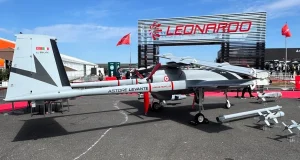
Israel Harpy: Anti-radiation loitering munition that autonomously detects, tracks, and destroys radar emitters — the human selects target class, not individual target. Exported to India, South Korea, Turkey, and formerly China. South Korea SGR-A1: Autonomous sentry weapon on the DMZ with lethal-autonomous mode reportedly deactivated due to legal uncertainty — human in the loop for lethal engagement. Turkey KARGU-2 (STM): UN Panel of Experts 2021 alleged autonomous lethal engagement in Libya. STM denied. The ambiguity illustrates exactly the accountability gap ban advocates warn about: if an autonomous weapon commits what might be a war crime, who is prosecuted?
Selected LAWS Programs
| System | Country | Type | Autonomy Mode | Legal Status |
|---|---|---|---|---|
| Harpy | Israel / IAI | Anti-radiation loitering munition | Fully autonomous (target class pre-set) | Widely considered legal; anti-radiation homing long accepted |
| SGR-A1 | South Korea / Hanwha | Fixed autonomous sentry | Lethal-autonomous mode deactivated | Human-in-loop for engagement per reports |
| KARGU-2 | Turkey / STM | Rotating-wing loitering munition | Autonomous detection + engagement available | UN Panel Libya 2021 alleged autonomous use; STM disputes |
| MQ-28 Ghost Bat | US-Australia / Boeing | Autonomous combat air vehicle | Human-supervised autonomous | DoD 3000.09 compliance required |
| Phalanx CIWS | United States / Raytheon | Ship-based defense interceptor | Automated within human-authorized parameters | Accepted “defensive exception”; decades of operation |
The IHL Challenge
Distinction: ML classifiers achieve high average-case accuracy on training distributions but degrade catastrophically in novel environments — adversarial camouflage, demographic shifts, MOUT complexity. A model cannot assess intent, only pattern. Proportionality: Weighing incommensurable values — military advantage vs. civilian harm — is a moral judgment, not an optimization problem. No algorithm makes genuine proportionality assessments; a human who acts on collateral damage estimates does. Removing the human removes the assessment. Accountability: IHL requires criminal accountability. Algorithms have no legal personality. When an autonomous system kills unlawfully, liability is distributed across programmer, commander, operator, and manufacturer — and potentially rests with none of them. The ICRC’s 2021 position: humans must retain control over the selection and attack of individual targets, not just target classes.
The Clock Problem
The CCW’s twelfth year of discussion has not produced consensus. The KARGU-2 is in production. The Harpy is in service in four major Asian militaries. The SGR-A1 sits on the DMZ with its lethal mode turned off — not because law requires it, but because the law is unclear. That restraint is not guaranteed to persist. The scenario that opened this analysis is not a prediction. It is a warning. The question is whether the international community is willing to answer it with law rather than catastrophe — and the time remaining to do so is shorter than the debate’s pace suggests.
Sources
- UN Panel of Experts on Libya, S/2021/229 (March 2021)
- US DoD Directive 3000.09 (2012, updated 2022)
- ICRC Position on Autonomous Weapon Systems (May 2021)
- Campaign to Stop Killer Robots, Country Views 2023
- Human Rights Watch / Harvard — “Losing Humanity” (2012)
- CCW GGE Meeting Records, Geneva 2014–2026