





Ukraine Destroys Russia’s New Sarma Rocket System for the First Time

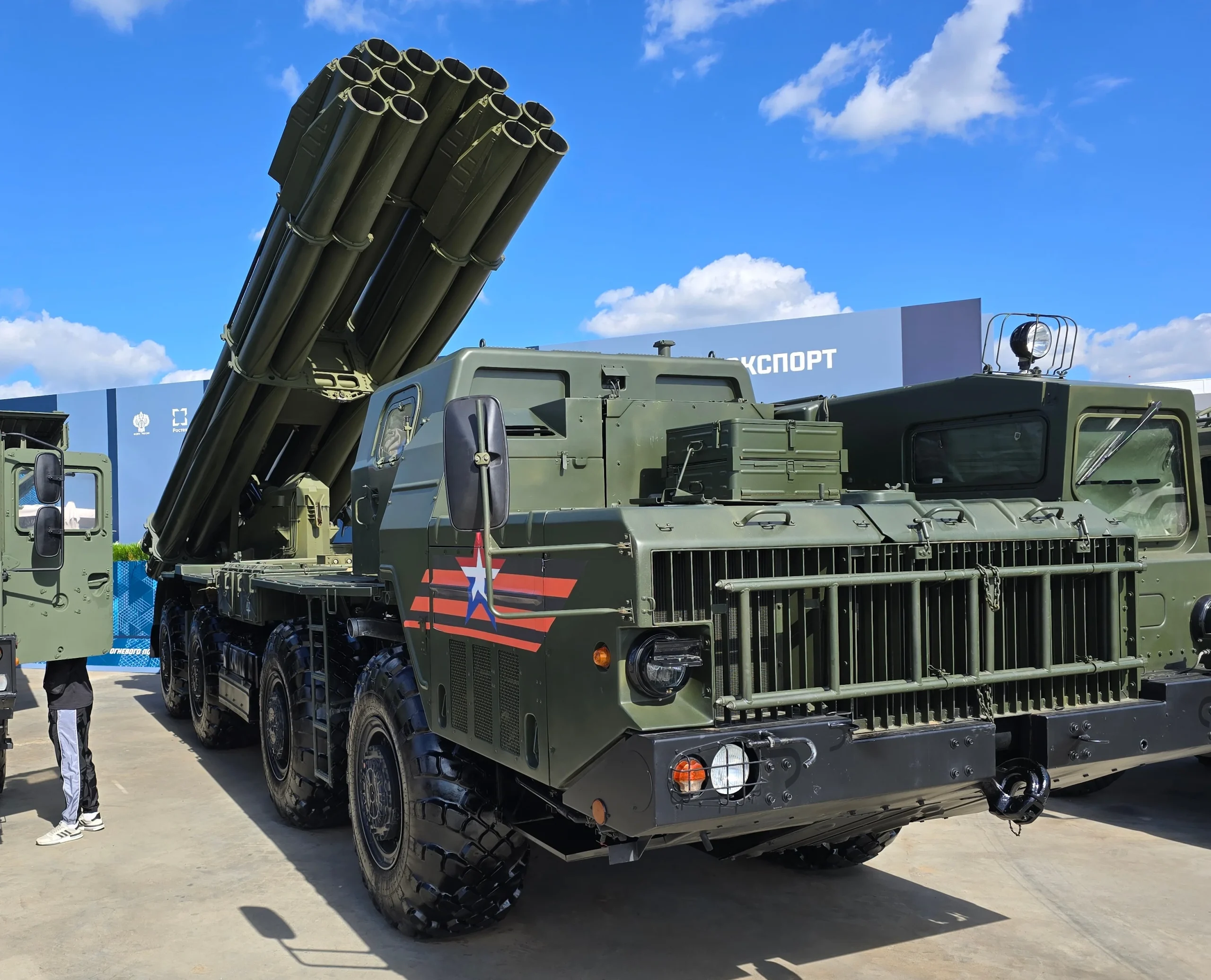
Ukraine’s 1st National Guard Corps “Azov” has struck and destroyed Russia’s new Sarma multiple launch rocket system for the first time. The strike took place on 22 July 2026 along the Dobropillia axis in Donetsk region, during a large Russian push involving the 8th and 41st Combined Arms Armies and the 90th Tank Division. The development was confirmed and analyzed by open-source defense outlet Militarnyi on 25 July 2026.
Details of the Development
Footage released by the Azov Brigade shows a fixed-wing attack drone striking a Sarma launcher directly. Militarnyi reporter Vladyslav Khomenko confirmed the targeted vehicle was Sarma, a product of Russia’s “Kama” rocket-artillery development program. The strike occurred as Russian units pressed a broad offensive along the Dobropillia line, backed by artillery and armored elements.
System and Program Context
Sarma is a 300mm-class multiple rocket launcher mounted on a KamAZ-63501 chassis, capable of firing guided munitions from six launch rails. It is designed to be roughly 10 tonnes lighter than the existing Tornado-S system. Western analysts have occasionally described it as Russia’s “HIMARS equivalent,” though its production timeline and full operational status remain unclear. The Kama program is understood to be part of a broader effort to modernize Russian rocket artillery with lighter, more mobile launch platforms.
Technical and Operational Significance
The near-simultaneous first sighting and first destruction of a new rocket system provides a notable intelligence and doctrinal data point. For Ukraine, it demonstrates that drone-based reconnaissance and precision-strike chains can detect and neutralize a newly fielded enemy platform at an early stage. For Russia, it illustrates the cost of deploying an immature system to the front before it has reached full operational maturity.
Regional and Strategic Meaning
The Dobropillia sector remains one of the most contested stretches of the front, where Russia has committed large formations including the 8th and 41st Combined Arms Armies alongside the 90th Tank Division. Fielding systems such as Sarma there suggests Moscow continues to expand its long-range precision-fire capacity, while Ukraine’s drone-intelligence approach continues to offset that build-up in real time.
Comparative Context
Russia’s rocket-artillery inventory has long relied on older platforms such as the BM-21 Grad, Uragan and Smerch, alongside the more modern, guided-munition-capable Tornado-S. Sarma being noticeably lighter than Tornado-S suggests it is designed for greater mobility and easier concealment, offering an advantage in rapid repositioning behind the front line. Yet its destruction on its apparent combat debut also illustrates how vulnerable such newly fielded platforms can be to a mature reconnaissance-strike chain when deployed early. On the Ukrainian side, fixed-wing attack drones appear to be an increasingly preferred tool against long-range artillery and rocket-launcher targets, a trend that points to a maturing strategy of neutralizing high-value targets with low-cost platforms.
Kaynakça
- Militarnyi (militarnyi.com) — analysis published 25 July 2026, reporter Vladyslav Khomenko. Strike details and system identification sourced here. Militarnyi is an independent Ukrainian open-source defense outlet.
- Azov Brigade official release — video documentation of the strike, dated to the 22 July 2026 engagement; treated as a primary source.
Görsel Bilgisi
Image URL: https://www.militarnyi.com/wp-content/uploads/2026/07/kolazh-sarma-eng.jpg
Source: Militarnyi (comparison collage built from Azov Brigade drone footage)
Alt text: “Russian Sarma multiple rocket launcher struck by a Ukrainian attack drone”
Usage note: Sourced from the outlet’s own analysis collage, not a copyrighted wire-agency image (Getty/Reuters/AP).
Yayın Durumu
Scheduled as part of the English publishing track, independent of the Turkish, Arabic, Spanish and Russian versions.