
Iran’s Fattah-1 and Fattah-2: are they really hypersonic?

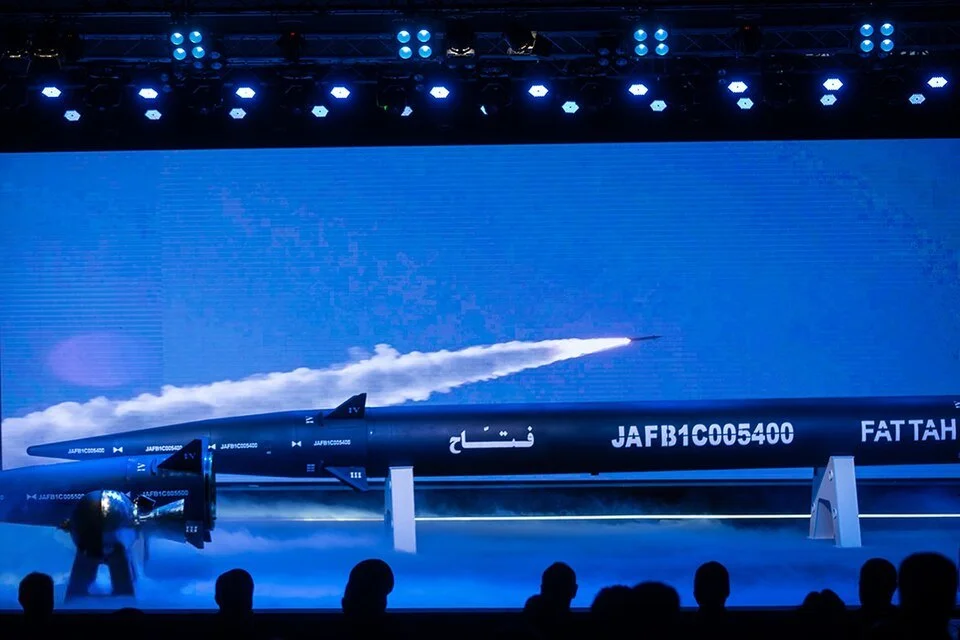
Iran presents the Fattah-1 and Fattah-2 missiles it unveiled in 2023 as hypersonic weapons. Its claims on speed, range and the ability to beat air defences have not been independently verified.
Short answer: Fattah is a missile family that Iran’s Revolutionary Guards (IRGC) describe as hypersonic. Fattah-1 was shown as a ballistic missile with a movable nozzle, and Fattah-2 as a model carrying a gliding, manoeuvring warhead. Iran states very high speeds, but true hypersonic capability has not been independently confirmed.
What hypersonic means
As summarised by Aerospace Global News, a hypersonic weapon flies at Mach 5, five times the speed of sound, or faster and can manoeuvre in flight. A ballistic missile follows a predictable arc, which lets radar and interceptors calculate its path.
Glide vehicles spend much of their flight inside the atmosphere and change course, so their path is far harder to predict. The same outlet notes that terminal-phase systems such as THAAD and Patriot PAC-3 have only a narrow window to intercept them. Speed alone is therefore not the whole question.
Iran’s claims for Fattah-1
Fattah-1 was unveiled on 6 June 2023 with President Ebrahim Raisi attending. IRGC Aerospace Force commander Amir Ali Hajizadeh gave a range of 1,400 kilometres and a speed of Mach 13, and said the missile had a movable nozzle able to turn in all directions. He also claimed no missile defence could counter it.
In October 2024 Iran’s Mehr agency described Fattah-1 as a two-stage, solid-fuel medium-range ballistic missile, gave a terminal speed of Mach 13 to 15 and claimed it was immune to all existing missile defences. All of this is Iran’s own account.
What Fattah-2 adds
Fattah-2 was shown on 19 November 2023 during a visit by Supreme Leader Ali Khamenei to an IRGC exhibition. Iran claimed a speed of Mach 5 to 20, flight at much lower altitude, several changes of course and a gliding, manoeuvring warhead. According to Euronews Persian, Iranian media did not say how its range differed from that of the first model.
| Item | Fattah-1 | Fattah-2 |
|---|---|---|
| Unveiled | 6 June 2023 | 19 November 2023 |
| Claimed speed | Mach 13 (terminal 13 to 15, per Mehr) | Mach 5 to 20 |
| Claimed range | 1,400 km | No separate figure at the unveiling |
| Highlighted feature | Movable nozzle | Gliding, manoeuvring warhead |
None of these values has been independently verified.
What outside analysts say
Janes reported that the Fattah-2 booster resembles the one used on Fattah and that the re-entry vehicle appears inspired by the US X-51 test craft. It does not, however, appear to have a scramjet air intake like the X-51’s. A cutaway model showed two tanks resembling the fuel and oxidiser tanks of liquid-fuelled ballistic missiles.
Janes also relayed a Tasnim account that the vehicle uses a hydrazine engine and can steer only inside the atmosphere with aerodynamic surfaces. That is Iranian-sourced and not separately confirmed.
In a November 2023 commentary in the Jerusalem Post, Seth J. Frantzman argued that the missiles were unproven and unlikely to be ready for combat, while saying Iran’s missile programme still had to be taken seriously.
Has it been used in war
Reports of use come mainly from Iran.
- October 2024: Mehr listed Fattah among the missiles used against Israel in Operation True Promise II.
- 18 June 2025: the IRGC said it had used Fattah missiles and penetrated Israeli air defences (Press TV). No Israeli confirmation was found for this guide.
- 5 March 2026: the IRGC claimed that some Fattah-2 missiles had got past the US-made THAAD system deployed in Israel.
Reporting the March 2026 claim, Aerospace Global News said it remained unclear whether the missiles used truly had hypersonic capability. Defence analysts it cited cautioned that individual impacts do not by themselves show that a defence system failed.
Why the distinction matters
A missile can be very fast in its final phase, and even manoeuvre to some degree, without being the same thing as a vehicle that glides through the atmosphere for a long distance. For the defender, the key question is how predictable the path is. No public test data independently establishes the flight profile of either Fattah model, so Iran’s speed, range and unstoppability statements should be read as claims rather than measured performance.
Frequently asked questions
What is the range of Fattah-1?
Iran says 1,400 kilometres. The figure has not been independently verified.
How do Fattah-1 and Fattah-2 differ?
In Iran’s account, Fattah-2 carries a different warhead that glides and manoeuvres, flies lower and can change course.
Is the Fattah missile really hypersonic?
Iran says so. True hypersonic capability has not been independently verified.
Is the Fattah missile unstoppable?
That is Iran’s claim. Open sources offer no independent data proving it.
Sources
- Entekhab (from Tasnim), unveiling of Fattah, in Persian (6 June 2023)
- Euronews Persian, unveiling of Fattah-2 (19 November 2023)
- Janes, Fattah-2 and its possible hypersonic re-entry vehicle
- Jerusalem Post, commentary by Seth J. Frantzman (20 November 2023)
- Mehr, missiles used in the attack on Israel (2 October 2024)
- Press TV, IRGC statement on Fattah (18 June 2025)
- Aerospace Global News, US missile defence and Iran (9 March 2026)
Related articles
Last checked: 28 November 2026. Cover image: Mohammad Sadegh Nikgostar / CC BY 4.0 / Wikimedia Commons.