





How the MQ-9 Reaper Hunts: A Guide to Armed Drone Warfare

What Is the MQ-9 Reaper?
The MQ-9 Reaper (formerly Predator B) is a multi-role armed unmanned aerial vehicle (UAV) developed by General Atomics Aeronautical Systems. It falls into the MALE (Medium Altitude, Long Endurance) category — designed for persistent surveillance and precision strike at ranges and durations impossible for crewed aircraft.
Key specifications:
- Wingspan: 20 meters
- Maximum takeoff weight: 4,763 kg
- Maximum speed: 480 km/h (cruise ~280 km/h)
- Service ceiling: 15,240 m (50,000 ft)
- Endurance: 27–30 hours (with extended fuel tanks)
- Engine: Honeywell TPE331-10GD turboprop, 900 shp
- Operator: Remote crew — one pilot and one sensor operator at a ground control station
Weapons:
- 6 hardpoints; maximum payload 1,746 kg
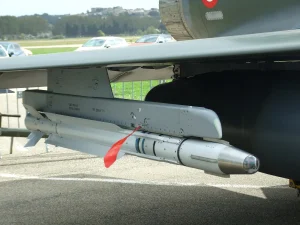
- Up to 14 AGM-114 Hellfire missiles
- AIM-9 Sidewinder (air-to-air)
- GBU-12 Paveway II laser-guided bomb
- GBU-38 JDAM (GPS-guided)
- AIM-92 Stinger
Why It Was Built
The MQ-1 Predator was developed in the 1990s purely for reconnaissance. But in the Balkans and then Afghanistan, intelligence operators faced a repeated frustration: they could find and track a target with the drone, but destroying it required coordinating a separate strike package — by which time the target had often moved or the window had closed.
Post-9/11 operations made the requirement explicit: integrate the find-and-strike capability in a single platform. The MQ-9 was designed as a larger, far more capable successor — with nine times the engine power and dramatically expanded weapons capacity.
How It Works
Ground Control Station (GCS)
The MQ-9 is not flown from inside the aircraft. A pilot and a sensor operator sit at a ground control station — which may be located thousands of kilometers away — and fly the aircraft through screens and joysticks.
The control link runs over:
- Satellite communications (SATCOM): Real-time command, control, and video link over Ku-band satellite; used for global operations
- Line of Sight (LOS): Local frequency link for short-range operations (takeoff, landing, nearby missions)
Commands travel via satellite, introducing approximately 1–2 seconds of latency. This is manageable for most mission profiles but limits use in highly time-critical maneuvering.
Sensor Suite: MTS-B Ball
The MQ-9’s primary sensor is the MTS-B (Multi-Spectral Targeting System), a gyro-stabilized ball turret mounted under the nose:
- EO (Electro-Optical): High-resolution daylight camera
- IR (Infrared / FLIR): Thermal imaging for night and low-visibility conditions
- Laser designator: Locks on target for laser-guided munitions
- Laser rangefinder: Calculates precise GPS coordinates for targeting
With the MTS-B, the crew can track individual vehicles or persons at standoff distance, in darkness, through cloud cover. Zoomed in, it can distinguish facial features at altitude.
Autonomous Flight
The MQ-9 has an autopilot system. For takeoff and landing, a local crew at a forward airfield handles the aircraft within line-of-sight range; the rest of the mission — often 20+ hours over a target area — is managed by the remote crew. The aircraft can follow pre-programmed waypoints autonomously.
Core avionics:
- INS/GPS navigation: Autonomous positioning with inertial backup
- Autopilot: Waypoint-based route following
- AES-256 encrypted data link: Protection against jamming and interception
The Fire Cycle: “Kill Chain”
For the MQ-9 to strike a target, a multi-step approval chain is required:
1. Analyst/crew identifies and positively identifies the target
2. A legal officer (Judge Advocate General) reviews the legality of the strike
3. The command chain authorizes the engagement
4. The pilot locks on with Hellfire and fires
This chain can take hours when a deliberate targeting process is followed, or compress to minutes in a time-sensitive targeting scenario. Once fired, a Hellfire reaches a typical target in 10–15 seconds.
AGM-114 Hellfire: Primary Weapon
The Hellfire missile family provides the MQ-9’s precision strike capability across a wide range of target types:
| Hellfire Variant | Guidance | Target |
|---|---|---|
| AGM-114K (Hellfire II) | Semi-active laser + millimeter-wave radar | Armored vehicles |
| AGM-114N (Metal Augmented Charge) | Laser | Buildings, soft targets (thermobaric) |
| AGM-114R (Romeo) | Laser + GPS | Multi-purpose; most recent standard variant |
| AGM-114R9X (Ninja/Flying Ginsu) | Laser | No explosive; kinetic blades |
The AGM-114R9X is the most notable development: it carries no explosive warhead. Six blades deploy just before impact, shredding the target through kinetic energy alone. Designed to eliminate an individual inside a vehicle without causing blast damage to those nearby. Confirmed in use in Syria and Yemen since 2019.
Key Technologies
| Technology | Function |
|---|---|
| Turboprop engine | Fuel efficiency; 27–30 hour endurance |
| SATCOM data link | Global remote control over Ku-band satellite |
| MTS-B multispectral targeting | EO + IR + laser; day/night surveillance and targeting |
| AGM-114 Hellfire | Laser and GPS guided; ~8 km range |
| GBU-38 JDAM | 227 kg GPS-guided general purpose bomb |
| INS/GPS autonomous navigation | Inertial backup when GPS is denied |
| AES-256 encrypted link | Anti-jamming and interception protection |
Advantages
- Extreme persistence: 27–30 hours on station; operator fatigue mitigated by shift crews
- Low cost relative to manned aircraft: A fraction of the cost of a fighter; no pilot risk in high-threat areas
- Persistent ISR: Can maintain continuous surveillance of a target area for days
- No aircrew casualties: If lost, no pilot to rescue or grieve
- Precision strike options: From thermobaric to blade-only R9X, matched to the target
- Broad weapons payload: Hellfire, JDAM, Sidewinder combinations
Limitations
- Slow and un-maneuverable: At 480 km/h, it is vulnerable to virtually any air defense system
- Low survivability: Even Cold War-era MANPADS can engage it; no stealth, no ECM worth noting
- Satellite link dependency: Link disruption limits strike authority; autonomous return mode activates but no weapons engagement
- Permissive environment only: Effective only where adversary air defenses are absent or suppressed — useless against peer adversaries
- Legal and sovereignty controversy: Operations in non-consenting states raise unresolved questions under international law
- Operator psychological effects: Remote warfare PTSD documented among MQ-9 crews; ethical debate ongoing
Combat History
Afghanistan and Pakistan (2004–2021)
The most extensive deployment. CIA and USAF strikes in Pakistan’s tribal areas targeted senior militant leadership over 17 years. Estimates of total drone-related deaths in Pakistan range from 2,200 to 3,300, with civilian death estimates varying widely between reporting organizations (300–900).
General Qassem Soleimani (January 2020)
The commander of Iran’s Quds Force was killed near Baghdad International Airport by Hellfire missiles fired from an MQ-9 Reaper. The strike was authorized by the U.S. President and the geopolitical consequences are ongoing.
Somalia and Yemen (2011–present)
Targeted strikes against Al-Shabaab and AQAP leadership, conducted largely under presidential counterterrorism authorities rather than battlefield law of war frameworks.
Syria: Anti-ISIS Campaign (2014–present)
MQ-9s played a central role in the Coalition’s campaign, striking command figures, vehicle convoys, and fixed infrastructure.
Who Operates MQ-9
| Country | Notes |
|---|---|
| USA | 300+ active; CIA and USAF |
| UK | RAF Reaper; Afghanistan, Syria |
| Italy | Mediterranean surveillance |
| France | Sahel region (Niger, Mali) |
| Netherlands | NATO contributions |
| Belgium | Delivery in progress |
| UAE | Middle East operations |
| Australia | Indo-Pacific surveillance |
Comparable Systems
| System | Country | Notes |
|---|---|---|
| MQ-1 Predator | USA | MQ-9’s predecessor; largely retired |
| RQ-4 Global Hawk | USA | ISR only; no weapons |
| Bayraktar TB2 | Turkey | Lower cost; transformative in Nagorno-Karabakh and Ukraine |
| Wing Loong II | China | MQ-9 counterpart; export variant |
| CH-4/CH-5 | China | Multi-role; Middle East exports |
| Hermes 900 | Israel | MALE; export version |
Frequently Asked Questions
Is the MQ-9 fully autonomous?
No. Current MQ-9 operations require a human to authorize weapons release at every engagement. Autonomous flight, route following, and sensor tracking are available, but firing decisions require command chain approval. Fully autonomous lethal weapons systems (LAWS) are a separate category.
Why can’t the MQ-9 operate against peer adversaries?
At 480 km/h with no significant countermeasures, it is a slow, large, heat-generating target. Even legacy MANPADS like the SA-7 or SA-14 represent a credible threat. Against Russian or Chinese air defense networks, it would not survive.
What is the R9X “Ninja” missile?
The AGM-114R9X carries no explosive warhead. Six blades deploy just before impact, shredding the target through kinetic energy. Designed to eliminate an individual inside a vehicle without detonating and harming nearby people. First publicly confirmed in 2019; used in Syria and Yemen against high-value individuals.
What are the international law issues?
Strikes in non-consenting states raise questions about sovereignty under the UN Charter, lawfulness under international humanitarian law if outside recognized armed conflict zones, and whether targeted killings constitute extrajudicial execution. These are actively debated in international legal scholarship and remain politically unresolved.
Sources
- General Atomics – MQ-9B SkyGuardian Product Sheet (ga-asi.com)
- U.S. Air Force – MQ-9 Reaper Fact Sheet
- New America Foundation – Drone Wars: The Constitutional and Counterterrorism Implications, 2013
- Amnesty International – Will I Be Next? US Drone Strikes in Pakistan, 2013
- Human Rights Watch – Yemen Drone Strike Reports, 2020–2023
- CSIS – “Lethal Drones in the Middle East,” 2021
- IISS, The Military Balance 2024