What is Iran’s Bavar-373 air defence system?

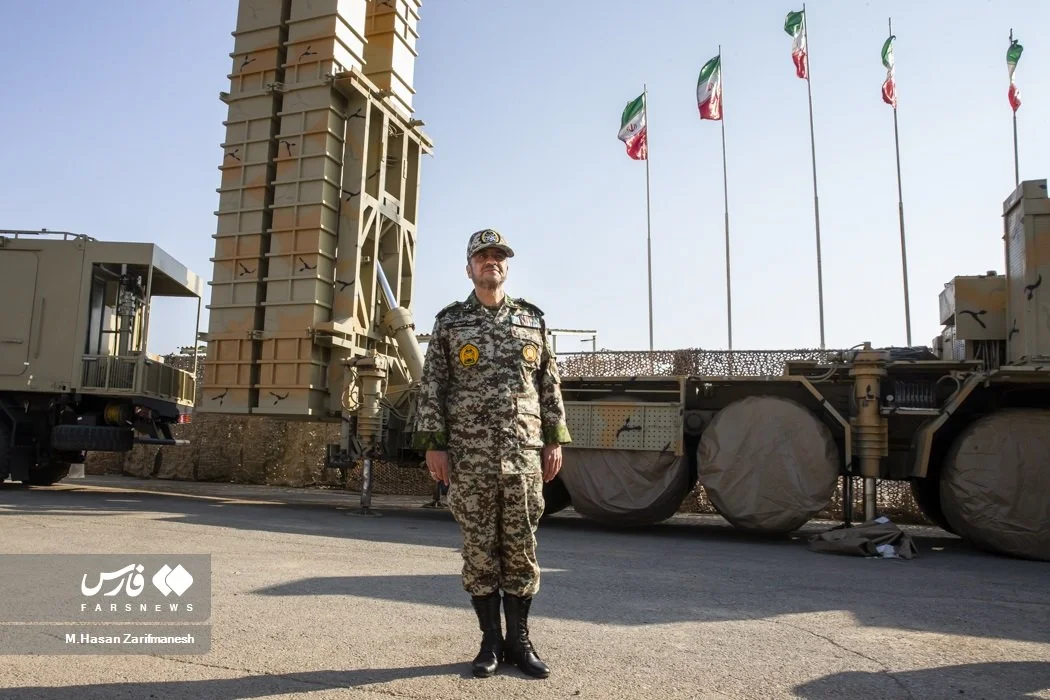
The 300-kilometre range announced for Bavar-373, unveiled in 2019, rests on Iran’s own statements. Independent data on the system’s combat performance are limited.
Short answer: Bavar-373 is a long-range, vehicle-mounted surface-to-air missile system that Iran developed domestically. It was formally unveiled on 22 August 2019 (31 Mordad 1398 in the Iranian calendar). Iran says the Sayyad-4B missile has extended its engagement range to 300 kilometres. That figure has not been independently verified.
When was it developed
According to the defence publication Army Recognition, the first prototype was completed in November 2011. The system was presented on 22 August 2019 at a ceremony attended by then President Hassan Rouhani. An upgraded version was announced in 2022. In February 2025, Iran’s semi-official media reported that a new variant called Bavar-373-II had been put on display.
What Iran says it can do
The numbers most often repeated come from Iranian military officials. They are best read as declared values: what the manufacturer country says the system can do, not what an outside body has measured.
| Feature | Declared value |
|---|---|
| Engagement range | Raised from 200 km to 300 km (with Sayyad-4B) |
| Detection range | Over 320 km |
| Tracking range | Over 260 km |
| Targets tracked at once | 60 |
| Targets engaged at once | 6 |
Source: Iranian military officials as reported by Tehran Times, 2 March 2025. Not independently verified.
The same statement said that in the new version the launchers can operate independently and that each launch vehicle carries its own radar. Some defence publications give a range of up to 400 kilometres for Sayyad-4B. The gap between sources shows that the figures have not yet settled.
It also helps to keep the three distances in the table apart. Detecting an object, tracking it and engaging it with a missile are separate steps, and the declared value for each is different.
Is it the same as the S-300
No. The S-300 is a family of Russian-made systems. Deliveries to Iran were completed in October 2016, according to the Washington-based Center for Strategic and International Studies (CSIS). Bavar-373 is Iran’s own programme. Both were designed for long-range area defence, and in Iran they have been referred to as parts of the same network.
Range comparisons call for care. CSIS gives a band of 25 to 150 kilometres for the S-300P family; this is an outside institution’s data relating to particular missile types within that family. The 300 kilometres quoted for Bavar-373 is a claim by the producing country.
Putting the two numbers side by side cannot show which system is better, because they refer to different versions, missiles and target types. A range quoted against a large aircraft flying at high altitude does not apply to a low-flying target or one with a small radar signature.
How did it perform in war
A study dated 30 June 2026 by the Combined Strategic Analysis Group (CSAG), part of US Central Command, says that Israeli aircraft met very little effective resistance over Iran in the June 2025 war. It says they destroyed about 120 air defence systems, including S-300 and Bavar-373 batteries.
The study does not blame a single platform. It points instead to a network made up of Russian, Chinese and domestic systems that was poorly integrated and weak at discriminating between targets.
This count is the assessment of an analysis group close to one of the warring sides. The air defence arm of Iran’s army said it replaced damaged systems with domestic ones held in stock within a few weeks. According to the same CSAG study, the network recovered in numbers but did not return to its previous level in quality. Air defence systems again suffered heavy blows in the campaign that began in February 2026.
Iran had earlier asserted that during exercises the system engaged targets representing stealth aircraft at 300 kilometres. An exercise result is not the same thing as data from real combat.
Can Bavar-373 detect an F-35
Open sources contain no verified case of Bavar-373 detecting and shooting down an F-35. Against low-observable aircraft, the outcome depends on the radar’s frequency band, the angle from which the aircraft approaches, the electronic warfare environment and whether the command network is intact. A detection range figure on its own does not answer the question.
Türkiye’s long-range answer: SİPER
Türkiye is developing its own system for the same long-range layer, called SİPER. The Presidency of Defence Industries (SSB), the government body that manages Turkish defence procurement programmes, says the project is run with the partnership of ASELSAN, ROKETSAN and TÜBİTAK SAGE. The stated goal is an air defence system effective at long range and high altitude against combat aircraft, cruise missiles, drones and helicopters.
Anadolu Agency has reported that SİPER Product-1 has entered the inventory of the Turkish Armed Forces, while work on Product-2 continues.
SİPER is part of a layered architecture called Steel Dome (Çelik Kubbe), alongside systems such as HİSAR and KORKUT. The weakness that analysts identified in the Iranian case is relevant to any such architecture: what proves decisive is less the range of one battery than the ability of sensors and weapons to share the same picture.
Frequently asked questions
What does Bavar mean?
Bavar means “belief” in Persian.
What is the range of Bavar-373?
Iran has announced 300 kilometres with the Sayyad-4B missile. The value has not been independently verified.
Is Bavar-373 a copy of the S-300?
Iran describes the system as a domestic development. The two have similar missions, but open sources offer no technical data that would prove Bavar-373 is a direct copy.
Can SİPER and Bavar-373 be compared?
Both belong to the long-range layer. With no open data from tests under the same criteria, however, a sound performance comparison is not possible.
Sources
- Tehran Times, Iranian officials' statements on Bavar-373-II (2 March 2025)
- Army Recognition, Bavar-373 product page
- CSIS Missile Threat, S-300 (last updated July 2021)
- CSAG, Constrained Shield: Iran's Artesh (30 June 2026)
- SSB, SİPER project page (in Turkish)
- Anadolu Agency, SİPER Product-1 enters the inventory (in Turkish)
Related articles
- Iran's army and the Revolutionary Guards: what is the difference?
- How big is Iran's missile and drone arsenal?
- Gulf demand for Turkish air defence after Iran's attacks
Last checked: 28 November 2026. Cover image: M. Hasan Zarifmanesh, Fars / CC BY 4.0 / Wikimedia Commons.