Ecuador’s Military Strength: How Many Tanks, Aircraft and Ships in the Inventory? (2026)

Ecuador’s military inventory belongs to one of the Latin American armed forces that has made the sharpest shift from conventional defence to internal security. The country ranks 72nd among 145 militaries; its air force no longer has any fighter aircraft, its tank fleet consists of light AMX-13s, and almost all of its missile power sits on the decks of six corvettes and two frigates. Yet over the past two years purchases of helicopters, armoured vehicles and radar have reached their highest level in a decade — and Turkey features in that picture as an actual supplier. This article examines Ecuador’s land, air, missile and naval inventory item by item, using open sources.
At a Glance
- Active personnel: ≈ 41,250 active, 118,000 reserve and 1,500 paramilitary (Global Firepower 2026)
- Tanks: Global Firepower lists 202; the core is roughly 108 AMX-13 light tanks upgraded with a 105 mm gun. There is no heavy main battle tank in the inventory
- Military aircraft: ≈ 99; zero fighters. The last Atlas Cheetah Cs were retired on 28 July 2024, leaving 17 A-29 Super Tucanos as the combat backbone
- Missile power: No ballistic or cruise missiles; the real missile power is at sea, with six Esmeraldas-class corvettes carrying Exocet anti-ship and Aspide air-defence missiles
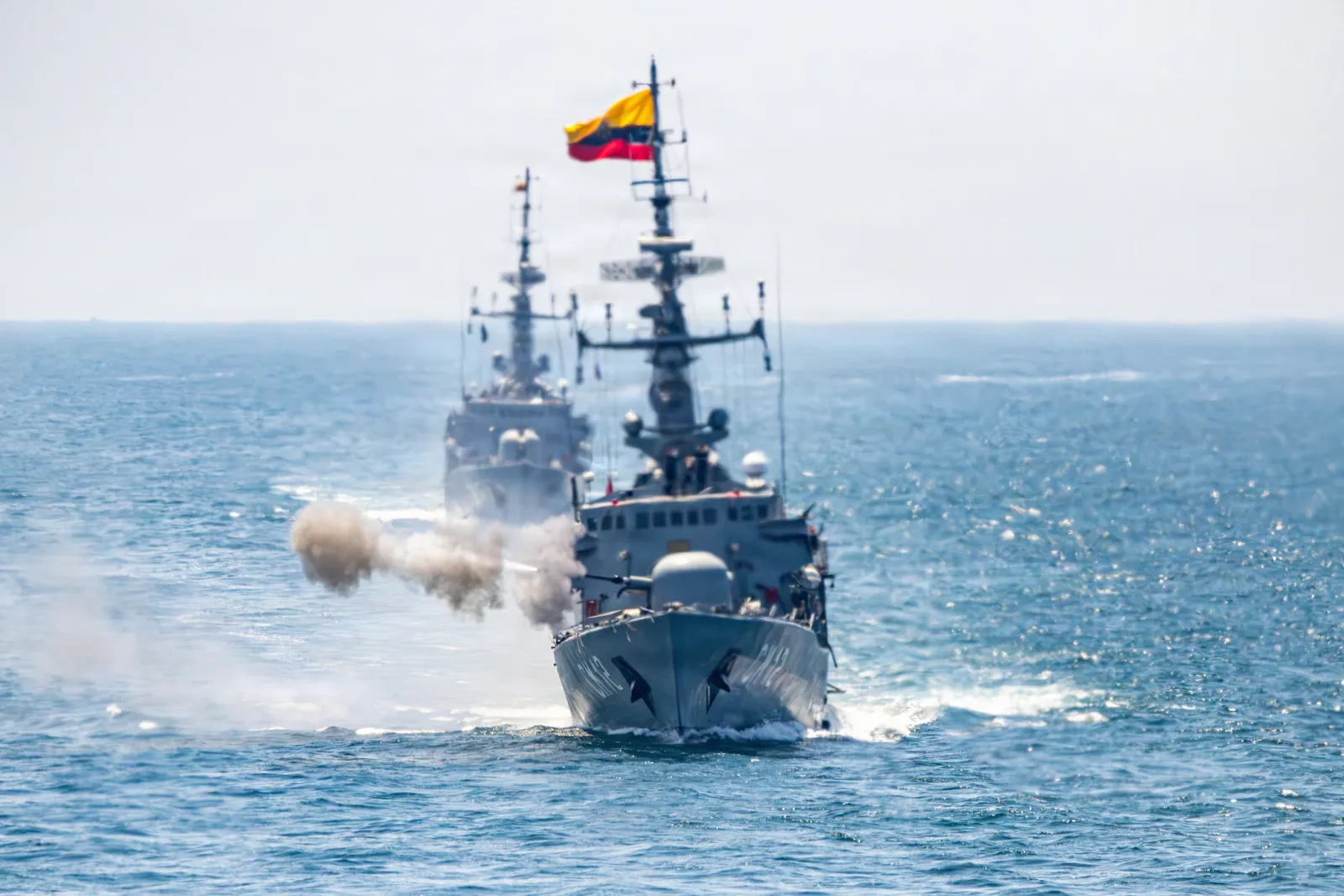
- Naval power: 30 platforms: 2 Type 209 submarines, 2 frigates, 6 corvettes, 3 fast attack craft and offshore patrol vessels, covering a large exclusive economic zone that includes the Galápagos
- GFP ranking and budget: 72nd of 145 militaries with a PwrIndx of 1.4479. Global Firepower gives a defence budget of $2.96 billion; the figure varies between sources depending on how internal security spending is counted
Note: The inventory figures below are approximate values drawn from open sources such as Global Firepower, the IISS Military Balance and SIPRI.
About the Ecuador Armed Forces
The Ecuadorian Armed Forces (Fuerzas Armadas del Ecuador) comprise three services under the Joint Command: the Land Force (Fuerza Terrestre), the Navy (Armada del Ecuador) and the Air Force (Fuerza Aérea Ecuatoriana). In Global Firepower’s 2026 data the country ranks 72nd of 145 militaries with a PwrIndx of 1.4479. Active personnel are given as 41,250, reserves as 118,000 and paramilitary forces as 1,500. Global Firepower puts the defence budget at $2.96 billion; the figure varies markedly between sources depending on how internal security spending is counted.
The turning point that defines the military’s current mission came in January 2024. After gunmen stormed a television studio in Guayaquil during a live broadcast and riots broke out in the prisons, President Daniel Noboa declared on 9 January 2024, by Executive Decree 111, that the country was in a state of internal armed conflict, and designated 22 criminal organisations — among them Los Choneros and Los Lobos — as terrorist groups. The decision placed the prisons under military control and brought the armed forces onto the streets alongside the police.
Noboa was re-elected in the run-off of 13 April 2025. The government’s proposed constitutional change to allow foreign military bases, however, was rejected in the referendum of 16 November 2025. The defence ministry is led by Gian Carlo Loffredo Rendón and the Joint Command by General Henry Delgado Salvador. In March 2026 the government launched a broad offensive against the criminal economy, deploying 75,000 soldiers and police officers to four provinces under a nightly curfew.
Military cooperation with the United States deepened rapidly over the same period. A status of forces agreement signed in 2023 entered into force in 2024, and a temporary US military presence in Manta was announced in December 2025. In March 2026 the United States struck an alleged training camp near the Colombian border — its first direct military action inside the country. Ecuadorian officials said US special forces were conducting joint operations with local troops, and a ministerial arrangement issued in August 2026 granted US personnel entry facilities and administrative immunity. In a report published on 21 July 2026, Human Rights Watch drew attention to allegations of abuses linked to that cooperation.
On the procurement side, 2025 was the year of the highest arms imports in a decade. The first two of five H225M Super Pumas, a second-hand purchase from Romania worth about $90 million, were delivered in June 2025, and the fleet was completed in June 2026. Thirty-five vehicles from a 2022 contract for 124 armoured vehicles arrived in July 2025; a modernised TPS-43 radar was received via US Southern Command in September 2025, and an Island-class patrol boat transferred from the US Coast Guard entered service in November 2025. The defence ministry has also bought seven Leonardo AW139M helicopters for $209.8 million, with deliveries due to begin in December 2027.
In the air force the transformation is complete: the Atlas Cheetah Cs acquired from South Africa were retired on 28 July 2024, leaving Ecuador without fighter aircraft. In January 2024 the government announced a plan to hand over old Russian-origin military equipment in exchange for roughly $200 million of new US equipment, prompting Russia to impose restrictions on some Ecuadorian banana exporters; there is no open-source record of the swap having been completed. The role of the Russian-built Mi-17s is now being taken over by the H225Ms.
Land Forces Inventory
| System type | Est. quantity |
|---|---|
| Light tanks (AMX-13/105) | ≈ 108; French-built and upgraded in 1988-1990 with a 105 mm gun and the SOPTAC 18 fire-control system. Global Firepower’s tank count of 202 includes this class |
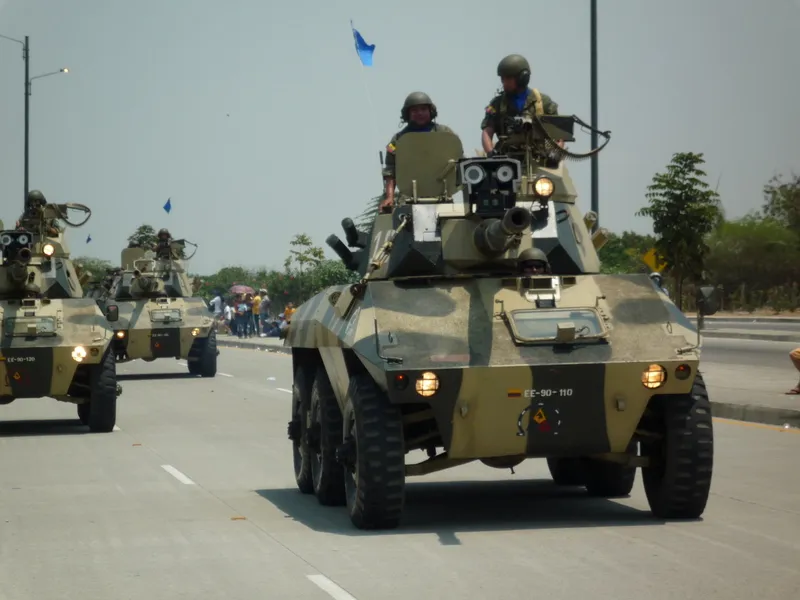
| Reconnaissance vehicles (EE-9 Cascavel and EE-3 Jararaca) | ≈ 32 Cascavels (90 mm gun) and ≈ 10 Jararacas, both Brazilian-built wheeled vehicles |
| Armoured personnel carriers (AMX-VCI, M113, EE-11 Urutu, UR-416) | ≈ 82 AMX-VCIs, ≈ 20 M113s, ≈ 17 Urutus and ≈ 32 UR-416s, mostly of the 1970s-1980s generation |
| Tactical armoured vehicles (Otokar Cobra II) | 20; from Turkey, with delivery announced by the Ministry of Defence on 7 August 2023. Used by the Durán Joint Task Group in counter-narcotics and counter-terrorism operations |
| Tactical armoured vehicles (Otokar Ural) | 15; the second Turkish-built vehicle class listed in open-source inventory compilations |
| Armoured vehicles (Mbombe 6 and David) | 35 vehicles delivered in July 2025 under a 2022 contract for 124 vehicles worth about $65 million: 2 Mbombe 6s (South Africa) and 33 David 4x4s (Israel) |
| Light tactical vehicles | ≈ 820 Humvees (some fitted with Spike, MAPATS and HJ-8 anti-tank missiles), 280 AIL Storms and 130 Agrale Marruás |
| Total armoured vehicles | ≈ 5,322 in Global Firepower’s broadly defined 2026 count, which also covers tactical and logistic vehicles |
| Towed artillery | 106: 24 Model 56s, 36 M101s and 24 M2A2s (105 mm), plus 12 M114s and 10 M198s (155 mm) |
| Self-propelled artillery (Mk F3) | 5; French-built 155 mm |
| Rocket artillery (MLRS) | 24: 18 BM-21 Grads and 6 RM-70s, both 122 mm |
| Anti-tank missiles | 244 Spikes (Israel, delivered from 2009) plus MAPATS, MILAN and HJ-8, some vehicle-mounted |
| Mortars | ≈ 357 M29 81 mm tubes, the infantry’s main indirect-fire weapon |
Air Force Inventory
| Platform | Est. quantity |
|---|---|
| Total military aircraft | ≈ 99 (Global Firepower); fighters 0, attack helicopters 0, transports 20, trainers 34, helicopters 43 |
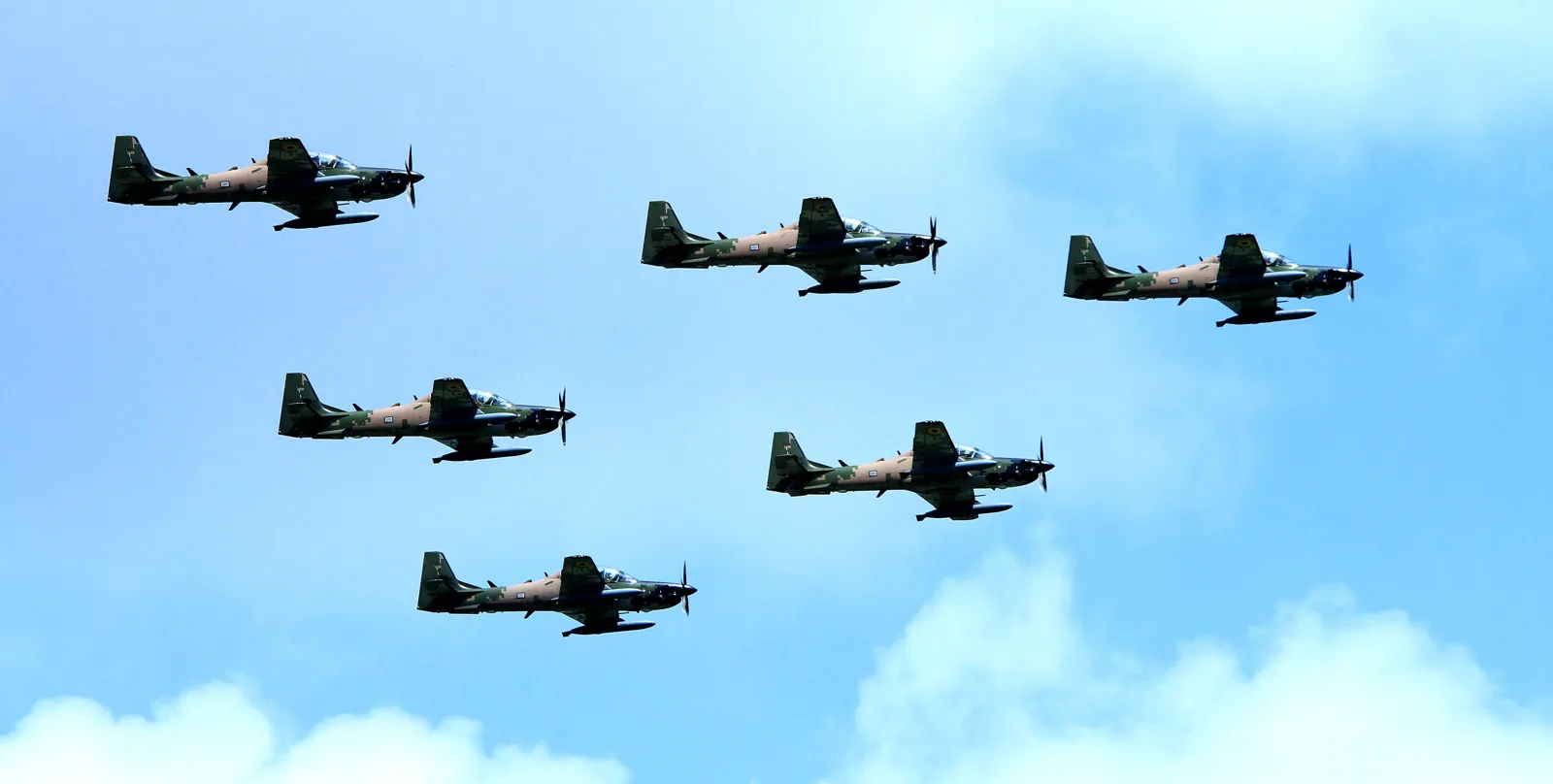
| Light attack aircraft (A-29 Super Tucano) | 17; Brazilian-built and flown by the 2311 ‘Dragones’ squadron at Manta. Since the Cheetah Cs were retired on 28 July 2024, it has been the country’s only fixed-wing combat aircraft |
| Transport aircraft | 3 C-130E/H Hercules, 3 CASA C-295s and 3 DHC-6 Twin Otters; in army aviation 2 C-212s, 2 CN-235s and PZL M28 Skytrucks (a new M28 was received in June 2026) |
| Trainers | 8 Grob G 120TPs and 19 Diamond DA20s (one DA20 was lost in an accident in November 2024) |
| Heavy transport helicopters (H225M Super Puma) | 5; a second-hand purchase worth about $90 million, with the first two arriving in June 2025 and the fleet completed in June 2026. Their role is to take over from the Russian-built Mi-17s, which have faced maintenance problems |
| Army aviation helicopters | 8 AS532 Cougars, SA330/AS332 Pumas, ≈ 10 Mi-17s, ≈ 18 AS550/AS555 Fennecs and AS350s; the last HOT-armed Gazelles were retired on 20 January 2025 |
| Air force helicopters | 4 AW119 Koalas, 6 EC145s and 4 Bell 206s; the HAL Dhruv fleet bought from India was withdrawn after a series of crashes |
| On order: AW139M | 7; bought from Italy’s Leonardo for $209.8 million under a government-to-government contract. Deliveries run from December 2027 to May 2028; one is in presidential VIP configuration |
| Naval aviation and UAVs | 2 CN-235 Persuader and 3 King Air CATPASS maritime patrol aircraft; 2 IAI Heron Is and 4 Searcher III reconnaissance UAVs. There is no armed UAV in the inventory |
| VIP and special missions | Boeing 737, Boeing 727, Gulfstream II and Super King Air 350 |
Missile and Air-Defence Systems
| System | Type / Note |
|---|---|
| Ballistic and cruise missiles | None |
| Anti-ship missiles (MM40 Exocet Block II) | Carried by the Condell-class frigates and Esmeraldas-class corvettes; the country’s longest-range strike weapon |
| Anti-ship missiles (MM38 Exocet and Gabriel Mk 2) | On the TNC-45 Quito-class fast attack craft |
| Ship-based air-defence missiles | Albatros/Aspide on the Esmeraldas-class corvettes; Simbad/Mistral on the Condell class |
| Ground-based air-defence missiles (9K33 Osa) | ≈ 10; a Soviet-generation short-range system whose operational status is unclear in open sources |
| Man-portable air-defence missiles | Igla, Strela-2, Mistral, HN-5 and Blowpipe, some mounted on Humvees and trucks |
| Anti-aircraft guns | ≈ 128 ZPU-1/2s, 34 ZU-23-2s, 44 M163 and 10 M167 Vulcans, 30 Bofors L/70 40 mm guns and 28 20 mm guns |
| Airspace radar | A modernised TPS-43 3D search radar was received via US Southern Command in September 2025; earlier radars bought from China ended in contract termination after performance problems |
Naval Power
| Class / Type | Est. quantity |
|---|---|
| Total platforms | 30 (Global Firepower): 2 submarines, 2 frigates, 6 corvettes, 5 patrol vessels |
| Submarines (Type 209/1300) | 2: BAE Shyri (S101) and BAE Huancavilca (S102); Huancavilca was modernised at Chile’s ASMAR yard in 2011-2014 |
| Frigates (Condell / Leander) | 2: Presidente Eloy Alfaro (FM-01) and Morán Valverde (FM-02), acquired from Chile in 2008 and armed with MM40 Exocet and Phalanx |
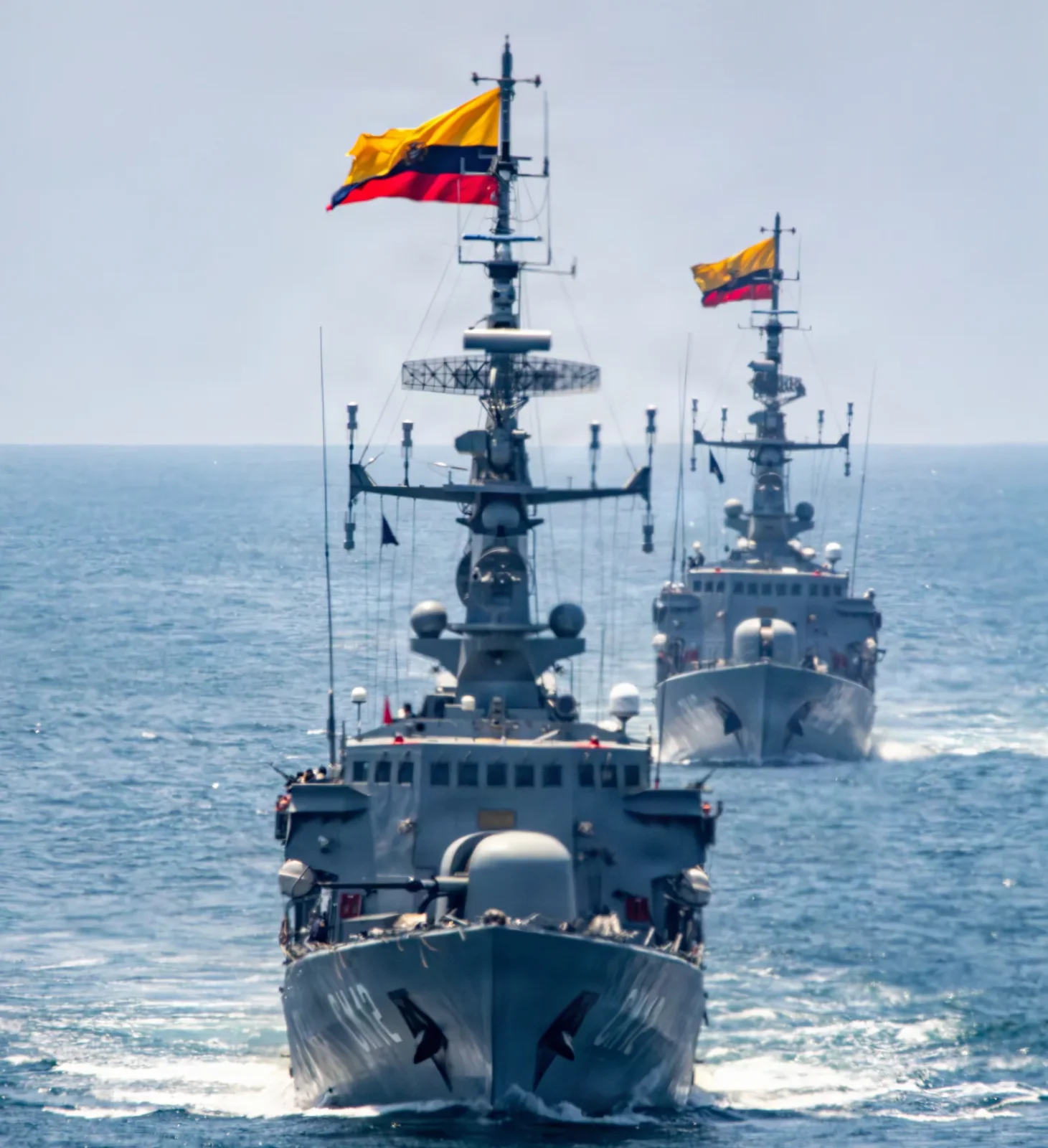
| Corvettes (Esmeraldas class) | 6: CM-11 to CM-16; Italian-built with a 76 mm gun, Exocet and Aspide. Manabí, Los Ríos and Loja returned to the fleet after modernisation in 2018-2019 |
| Fast attack craft (TNC-45 Quito class) | 3: Quito, Guayaquil and Cuenca; German-built and modernised |
| Offshore patrol vessels | 2 Damen Stan 5009s (Isla San Cristóbal and Isla Isabela), plus the Island-class Isla Santa Rosa transferred from the US Coast Guard in November 2025 |
| Coast Guard | Some 30 major and 40 smaller patrol craft; river zones are also within its remit |
| Marine Corps | ≈ 1,700 personnel in five battalions; amphibious assault and sealift capability is limited |
| Training and auxiliary vessels | The sail training ship Guayas (BE-21), 12 auxiliaries and the research vessels Orion and Sirius |
The Turkey Angle: Turkish Defence Industry
Ecuador is one of the Turkish defence industry’s concrete customers in Latin America. On 7 August 2023 Ecuador’s Ministry of Defence announced the delivery of 20 Cobra II tactical wheeled armoured vehicles built by Otokar. The vehicles are in active use with the Durán Joint Task Group around Guayaquil in counter-narcotics and counter-terrorism operations. Open-source inventory compilations also list 15 Otokar Ural tactical armoured vehicles, and the same compilations record that part of the army’s HK33 rifles was procured from Turkey.
The relationship has not stopped at a single purchase. According to reports in the regional defence press in March 2025, the Ecuadorian Army is negotiating with Otokar for an additional batch of around 200 Cobra IIs, under a proposed scheme of phased deliveries of up to 40 vehicles a year and configurations with remote weapon stations. No public announcement that this follow-on contract has been signed has yet been made.
A new channel has also opened on internal security. Ecuador’s Interior Minister John Reimberg visited Turkey on 12-14 January 2026; his meeting with Interior Minister Ali Yerlikaya on 13 January covered counter-terrorism, organised crime, narcotics and police training. A Memorandum of Understanding on Police Training Cooperation and a Statement of Intent on strengthening security cooperation were signed. These documents concern law enforcement, not defence; there is no publicly announced military framework agreement between the two countries.
Diplomatic relations date to 1950. Ecuador opened an embassy in Ankara in 2009 and Turkey opened one in Quito in 2012. Then-President Rafael Correa visited Turkey on 15-16 March 2012, and President Recep Tayyip Erdoğan made the first visit at that level from Turkey to Ecuador on 3-4 February 2016, with an Ecuador-Turkey Business Forum held in Quito on 4 February. Foreign Minister Mevlüt Çavuşoğlu was in Quito on 25-26 April 2022. According to DEİK, bilateral trade peaked at $177 million in 2013 and stood at $138 million in 2017.
Ecuador’s procurement priorities leave considerable room for the Turkish defence industry: protected tactical vehicles for urban and rural operations, unmanned aerial vehicles for border and coastal surveillance, patrol boats and infantry equipment. The Cobra II’s active use in the field is an important reference point. Regional precedents point the same way: in Chile, ASELSAN is running the Leopard 2A4 upgrade and HAVELSAN the combat management system for two frigates. That said, Ecuador’s closest military partner today is clearly the United States; whether Turkish firms can grow their share will depend on how far they can offer financing and rapid delivery.
Frequently Asked Questions
How many tanks does Ecuador have? Global Firepower’s 2026 data gives Ecuador 202 tanks, but that count includes light tanks. The core of the inventory is roughly 108 French-built AMX-13 light tanks, upgraded in 1988-1990 with a 105 mm gun and the SOPTAC 18 fire-control system; there is no heavy main battle tank. On the armoured vehicle side there are some 32 EE-9 Cascavels, 82 AMX-VCIs, 20 M113s, 17 EE-11 Urutus, 32 UR-416s, 20 Otokar Cobra IIs and 15 Otokar Urals, and in July 2025 two Mbombe 6s and 33 David 4x4s joined the inventory. Global Firepower gives a total armoured vehicle figure of 5,322.
Does the Ecuadorian Air Force have fighter aircraft? No. With the retirement of the Atlas Cheetah Cs acquired from South Africa on 28 July 2024, Ecuador has no fighter aircraft left in its inventory; the Mirage F1 and Kfir fleets had already been withdrawn. Today the only fixed-wing combat aircraft are the 17 A-29 Super Tucano light attack aircraft flown by 2311 Squadron at Manta. The transport fleet consists of 3 C-130s, 3 C-295s and 3 Twin Otters, and the training fleet of 8 G 120TPs and 19 DA20s. On the rotary side, delivery of five H225M Super Pumas was completed in June 2026, while deliveries of seven AW139Ms worth $209.8 million will begin in December 2027.
What are Ecuador’s air-defence and missile capabilities? Ecuador has no ballistic or cruise missiles. The centre of gravity of its missile power is the navy: six Esmeraldas-class corvettes carry MM40 Exocet anti-ship and Albatros/Aspide air-defence missiles, two Condell-class frigates carry MM40 Exocet and Simbad/Mistral, and three TNC-45 fast attack craft carry MM38 Exocet and Gabriel missiles. On land there are roughly ten Soviet-built 9K33 Osa systems, whose operational status is unclear, plus Igla, Strela-2, Mistral and HN-5 shoulder-launched missiles. Low-altitude defence rests mainly on ZPU, ZU-23-2, Vulcan and Bofors guns. A modernised TPS-43 3D radar was received via the United States in September 2025.
Which ships does the Ecuadorian Navy operate? Global Firepower puts Ecuador’s naval inventory at 30 platforms. The fleet includes two Type 209/1300 submarines (Shyri and Huancavilca), two Condell-class frigates acquired from Chile in 2008, six Italian-built Esmeraldas-class corvettes, three TNC-45 fast attack craft and two Damen Stan 5009 offshore patrol vessels; the Island-class Isla Santa Rosa was taken over from the US Coast Guard in November 2025. The Coast Guard, with some 30 major and 40 smaller craft, patrols a large maritime area including the Galápagos, and the Marine Corps of about 1,700 personnel is organised in five battalions.
What weapons has Ecuador bought from Turkey? On 7 August 2023 Ecuador’s Ministry of Defence announced the delivery of 20 Cobra II tactical armoured vehicles built by Otokar; they are used by the Durán Joint Task Group in counter-narcotics and counter-terrorism operations. Open-source compilations also list 15 Otokar Urals. In March 2025 the army was reported to be negotiating with Otokar for an additional batch of around 200 Cobra IIs; the signing of that contract has not yet been announced. During Interior Minister John Reimberg’s visit to Turkey in January 2026 a Memorandum of Understanding on Police Training Cooperation was signed. There is no publicly announced military framework agreement between the two countries.
Bottom Line
Ecuador’s inventory is a clear example of how an armed force’s structure is reshaped when its definition of the threat changes. The fighter-, tank- and artillery-heavy structure inherited from the 1995 Cenepa conflict with Peru has largely unwound: the fighters were retired in 2024, the tank fleet has stayed with light AMX-13s, and the artillery rests on towed howitzers from the 1950s-1970s. The priorities that have replaced it are clear: helicopter mobility, protected tactical vehicles, and coastal and border surveillance. Five H225Ms, seven AW139Ms, 35 new armoured vehicles and 20 Cobra IIs are the concrete items of that transformation. At sea the picture is different: the Exocet-armed corvettes, frigates and two submarines still offer meaningful deterrence on a regional scale, though the platforms are ageing. The state of internal armed conflict in force since 2024 and rapidly deepening military cooperation with the United States indicate that procurement decisions will be shaped along the same axis in the short term. Turkey holds an established position in this market thanks to the Cobra IIs in field use and the 200-vehicle follow-on batch under negotiation; whether that position grows depends on that contract being concluded.
Related Reading
Sources
- Global Firepower — Ecuador
- IISS — The Military Balance
- SIPRI — Arms Transfers Database
- Wikipedia — Armed Forces of Ecuador
- Wikipedia — List of equipment of the Ecuadorian Army
- Wikipedia — Ecuadorian Air Force
- Wikipedia — Ecuadorian Navy
- Turkish MFA — Relations between Türkiye and Ecuador
- Army Recognition — Ecuador receives Otokar Cobra II
- Infodefensa — Ecuador seeks to expand its Cobra II fleet
- Primicias — Ecuador’s 2025 arms imports
- Pucará — Ecuador buys seven AW139Ms
- Military Times — Ecuador’s US-backed offensive (March 2026)