326 Days at Sea and One Fire: The Navy Still Promises USS Ford Back in Six Months


USS Gerald R. Ford, the Navy’s newest and most expensive aircraft carrier, returned home in May after 326 days at sea — the longest American carrier deployment since the Vietnam era. Midway through, on 12 March, a fire in the ship’s main laundry spaces gutted berthing compartments and left more than 600 sailors without a rack for the rest of the cruise. Norfolk Naval Shipyard says it will still deliver the ship on its original six-month schedule. The problem is that the acting Navy secretary’s own rule of thumb says this deployment added roughly 30 percent to the maintenance bill.
At a Glance
- What happened: USS Gerald R. Ford (CVN-78) returned from a 326-day deployment and entered a Planned Incremental Availability at Norfolk in July.
- Where: Norfolk Naval Shipyard, Virginia.
- Who said it: Shipyard commander Rear Adm. Kavon Hakimzadah: “I’m still going to deliver that ship in six months, but we’ve set up a second availability.”
- How long: 326 days, breaking USS Abraham Lincoln’s 294-day record from 2019-2020.
- The fire: 12 March 2026, main laundry, Red Sea; 200-plus sailors treated for smoke inhalation, 600-plus displaced from berthing.
- The arithmetic: Acting Navy Secretary Hung Cao told appropriators every 30 days of extension adds about 6 percent of maintenance — five extra months means roughly 30 percent.
- Why it matters: A carrier’s real measure is not tonnage but how many days a year it can stay at sea — and that number is set in the shipyard.
The longest cruise since Vietnam
USS Gerald R. Ford is the lead ship of the Navy’s newest carrier class. When she moored at Norfolk in May with a crew of roughly 4,600, she had been gone for 326 days — the longest uninterrupted American carrier deployment since the Vietnam War. The record she broke was recent: USS Abraham Lincoln’s 294 days in 2019-2020.
The cruise did not end the way it began. Ford first operated in U.S. Southern Command, part of a naval build-up off Latin America. Then the ship was pushed east into the Middle East and became the centrepiece of Operation Epic Fury. The carrier crossed the Atlantic more than once and put hundreds of sorties into the air.
The standard carrier deployment runs seven months, and that figure is not arbitrary. It is built around crew endurance, flight-deck wear rates, the service intervals of everything aboard that is not nuclear, and — above all — what the shipyards can absorb on the other end. Ford ran five months past it. In Navy accounting, every extra day at sea is a debt that comes due alongside the pier.
The size of that debt is not a mystery either. Acting Navy Secretary Hung Cao gave House appropriators a working rule: for every 30 days a ship is extended on deployment, maintenance grows by about 6 percent. Five extra months, then, is roughly 30 percent more work. Cao told the same hearing that Ford would need noticeably more maintenance after an eleven-month cruise than after a standard seven-month one.
12 March: a laundry fire in the Red Sea
The hardest day of the deployment came on 12 March 2026. Supporting Epic Fury in the Red Sea, Ford suffered a fire in her main laundry spaces. It was not combat-related — no missile, no drone — and it still took most of a day to deal with.
The casualty list is a reminder of how densely populated a carrier is. Two sailors were treated for non-life-threatening injuries and a third was flown off for further care. More than 200 sailors were treated for smoke inhalation and returned to duty. The lasting damage was to living spaces: several berthing compartments burned or took heavy smoke, and more than 600 sailors spent the rest of a record deployment without their own rack.
On its own, the fire reads as an accident. Set beside another detail from the same cruise, it starts to look like a pattern: the commercial-derived plumbing system chosen to hold costs down kept clogging with T-shirts and rope, and technicians had to clear it repeatedly. Neither is battle damage. Both are housekeeping that consumed days of a warship’s time — and both point at where a reduced-manning design gets tired on a cruise that runs past a year.
There is a human line here that rarely shows up in readiness charts. Finishing the last stretch of a year-long deployment with 600 people turned out of burned berthing is a load that does not appear in any availability schedule, but it is part of what the Navy is spending when it extends a carrier.
Two separate maintenance tracks at Norfolk
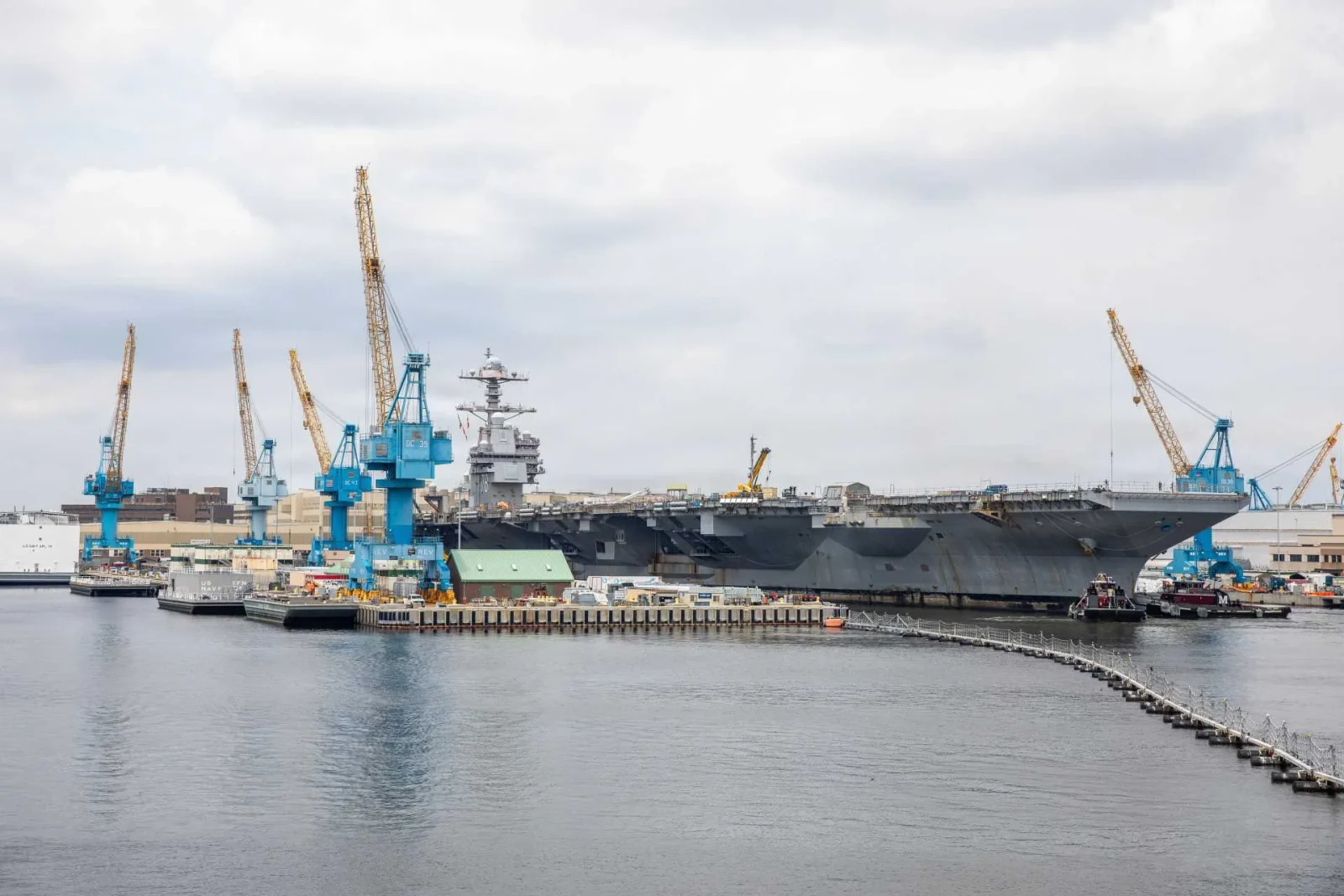
Ford entered a Planned Incremental Availability at Norfolk Naval Shipyard in July. A PIA is the mid-sized maintenance window carriers take between deployment cycles; it typically runs six to eight months. Ford’s was scheduled at six, and when fire damage was added to the work package, slipping that schedule was the obvious expectation.
Rear Adm. Kavon Hakimzadah says it will not slip. His formulation is precise: “I’m still going to deliver that ship in six months, but we’ve set up a second availability.” Rather than force the fire repairs into the PIA, the Navy carved them into a separate package run by a regional maintenance centre working with commercial partners.
That is a bigger move than it sounds. What governs a shipyard schedule is not total man-hours but the critical path — which job cannot start until another finishes. Because the fire damage is concentrated in living spaces, it can largely run in parallel with PIA work in the machinery spaces and on flight-deck systems. Pulling it onto a separate track keeps the critical path clean.
Hakimzadah’s confidence has a second basis: comparable carriers have recently finished PIAs ahead of schedule. Still, there is another way to read the move. A second availability does not create capacity; it redistributes it. Work handed to commercial partners leaves the public shipyard’s books. It does not leave the Navy’s.
Does the arithmetic close? 30 percent more work, same six months
This is where the story gets interesting. Two numbers from the same institution do not reconcile. The acting secretary’s 6-percent-per-30-days rule implies roughly 30 percent more work on Ford. The shipyard commander says the calendar has not moved. If both are true, the difference is being absorbed somewhere.
There are three candidates. The rule of thumb may simply be a conservative ceiling, and the real growth smaller. Some work may be deferred: in carrier maintenance, items are routinely pushed into the next availability, which protects this schedule and inflates the next one. Or the second availability is absorbing exactly this overflow — the work gets done, it just is not counted against the PIA.
These are not mutually exclusive, and some mixture of all three is the likeliest answer. What matters is that we will learn which one dominates not from whether Ford delivers in six months, but from how swollen her next availability turns out to be. Carrier maintenance delays rarely detonate in a single cycle; they surface two or three cycles later as the question of why nothing leaves the yard on time.
Ford carries one more variable: she is first-in-class. EMALS, the Advanced Arresting Gear and the electromagnetic weapons elevators have no long maintenance history behind them. A 326-day cruise has produced the first real endurance data set on all of it. That data may end up being worth more than the schedule.
The real constraint: how many carriers can actually sail?
Long deployments are a symptom, not a choice. The U.S. Navy has eleven carriers on paper, but at any moment some are in deep maintenance, some are working up, and some have just come home. The number that can be sent anywhere on short notice is set by shipyard throughput, not by tonnage. Ford was extended by five months for the simplest of reasons: there was nothing to relieve her with.
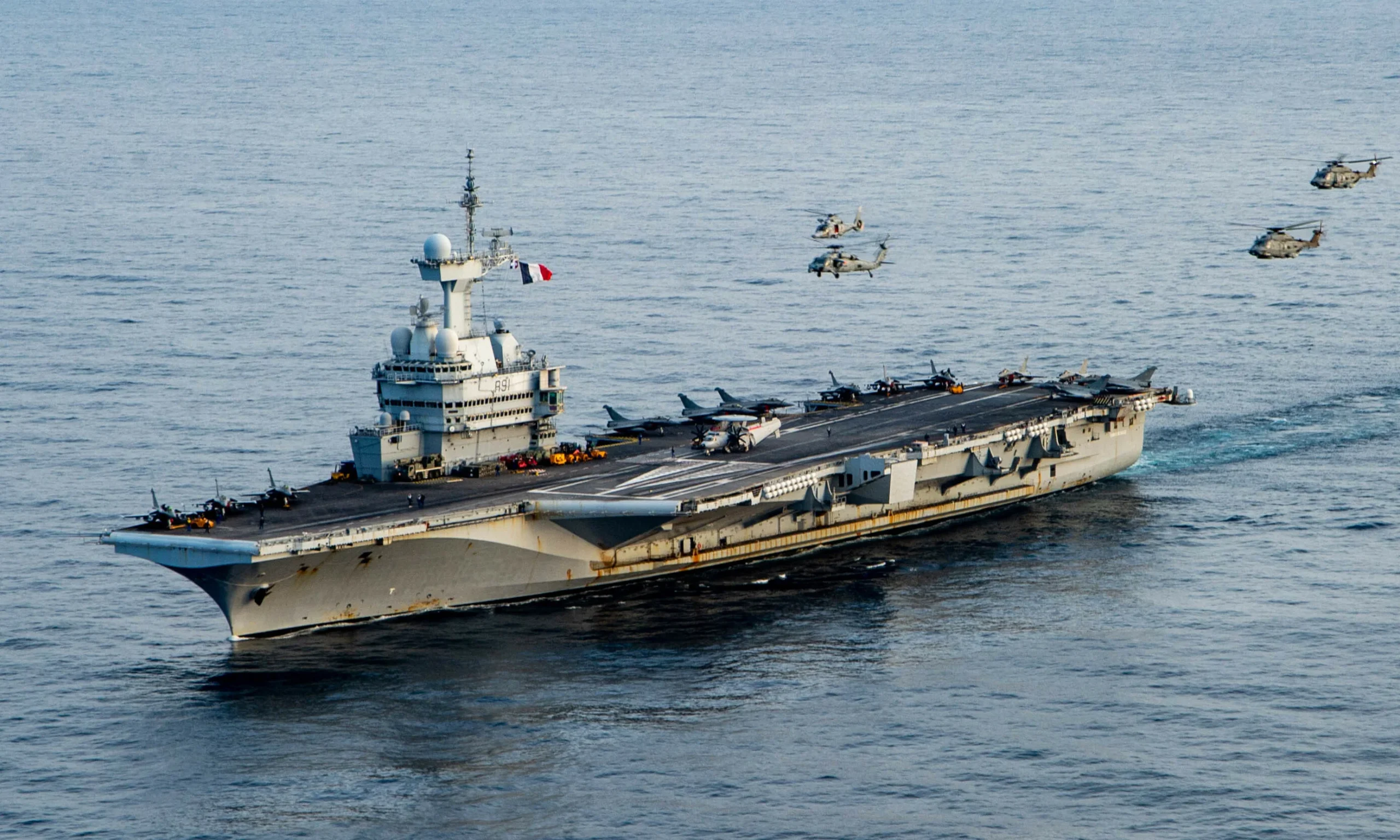
The constraint is not uniquely American. France operates a single nuclear carrier, Charles de Gaulle; when she goes into a major refit, the French Navy loses carrier aviation outright for the duration. In single-carrier navies, availability and ownership are very different things.
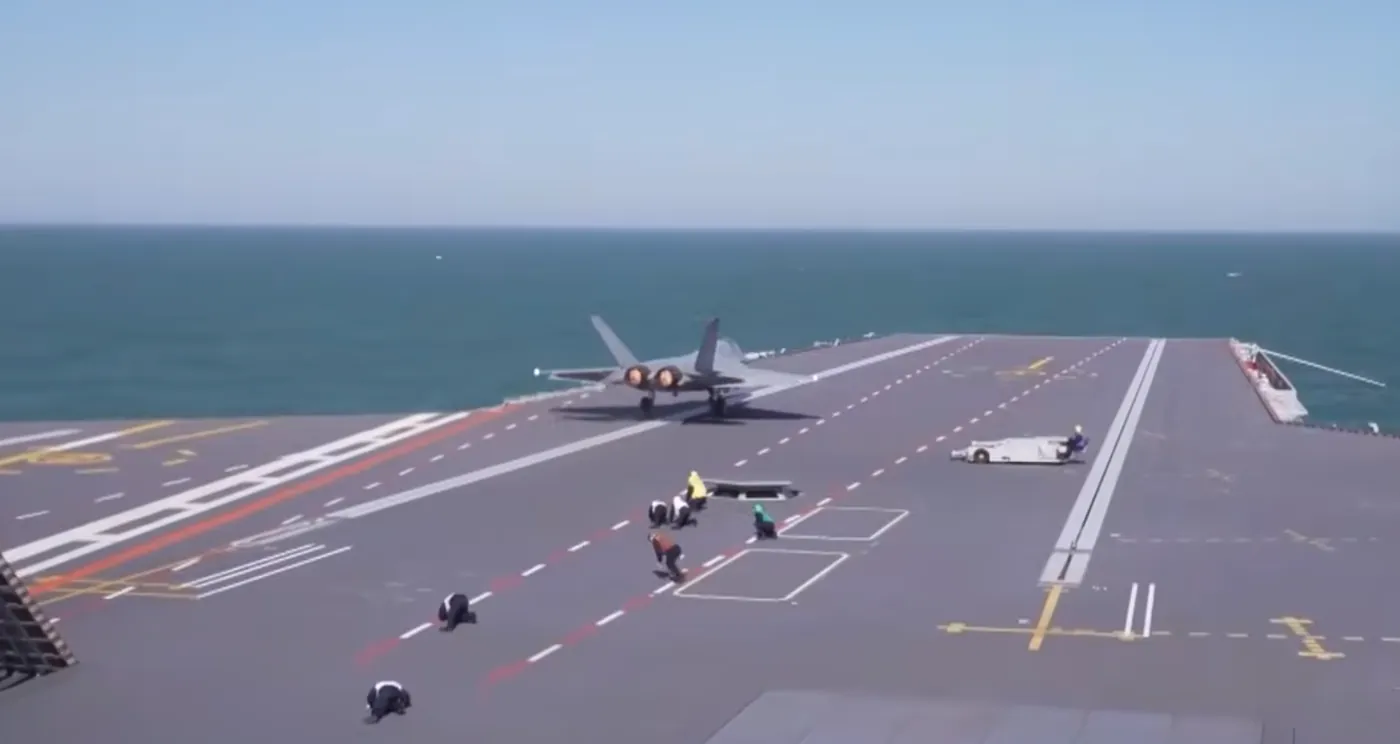
At the other end sits the pressure that stretched the cruise in the first place. China’s third carrier, Fujian, put Beijing in the electromagnetic-catapult club and continues to set a shipbuilding tempo that American yard capacity cannot match. Washington’s insistence on persistent presence in the Indo-Pacific while keeping a deck in the Middle East is paid for by running ships like Ford off the books.
The result is a loop: too few hulls stretches deployments, stretched deployments deepen maintenance, and deeper maintenance reduces the number of hulls that can sail. Ford’s six-month promise is a small pledge inside that loop. The larger question is whether the loop can be broken at all.
USS Gerald R. Ford: technical profile
| Feature | Detail |
|---|---|
| Class / hull number | Ford class / CVN-78 (lead ship) |
| Builder | Huntington Ingalls Industries – Newport News Shipbuilding, Virginia |
| Commissioned | 22 July 2017 |
| Full-load displacement | ~100,000 tons |
| Propulsion | 2 × A1B nuclear reactors |
| Launch system | EMALS (Electromagnetic Aircraft Launch System) |
| Recovery system | AAG (Advanced Arresting Gear) |
| Crew | ~4,600 (ship’s company and air wing) |
| Last deployment | 326 days, completed May 2026 — longest since Vietnam |
| Current status | PIA at Norfolk Naval Shipyard since July 2026, six-month target |
What the Ford class was meant to change
The Ford class was designed to replace the Nimitz class, the backbone of American naval aviation for half a century. The pitch was never a bigger ship; it was a more efficient one — more sorties from the same hull, generated by fewer people. EMALS instead of steam catapults, AAG instead of conventional arresting gear, and electromagnetic weapons elevators instead of hydraulics were the concrete expressions of that pitch.
Ford commissioned on 22 July 2017, but the new systems took years to mature. EMALS and the weapons elevators became the programme’s most criticised line items, falling short of reliability targets in the early years. That is why the ship’s first full combat deployment did not come until 2023.
The rest of the class is following: John F. Kennedy (CVN-79), Enterprise (CVN-80) and Doris Miller (CVN-81) are in construction and procurement, and Huntington Ingalls has been awarded early-materials work for the fifth ship, CVN-82. The class is advancing on lessons the lead ship is still paying for.
The United States is the only operator. But the design logic — automate to cut manning, electrify the systems, raise sortie generation — has become the reference point for every major naval programme. This year’s deployment also exposed the edge of that logic: automation raises sortie rates, and it also reduces the number of hands available to fight a fire, clear a drain line and find 600 people somewhere to sleep.
A different set of priorities: Türkiye’s carrier question
Carrier debates usually revolve around tonnage and aircraft type. Ford’s year offers a less glamorous metric that decides more: how many days a year can the ship actually be at sea? The answer lives in the shipyard, the spares chain and the crew rotation — not in the hull.
Türkiye enters that question from an unusual position. TCG Anadolu (L-400), the amphibious assault ship commissioned in 2023, was built domestically at Sedef Shipyard. The operational consequence is a maintenance one: when the yard that built the hull is in the country, major repair and modernisation are not hostage to someone else’s schedule. Much of the squeeze the U.S. Navy is living through is a capacity problem — and building capacity at home is precisely the model Ankara has been assembling.
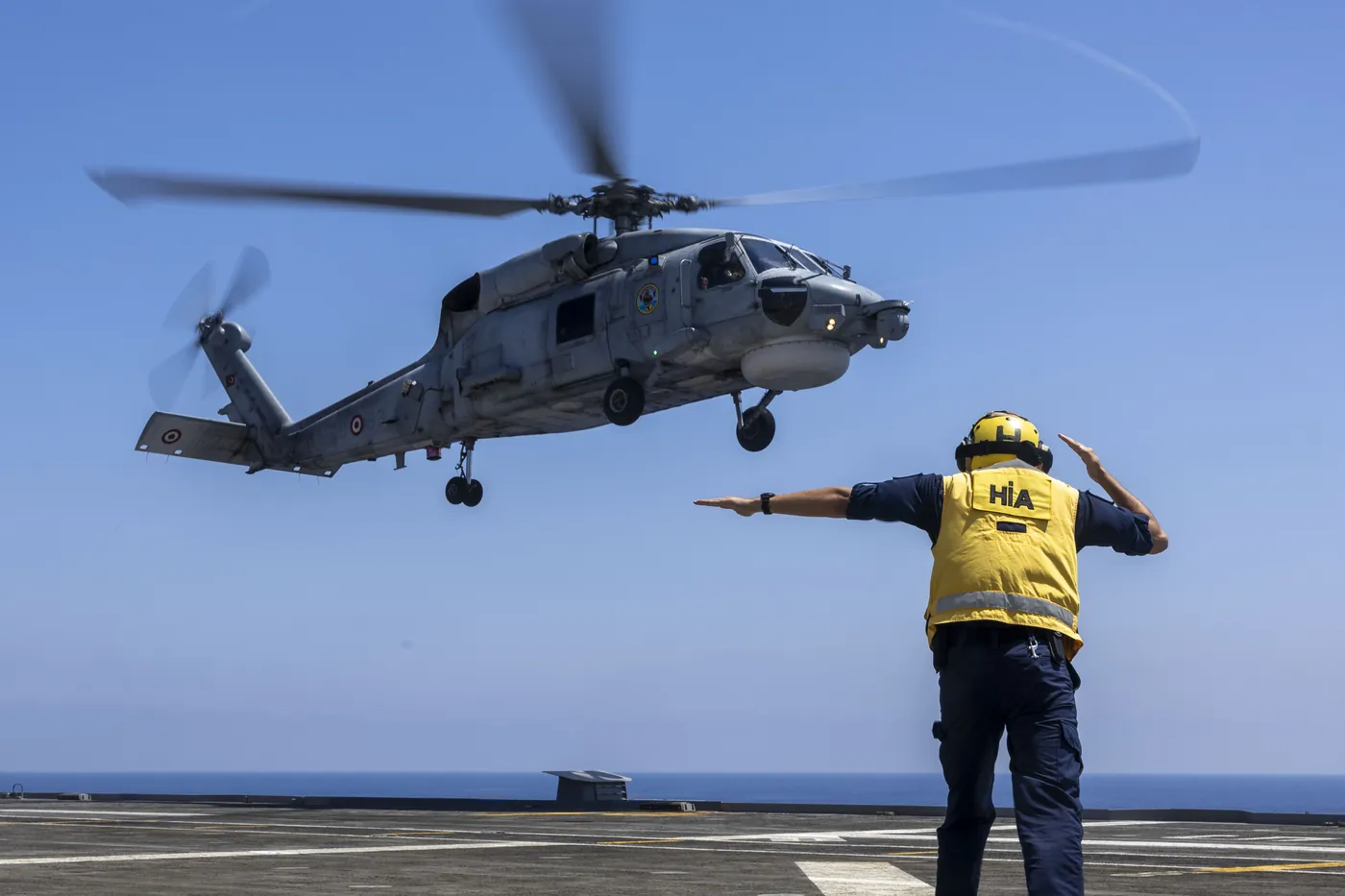
The second element is the air wing. In November 2024 the Bayraktar TB3 launched from and recovered aboard TCG Anadolu, becoming the first armed unmanned aircraft to operate from a short-deck ship, and deck work with KIZILELMA continues. An uncrewed air wing has a different maintenance profile from a crewed one: pilot training cycles, per-flight-hour human cost and crew fatigue largely drop out of the equation. On long cruises, that translates directly into days at sea.
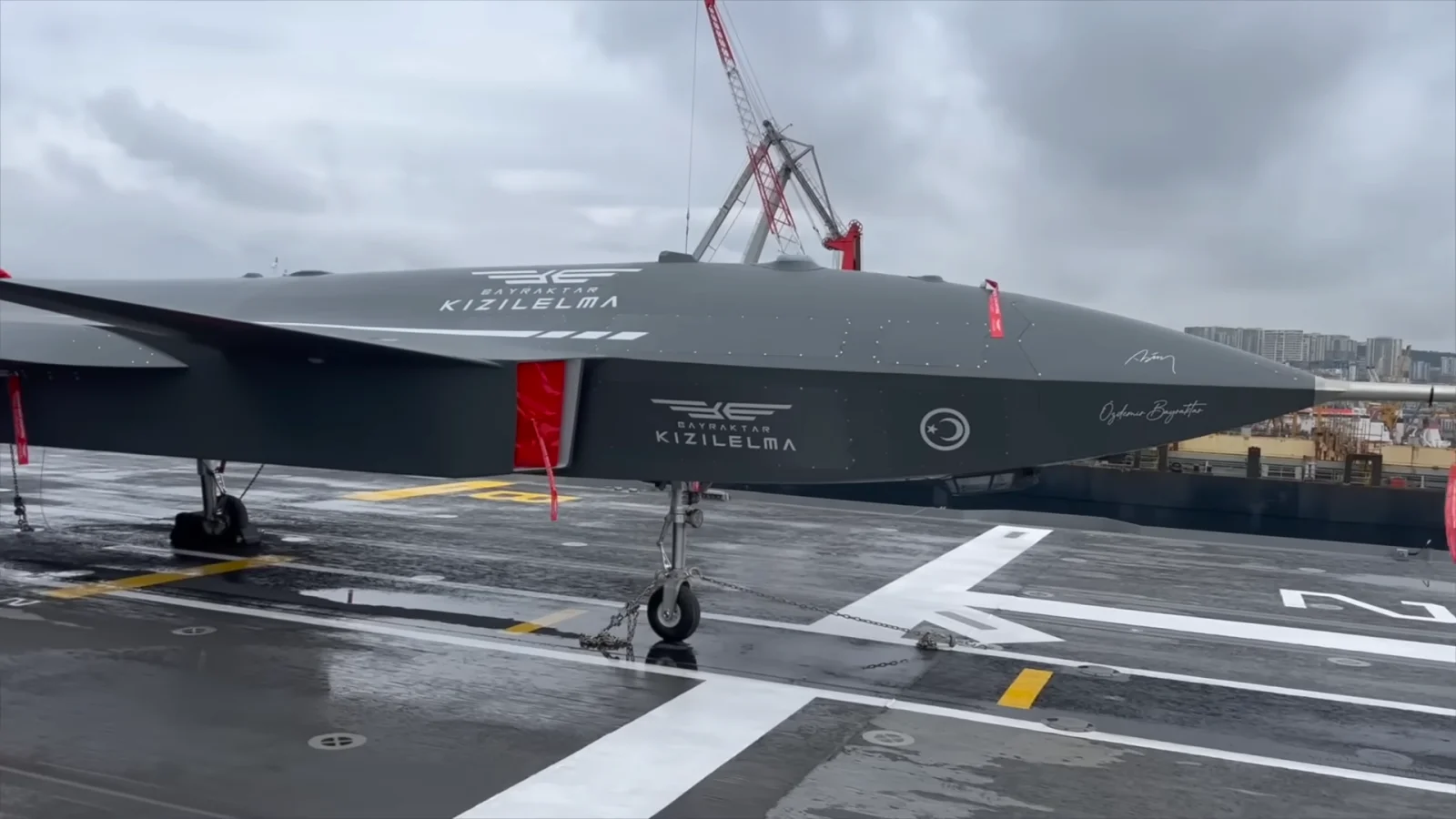
MUGEM, Türkiye’s national aircraft carrier programme, sits where those two lines meet: a larger hull built at home, with an air wing weighted toward uncrewed aircraft. The programme is still in design and preparation, and the engineering questions ahead of it are real — catapult or ramp, what propulsion architecture, where the crewed component of the air wing comes from. Ford’s year suggests a third question belongs alongside them from the start: where will the sustainment base be built that keeps the ship at sea 200 days a year?
Owning a carrier and having carrier capability are not the same thing. Even the most expensive warship in the world deters nobody while it is alongside.
Sources
- Breaking Defense — “Despite fire, lengthy deployment, Navy expects only six-month maintenance for USS Ford” (14 September 2026)
- USNI News — “Carrier USS Gerald R. Ford Suffers Fire, At Least 2 Sailors Injured” (12 March 2026)
- Navy Times — “Onboard fire extinguished on aircraft carrier in Red Sea, Navy says” (12 March 2026)
- U.S. Navy and Huntington Ingalls Industries public information (Ford-class technical profile)
- Turkish Presidency of Defence Industries (SSB) and Baykar public programme information (TCG Anadolu, TB3, MUGEM)