Turbojet vs Turbofan vs Turboprop vs Turboshaft: What Is the Difference?

A turbojet, turbofan, turboprop and turboshaft are all gas-turbine engines built around the same core: a compressor, a combustor and a turbine. The difference is where the core’s energy ends up. A turbojet produces thrust almost entirely from its hot exhaust jet; a turbofan uses a large front fan to push extra “bypass” air around the core; a turboprop sends most of its power through a gearbox to a propeller; and a turboshaft delivers power to a shaft that turns a helicopter rotor, a generator or a ship’s transmission. Türkiye now develops engines in each family: TEI’s TJ300 turbojet, TF6000 turbofan and TS1400 turboshaft, alongside Kale’s KTJ-3200 turbojet.
The common core: how any gas turbine works
Air enters the engine and is squeezed by a compressor. Fuel is injected and burned in the combustor, raising the temperature and energy of the flow. That hot gas expands through a turbine, which extracts enough work to keep the compressor spinning. Everything after that point is a design choice about how to use the remaining energy. NASA’s Glenn Research Center explains the same cycle in its widely used beginner’s guide to propulsion.
The four engine types side by side
| Type | Where the power goes | Strengths | Typical military uses | Examples |
|---|---|---|---|---|
| Turbojet | Almost all into the exhaust jet | Compact, simple, high exhaust velocity | Cruise and anti-ship missiles, target drones, early jet fighters | TEI TJ300, Kale KTJ-3200 |
| Turbofan | Shared between the core jet and a fan pushing bypass air | Better fuel efficiency at subsonic and transonic speeds; afterburner option for fighters | Fighters, trainers, transports, large UCAVs | TEI TF6000, GE F404/F414, EUROJET EJ200 |
| Turboprop | Mostly through a gearbox to a propeller | Very efficient at lower speeds and altitudes; short-field performance | Trainers, transports, maritime patrol | Pratt & Whitney Canada PT6A family, Europrop TP400-D6 |
| Turboshaft | Through a free power turbine to an output shaft | High power-to-weight for rotorcraft; flexible output | Helicopters, tiltrotors, some naval and ground power systems | TEI TS1400, GE T700, Rolls-Royce AE 1107C |
Turbojet: the simplest jet
A turbojet has no fan. The hot, fast exhaust leaving the nozzle is the thrust. That makes it noisy and thirsty at low speed, which is why turbojets disappeared from most manned aircraft, but its small size and simplicity suit one-way vehicles. Missiles and target drones still rely on small turbojets. In Türkiye, Kale’s KTJ-3200 is associated with the ATMACA anti-ship missile, and TEI’s TJ300 is a small turbojet for missile and munition applications. We cover both in our Turkish-language profiles of KTJ-3200 and TJ300.
Turbofan: adding bypass air
A turbofan places a large fan at the front, driven by the turbine. Part of the air flows through the core; the rest bypasses it. The ratio between the two is the bypass ratio. Moving a large mass of air more slowly is more efficient than moving a small mass very fast, so high-bypass turbofans dominate airliners and transports. Fighters use low-bypass turbofans, often with afterburners, to combine efficiency in cruise with high thrust for combat. TEI’s TF6000 is a 6,000 lbf-class turbofan developed for unmanned and light aircraft roles, including the KIZILELMA programme; HÜRJET currently flies with the GE F404, as explained in our HÜRJET engine guide.
Turboprop: a gas turbine that turns a propeller
In a turboprop, the turbine extracts most of the energy and sends it through a reduction gearbox to a propeller. Only a small part of the thrust comes from the exhaust. The result is excellent efficiency at the speeds and altitudes where trainers, tactical transports and patrol aircraft operate. Türkiye’s HÜRKUŞ trainer, profiled in our HÜRKUŞ explainer, is a turboprop aircraft, as is the A400M transport with its TP400-D6 engines.
Turboshaft: power for rotors and shafts
A turboshaft is closely related to a turboprop, but its output is a shaft rather than a propeller, usually driven by a separate “free” power turbine. Helicopter transmissions take that shaft power to the main and tail rotors. TEI’s TS1400 is Türkiye’s indigenous 1,400 shp-class turboshaft for the GÖKBEY utility helicopter. TEI reports that the engine first flew on GÖKBEY on 19 April 2023 and later reached a record 1,740 shp in one-engine-inoperative testing. Read more in our TS1400 article.
What about turbodiesels?
Turbodiesels are not gas turbines; they are piston engines with turbochargers. They appear in medium-altitude long-endurance drones and in many land vehicles because of their fuel economy. TEI’s PD170 is a turbodiesel aviation engine developed for Turkish UAVs.
Which engine fits which mission?
- Speed above about Mach 0.8 and fighter agility: low-bypass turbofan, often with afterburner.
- Long-range subsonic missiles: small turbojets or small turbofans, chosen for size and cost.
- Slow, efficient flight and short runways: turboprop.
- Vertical lift: turboshaft.
- Very long endurance at modest speed: turboprop or turbodiesel.
Frequently asked questions
Is a turbofan just a turbojet with a fan?
Conceptually, yes: a turbofan adds a fan driven by the turbine, plus a bypass duct. In practice the core, turbine stages and controls are designed together, so a turbofan is not simply a turbojet with a fan bolted on.
Why don’t fighters use high-bypass engines?
High-bypass engines are large in diameter and lose efficiency at high supersonic speeds. Fighters need a slim engine that can deliver high thrust and accept an afterburner, so they use low bypass ratios.
What is the difference between a turboprop and a turboshaft?
Both convert most of the gas energy into shaft power. A turboprop is designed around driving a propeller through a gearbox; a turboshaft delivers power to a shaft for a rotor, transmission or generator.
Does Türkiye produce its own jet engines?
Türkiye has indigenous programmes in several families: TEI’s TS1400 turboshaft, TF6000 turbofan and TJ300 turbojet, and Kale’s KTJ-3200 turbojet. Some are in qualification or certification stages; status should be checked against the manufacturers’ latest announcements.
Related on Envanter Medya
- GÖKBEY’s TS1400 Engine & Indigenization
- HÜRJET Engine: GE F404-104 Turbofan
- What is HÜRKUŞ?
- World’s Largest Military Engine Manufacturers
- EJ200 Turbofan Engine
Sources
- SSB Savunma Sanayii 360 Glossary (Turbojet, Turbofan, Turboprop, Turboshaft, Turbodiesel)
- TEI, TEI-TS1400 Turboshaft Engine Development Project
- TEI press release, TS1400 reaches record 1,740 SHP
- NASA Glenn Research Center, Beginner’s Guide to Propulsion: Turbofan Engine
- NASA Glenn Research Center, Turboprop Engine
Verified and updated: 3 November 2026. This article was checked against the publicly available sources below and will be updated as new official information is released.
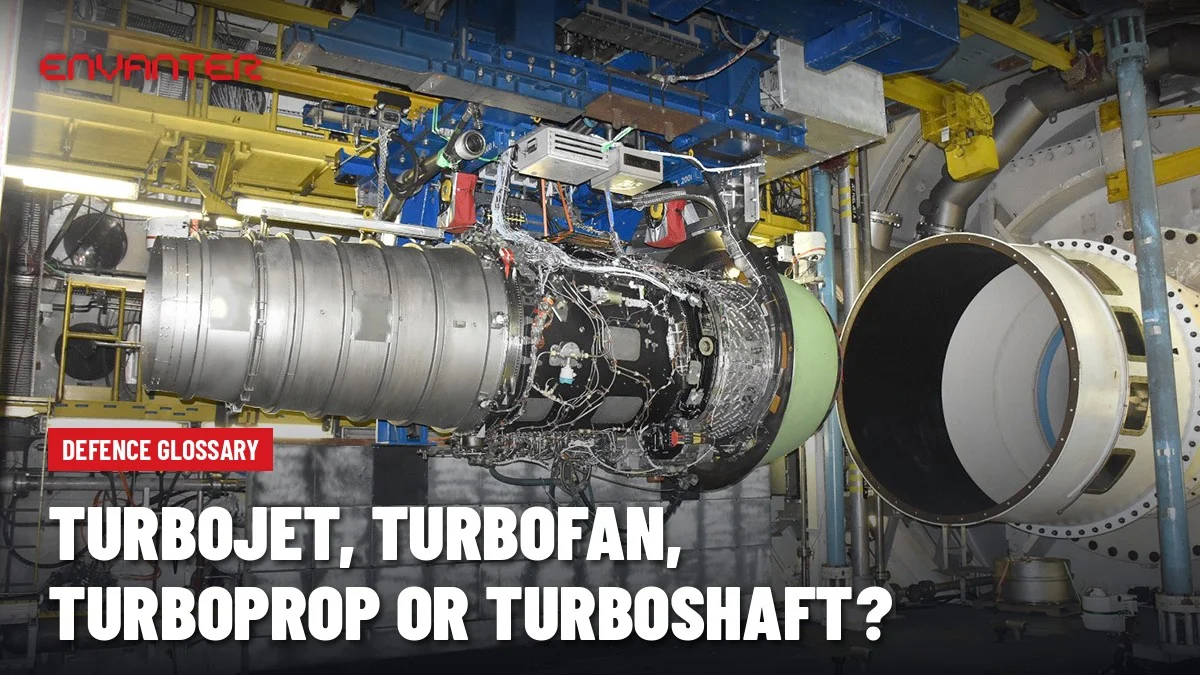
Cover photo: U.S. Air Force, free-jet engine test at AEDC. Public domain (U.S. Air Force), Wikimedia Commons: Wikimedia Commons