MAM Smart Munitions Explained: MAM-L, MAM-C and MAM-T

MAM (Smart Micro Munition) is ROKETSAN’s family of unpowered, gliding precision munitions built for unmanned aerial vehicles. It comes in three versions — MAM-C, MAM-L and MAM-T — with official ranges from 8 km to 30+ km, and it is the primary strike weapon of Turkish drones such as the Bayraktar TB2 and Akıncı. It has been exported widely alongside the Bayraktar TB2.
| MAM Family — At a Glance | |
|---|---|
| Product name | MAM — Smart Micro Munition |
| Class | Unpowered gliding smart micro-munition |
| Developer | ROKETSAN |
| Versions | MAM-C, MAM-L, MAM-T |
| Range | 8 km (C) – 80 km (T) |
| Weight | 6.5 kg (C) – 95 kg (T) |
| Guidance | Semi-active laser; IIR variants; optional GPS configuration on MAM-L and MAM-T |
| Warhead | Armour-piercing HE / thermobaric / multipurpose (weight undisclosed) |
| Platforms | Bayraktar TB2, Akıncı, Anka, Aksungur |
| Users | Türkiye, Poland (contract); use reported in Azerbaijan, Libya, Ukraine |
What is the MAM series?
MAM (Smart Micro Munition) is a family of precision-guided munitions designed by ROKETSAN specifically for unmanned aerial vehicles. Because it has no propulsion of its own, MAM is not a missile; it is a smart bomb that glides to its target using deployable fins after being released from a drone. That design keeps it light, inexpensive and small enough to be carried even by compact tactical drones.
The family has three main members: the lightest, MAM-C; the most widely used, MAM-L; and the heaviest and longest-ranged, MAM-T. This tiered structure lets ROKETSAN arm platforms ranging from small surveillance drones to large combat UAVs such as the Akıncı and Aksungur with a single munition concept.
The MAM family became globally recognised through the battlefield performance of the Bayraktar TB2. Its low cost, light weight and pinpoint accuracy make it an effective solution against armoured vehicles, fixed positions, light fortifications and personnel. The product has become one of the symbols of the Turkish defence industry’s drone-based precision-strike capability.
Technical specifications and how it works
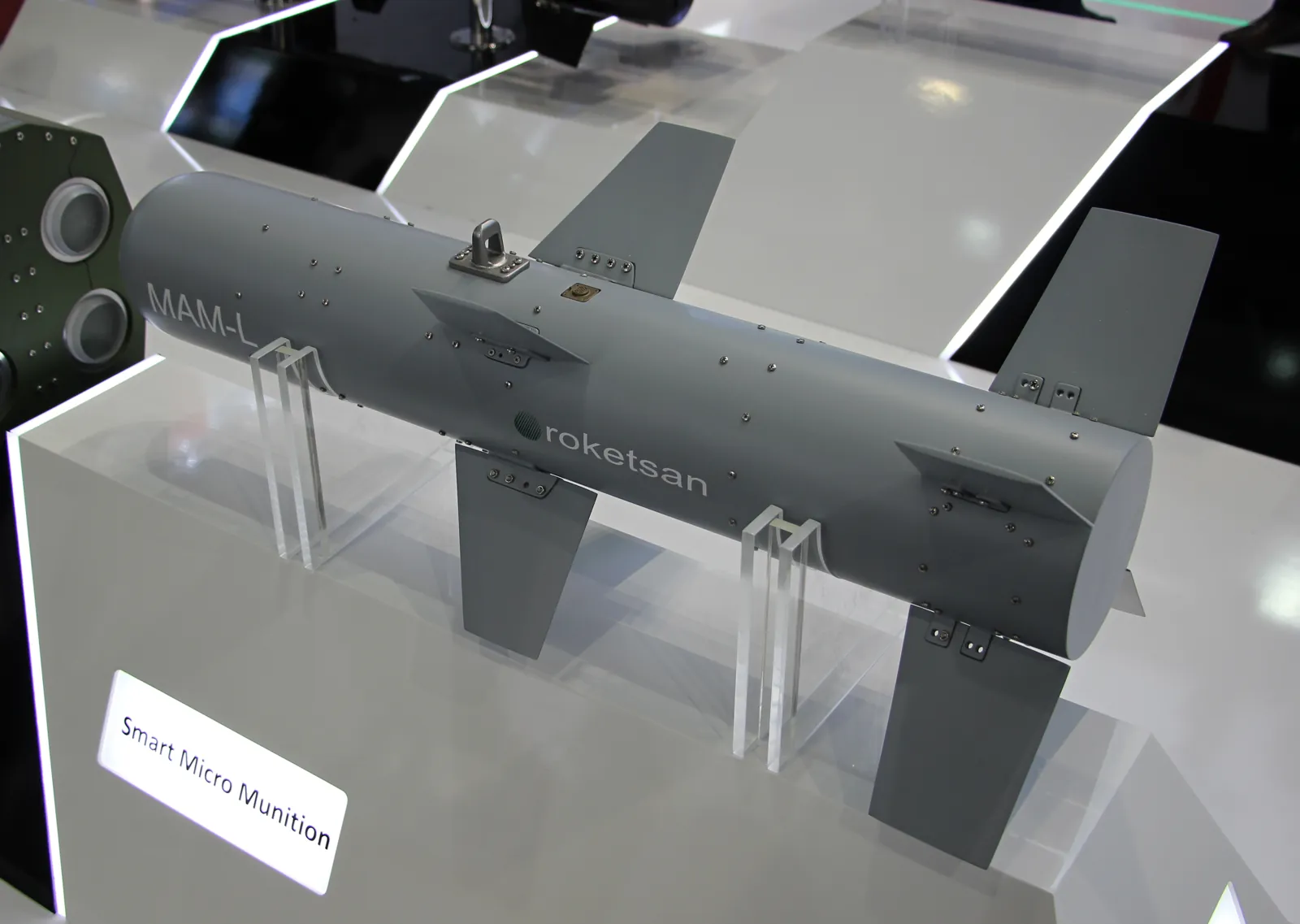
The MAM family works on the principle of powered-free gliding. The munition is released from a station under the drone’s wing, then extends its fins to glide and cover distance. As a result, range is largely determined by the release altitude and the platform’s speed.
For guidance, the baseline method is semi-active laser homing: the munition tracks a target designated by a laser from the drone or a ground team during the terminal phase. Imaging infrared (IIR) variants and an optional proximity-sensor/GPS configuration have also been developed for the MAM-L and MAM-T, allowing coordinate-based strikes without the need for laser designation.
Warhead types vary by target: armour-piercing high-explosive, thermobaric and multipurpose options are available. Warhead weights have not been officially disclosed by ROKETSAN; some independent sources cite roughly 10 kg for the MAM-L, but this is not a confirmed official figure. Ranges differ sharply between versions: the MAM-C reaches 8 km, the MAM-L 15 km (25+ km in the IIR variant), while the MAM-T is officially credited with 30+ km from a UAV (older sources cited 60–80 km from manned aircraft).
The closest foreign equivalents to the MAM family are the air-to-ground guided munitions launched from drones and helicopters. There is one crucial difference, though: Brimstone and Hellfire are missiles with their own rocket motors, while MAM is an unpowered gliding munition. That makes MAM lighter and cheaper, but its range depends heavily on the launch altitude of the platform.
Platforms, users and exports
One of the MAM family’s greatest strengths is its broad platform compatibility. The lightest member, MAM-C, can be carried on small tactical drones, while the MAM-L has become the standard weapon of medium and large UAVs such as the Bayraktar TB2, Akıncı, Anka and Aksungur. The heaviest version, MAM-T, is used only on high-payload platforms like the Akıncı and Aksungur because of its weight.
The MAM family has travelled with Bayraktar TB2 exports to many countries. Munition-level evidence is public for only a few of them: Türkiye operates it, Poland’s 2021 TB2 contract covers MAM-L and MAM-C, and use has been reported in Azerbaijan, Libya and Ukraine. Owning a TB2 does not by itself prove a country operates MAM. Exports of the munition are largely tied to drone sales; because it is supplied as a package alongside the TB2 and Akıncı, MAM has become one of Türkiye’s most widely exported precision munitions.
Place in Turkey’s defence industry, strengths and limits
The MAM family is a cornerstone of ROKETSAN’s drone-based precision-strike capability and acts as a multiplier that boosts the appeal of Türkiye’s unmanned aircraft exports. Munitions like MAM largely define the difference between an unarmed surveillance drone and an armed strike platform.
Strengths include low cost, light weight, compatibility across different drone classes and a choice of laser, IIR and GPS guidance. Its limitations stem from being unpowered: range depends heavily on release altitude and the munition cannot generate thrust of its own. For that reason ROKETSAN offers full missiles such as UMTAS and L-UMTAS as a separate class for longer, powered strikes. Because warhead weights and some MAM-T dimensions have not been officially disclosed, those values are described as unverified throughout this article.
Warhead weights for the MAM versions have not been officially disclosed by ROKETSAN; the ~10 kg figure cited for the MAM-L comes from independent sources (Janes) and is not an official statement. ROKETSAN gives the MAM-T’s total weight as 95 kg (96 kg for the IIR variant). Range figures depend on release altitude and platform.
Frequently Asked Questions
What is the range of the MAM munition?
Range varies by version: the MAM-C reaches roughly 8 km, the MAM-L 15 km (25+ km in the IIR variant), and the MAM-T 30+ km from a drone (older sources cited 60–80 km from manned aircraft). Range depends largely on release altitude.
Is MAM a missile or a bomb?
MAM is not a missile. Because it has no rocket motor, it is an unpowered gliding smart munition that glides to its target on deployable fins after release from a drone. In that sense it is closer to a guided smart bomb.
Which platforms launch MAM?
MAM-L is launched primarily from the Bayraktar TB2, as well as the Akıncı, Anka and Aksungur. The lightest version, MAM-C, is used on small tactical drones, while the heaviest, MAM-T, is carried only on large platforms such as the Akıncı and Aksungur.
Which countries use MAM?
Türkiye operates it; Poland’s 2021 TB2 contract covers MAM-L and MAM-C; use has been reported in Azerbaijan, Libya and Ukraine. Other TB2 operators have not been confirmed at munition level.
What is the equivalent of MAM?
Its closest foreign equivalents are the UK-built Brimstone and the US-built Hellfire air-to-ground missiles. However, those are powered missiles; ROKETSAN’s own powered equivalents are the UMTAS and L-UMTAS.
How large is the MAM warhead?
Warhead types include armour-piercing high-explosive, thermobaric and multipurpose options. Warhead weights have not been officially disclosed by ROKETSAN; the ~10 kg figure cited for the MAM-L in independent sources is not an official value.
Sources
- ROKETSAN official — roketsan.com.tr
- Janes — MAM family munition data
- Wikipedia (English) — MAM (munition)
- Baykar / Bayraktar TB2 integration information
- Defence industry press (2020-2026)