From Imported Tanks to KC-390: Brazil’s Domestic Airlifter Programme

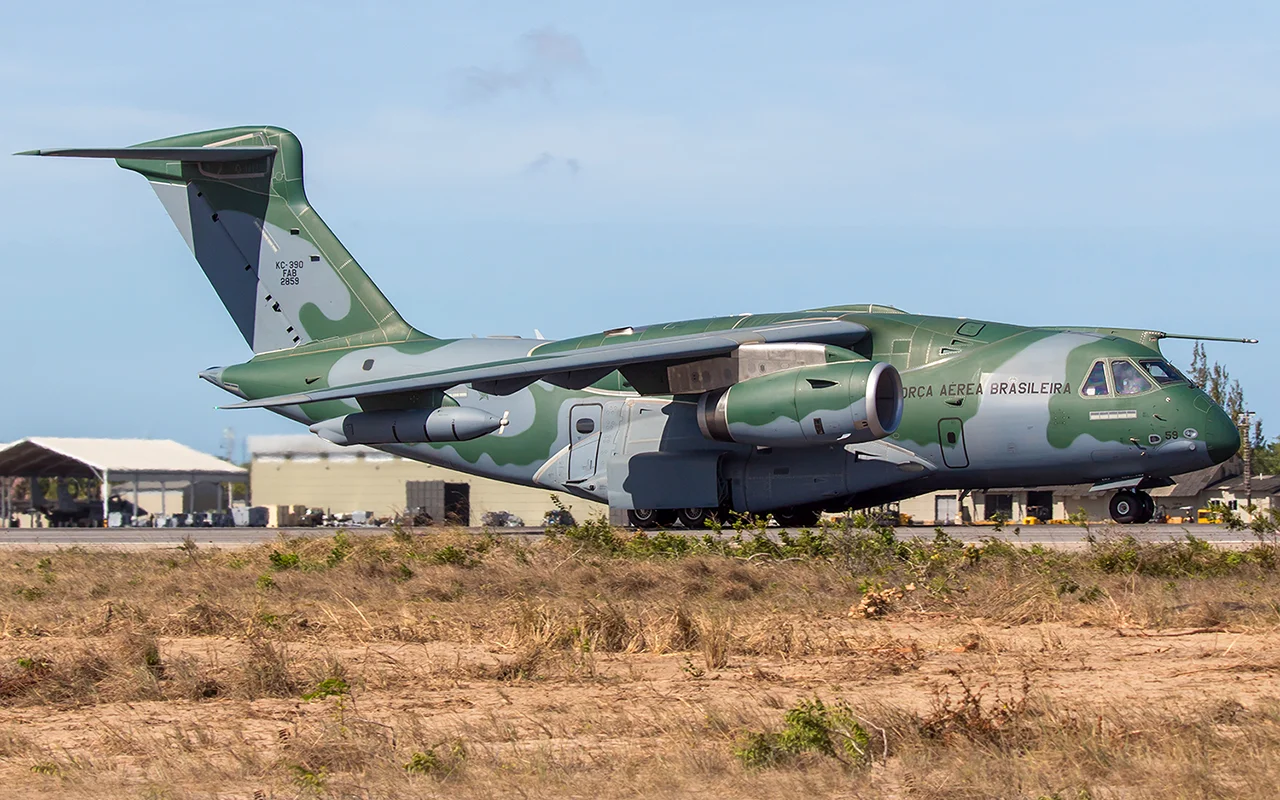
From Imported to Indigenous series · File 14 · Sarp Güçlü
Class: A — Direct Replacement
Current status: Fully replaced — the Brazilian Air Force (FAB) formally retired its entire C-130 Hercules fleet in February 2024, but full delivery of the replacement KC-390 Millennium fleet is scheduled to run until 2034.
On 29 February 2024, the Brazilian Air Force held a farewell ceremony for its last Lockheed C-130 Hercules, nearly 59 years after the type entered service. The outgoing Hercules flew alongside the Embraer KC-390 Millennium that was designed to take over its role — a program that had been running since the mid-2010s but whose fleet build-out is still years from completion.
What was the old system?
Brazil operated the US-built Lockheed C-130 Hercules from the mid-1960s, and the type formed the backbone of FAB’s tactical and strategic airlift. Part of the fleet was locally upgraded and redesignated C-130M. From 1983 the aircraft flew logistics and scientific-support missions to Antarctica under the PROANTAR programme, reportedly completing around 400 such sorties over the decades. The fleet had already shrunk well before the 2024 ceremony: some reports from around 2022 counted only four Hercules still active.
Why did Brazil need a domestic replacement?
By the 2010s, FAB’s Hercules fleet was approaching the end of its structural and economic service life. Rather than buy another imported type, Brazil chose to design and build its own tactical airlifter. The rationale combined three threads reported in the sources: an ageing, maintenance-heavy fleet; Brazil’s need for a faster, higher-capacity airlifter given its continental geography and Antarctic commitments; and an industrial-policy goal of extending Embraer’s civil-aircraft engineering base into military platforms with export potential. None of the available reporting points to an embargo or supply restriction behind the decision.
How was the indigenous aircraft developed?
The KC-390 programme began with a 2009 development contract between Embraer and FAB, followed by a firm order for 28 aircraft in 2014. The first prototype rolled out at Embraer’s Gavião Peixoto plant in São Paulo state on 21 October 2014 and made its maiden flight on 3 February 2015. In 2015 Embraer disclosed a two-year slip in the flight-test schedule, attributed to currency devaluation and government spending cuts. A second prototype flew on 28 April 2016. Brazil’s civil aviation authority, ANAC, issued type certification in October 2018, described as a key step toward military certification. The first production aircraft was handed to FAB’s 1st Troop Transport Squadron (“Esquadrão Zeus”) at Anápolis Air Base on 4 September 2019. Full Operational Capability (FOC) was jointly announced by Embraer and FAB on 3 April 2023, and the first aircraft delivered already in FOC configuration — the sixth airframe, FAB 2858 — followed on 16 June 2026.
Export orders arrived alongside the FAB programme: Portugal signed for five aircraft in 2019, Hungary followed in 2020, the Netherlands selected the type in 2022 to replace its own C-130s, and Austria, the Czech Republic and South Korea joined in 2023. In 2026 Colombia signed a $366.4 million contract for two aircraft (deliveries 2029-2030), and Uzbekistan received its first KC-390 in September 2026. Brazil’s own order, meanwhile, was repeatedly trimmed through renegotiation — different reports put the final FAB fleet at 18 or 19 aircraft, down from the original 28, with deliveries extending to 2034. Embraer delivered three Millennium-family aircraft in 2025 and is targeting six in 2026, aiming for an annual rate of ten by the end of the decade.
Old vs new: a side-by-side comparison
| Spec | C-130H/M Hercules | KC-390 Millennium |
|---|---|---|
| Manufacturer | Lockheed (USA) | Embraer (Brazil) |
| Entered FAB service | Mid-1960s | 4 September 2019 |
| Engines | 4 × Allison T56-A-15 turboprop (USA), 4,300 hp each | 2 × IAE V2500-E5 turbofan (international consortium), 139.4 kN each |
| Max speed | ~590 km/h (320 kn) | 988 km/h (Mach 0.93) |
| Max payload | ~19,090 kg | 26,000 kg concentrated / 23,000 kg distributed |
| Crew | 5 (2 pilots, navigator, flight engineer, loadmaster) | 2 pilots + 1 loadmaster (optional 3rd seat) |
| Status in FAB | Retired (Feb 2024) | Deliveries ongoing (to 2034) |
Sources: C-130H/M figures from US Air Force/Air National Guard fact sheets (generic type data; no Brazil-specific official figures published); KC-390 figures from manufacturer data as compiled by Army Recognition.
How much of it is actually domestic?
- Design and final assembly: Brazilian. The airframe is designed and finally assembled at Embraer’s Gavião Peixoto plant — the strongest domestic element of the programme.
- Engines: Not domestic. The two IAE V2500-E5 turbofans come from International Aero Engines, a consortium of Pratt & Whitney (US), Rolls-Royce (UK), Japanese Aero Engines Corporation and MTU Aero Engines (Germany) — the engine’s first military application.
- Select airframe parts: Not domestic. The tail cone, cargo door and landing-gear doors are supplied by Argentina’s FAdeA.
- Supply chain: Embraer says the programme built a new domestic supplier base in Brazil but has not published a domestic-content percentage. For the version pitched to the US market, the company says more than half the material content comes from 59 US suppliers — a figure describing the US-market offer, not the standard aircraft delivered to Brazil.
- Software/avionics: Not disclosed in available open sources with a verifiable breakdown.
Bottom line: the KC-390 is not a “fully indigenous” aircraft. It combines Brazilian design and final-assembly capability with foreign dependence on a critical subsystem (the engine) and on some structural parts.
Has it really replaced the old system?
Fully replaced — as a type. FAB retired its entire C-130 Hercules fleet at the 29 February 2024 ceremony, an event independently confirmed by FlightGlobal, Scramble.nl and MercoPress. Two caveats stand, though. First, the planned KC-390 fleet size (18-19 aircraft, sources differ slightly) is not yet complete; independent reporting put FAB’s delivered total at eight as of October 2026, with deliveries running to 2034. Second, there is no consistent official figure confirming that every delivered aircraft is simultaneously airworthy; some reporting notes maintenance and inspection cycles ground part of the fleet at any given time. In short, the aircraft type has been replaced, but the replacement fleet has not yet reached its planned size.
International parallels
Brazil’s KC-390 is not the only programme chasing the C-130’s role: the Netherlands selected the KC-390 in 2022 to replace its own Hercules fleet, and Portugal is also phasing it in against older C-130s. South Korea, the Czech Republic and Austria turned to the same platform to modernise their own ageing transport fleets. Few mid-sized industrial powers attempt to design their own tactical airlifter rather than buying an upgraded C-130J or joining a multinational programme like the Airbus A400M; Brazil’s single-manufacturer approach, combining domestic requirements with an export push, sets it apart from the European model. Türkiye’s own localisation programmes covered elsewhere in this series — ATMACA’s development alongside the RGM-84 Harpoon, or ALTAY’s replacement of the M60/Leopard family — follow a comparable logic of building indigenous capability on top of prior imported-system experience, at a different industrial scale.
Strategic and industrial takeaway
The KC-390 programme turned Embraer from a purely civil airliner maker into a developer of military airlift/tanker platforms and built a new domestic supplier network in Brazil. Its export record is the clearest sign of success: air forces across several continents — Portugal, Hungary, the Netherlands, the Czech Republic, Austria, South Korea, Colombia and Uzbekistan — have ordered or received the type, and Embraer is ramping production toward ten aircraft a year by decade’s end. Against that, dependence on a foreign-sourced engine persists, and FAB’s own delivery pace lags behind the export momentum — the repeated cut of the home order from 28 to 18-19 aircraft points to budget and programme-management pressures. For FAB’s own capacity, the stretched-out 2034 delivery horizon means Brazil’s tactical airlift will likely run at reduced strength for years, a gap partly offset by other transport types already in its inventory, such as the C-105 Amazonas (a C-295 derivative).
FAQ
Did the KC-390 replace the C-130 Hercules?
As a type, yes: FAB retired its entire Hercules fleet in February 2024 and the KC-390 took over the role. But the KC-390 fleet’s planned full size will not be reached until 2034.
Is the KC-390 entirely Brazilian-made?
No. Design and final assembly are Brazilian (Embraer), but the engines (IAE V2500-E5) come from an international consortium and some structural parts come from Argentina’s FAdeA.
How many KC-390s did Brazil order?
A 2014 contract covered 28 aircraft; renegotiations later trimmed the order to 18-19 (sources differ slightly), with deliveries running to 2034.
Which other countries fly the KC-390?
Portugal, Hungary, the Netherlands, the Czech Republic, Austria, South Korea, Colombia and Uzbekistan have ordered or received the type at various dates.
Has Brazil fully retired its C-130s?
Yes; FAB held a farewell ceremony on 29 February 2024 and withdrew the entire Hercules fleet from service.
Sources
Primary:
- Embraer, KC-390 Millennium Brochure (manufacturer technical data)
- Agência Brasil, “FAB recebe novo avião militar KC-390” (Brazilian government news agency, first delivery)
Independent:
- FlightGlobal, “Brazilian air force sends its last Hercules into retirement”
- Scramble.nl, “FAB says Goodbye to C-130 after nearly 59 years”
- Shephard Media, “Embraer reaches final agreement with Brazilian Air Force on KC-390 fleet size”
- Army Recognition, “Brazil extends KC-390 aircraft deliveries to air force until 2034”
Envantermedya archive: C-390 Millennium specifications and operators.
More in the From Imported to Indigenous series
- From Heron to TB2/ANKA: Türkiye’s Domestic UAV Alternative
- NIMR AJBAN/HAFEET alongside/replacing the HMMWV (UAE)
- HİSAR-A+/HİSAR-O+ alongside MIM-23 Hawk/Rapier/Stinger (Türkiye)
- S-80 Plus alongside the Agosta class (Spain)
- From licensed M109 to K9 Thunder (South Korea)
- HÜRJET alongside the T-38M Talon (Türkiye)