How Radar-Absorbent Material (RAM) Works: Types, Trade-offs and Türkiye’s Low-Observable Programmes

Radar-absorbent material (RAM) works by letting incoming radar waves enter the material with as little reflection as possible and then dissipating that electromagnetic energy as heat, so that only a weak echo returns to the radar. It is one of the two main tools of low-observable design, alongside shaping, and is used to reduce a platform’s radar cross section (RCS). In Türkiye, ASELSAN has reported that applying its radar-absorbent material to the scattering centres of an unmanned aircraft reduced the RCS value to one-thousandth, while TÜBİTAK MAM has developed the RASEM software to model radar-absorbing thin-film coatings for KAAN’s canopy.
The basic physics in two steps
An absorber has two jobs. First, it must avoid reflecting the wave at its surface. This is achieved by impedance matching: the material is designed so that the wave “sees” an impedance close to that of free space when it reaches the surface, rather than an abrupt change that would bounce it back. Second, once the wave is inside, the material must absorb it through dielectric or magnetic losses, turning RF energy into a small amount of heat. ASELSAN describes the same principle for its own products: maintaining impedance continuity so that most of the wave enters the material, where it is then absorbed through several mechanisms.
RAM rarely works alone. Shaping redirects energy away from the radar, while RAM treats the areas shaping cannot fix: edges, gaps, inlets, cavities and seams. To understand how these combine into a single number, see our guide “What Is Radar Cross Section (RCS)?”.
Main families of radar absorbers
| Family | How it works | Typical strengths | Typical limits |
|---|---|---|---|
| Magnetic absorbers (e.g. ferrite or carbonyl-iron loaded coatings) | Magnetic losses dissipate energy in a thin layer | Relatively thin; usable as paints | Weight; performance depends on frequency band |
| Dielectric absorbers (e.g. carbon-loaded foams) | Dielectric losses absorb energy over depth | Light; broadband if thick enough | Thickness needed at lower frequencies |
| Resonant absorbers (Salisbury screen, Dallenbach, Jaumann layers) | Layers spaced so reflections cancel at design wavelengths | Very effective at chosen frequencies | Narrow band unless multiple layers are used |
| Radar-absorbing structures (RAS) | Absorption built into load-bearing composite structure | No separate coating to wear off; light | Complex design and manufacturing |
| Frequency-selective surfaces (FSS) | Patterned layers pass some frequencies and block others | Ideal for radomes: own radar passes, threat radars reflected away | Precise manufacturing and modelling |
The trade-offs designers face
- Bandwidth vs thickness: lower radar frequencies have longer wavelengths, so absorbing them requires thicker or more complex layers.
- Weight and manoeuvrability: ASELSAN notes that directly applied RAM can add weight and thickness that restrict the manoeuvre and operational capabilities of some platforms.
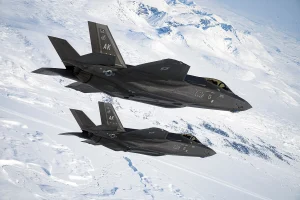
- Maintenance: coatings and seals degrade with weather, heat and handling. The U.S. Air Force, for example, has dedicated low-observable maintenance specialists who inspect and repair F-35 coatings and seams.
- Environmental endurance: naval and submarine applications must survive salt water, pressure and UV exposure.
Türkiye’s RAM and RAS work
| Organisation | Work | Publicly reported detail |
|---|---|---|
| ASELSAN | RAM and RAPID scattering analysis software | RAPID identifies a platform’s scattering centres; applying ASELSAN RAM to a UAV’s scattering centres reduced RCS to one-thousandth (Anadolu Agency) |
| ASELSAN | Composite radar-absorbing structures for submarines | Used to cover the periscopes of Reis-class (Type 214) submarines; factory acceptance tests held with tkMS, Hensoldt Optronics, SSB and the Naval Forces (Anadolu Agency) |
| TÜBİTAK MAM | RASEM software for KAAN | Electromagnetic modelling and optimisation of radar-absorbing multilayer thin-film coatings, especially for the canopy; delivered to TUSAŞ |
| TÜBİTAK MAM | HAVSET and FRESEÇ projects | Low-observable sets for KAAN’s air intake duct, and frequency-selective surface design for the radome |
For a wider view of KAAN’s sensors and stealth-related systems, see KAAN Radar and Avionics, and for the flying-wing approach to low observability, ANKA III and the Low-Observable UCAV Programmes.
Global examples
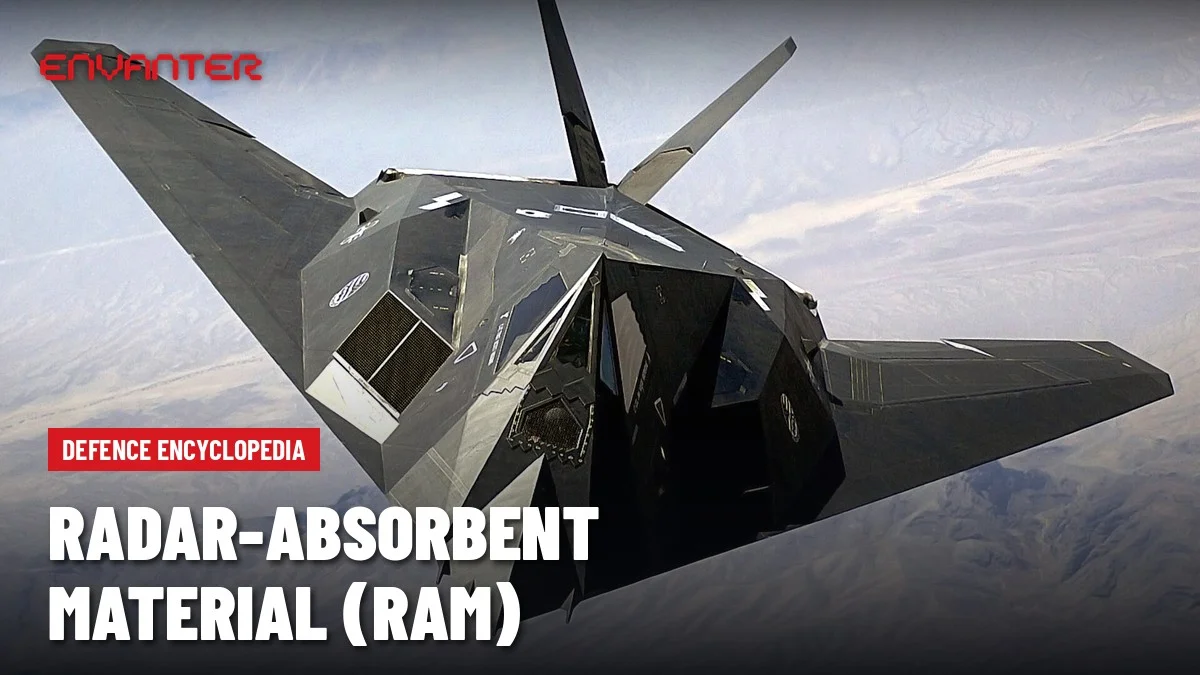
The F-117 Nighthawk combined faceted shaping with absorbent coatings, while later aircraft such as the B-2, F-22 and F-35 moved towards curved shaping, integrated structures and more durable coatings. You can read more in our explainers Why Radar Can’t See the F-35 and What Is Stealth Technology?.
Frequently asked questions
Does RAM make an aircraft invisible?
No. It reduces the radar echo and therefore the detection range; it does not eliminate detection, especially against low-frequency radars.
What is the difference between RAM and RAS?
RAM is generally applied as a coating or layer, while radar-absorbing structures (RAS) build absorption into the load-bearing composite structure itself.
Why is the canopy a special problem?
The canopy must stay optically transparent while preventing radar energy from reaching and reflecting off the cockpit interior, which is why thin-film coatings such as those modelled by TÜBİTAK MAM’s RASEM are used.
Is RAM used only on aircraft?
No. It is also used on ships, submarine masts and periscopes, ground vehicles, and in anechoic test chambers.
Related on Envanter Medya
- What Is Radar Cross Section (RCS)?
- What Is Stealth Technology?
- Why Radar Can’t See the F-35
- Glossary: Radar-Absorbent Material
Sources
- SSB Savunma Sanayii 360, Glossary (Radar Soğurucu Malzeme, Radar Kesit Alanı)
- Anadolu Agency, “Milli platformlar ASELSAN ile görünmez oluyor”
- Anadolu Agency, “Denizaltılar ASELSAN ile görünmez oluyor”
- TÜBİTAK MAM, RASEM software delivered to TUSAŞ
- TÜBİTAK MAM, systems developed for KAAN
- U.S. Air Force, Tyndall LO Airmen protect F-35 stealth capabilities
- ASELSAN radar-absorbent paint and materials (Millisavunma)
Verified and updated: 3 November 2026. This article was checked against the publicly available sources below and will be updated as new official information is released.
Cover photo: F-117 Nighthawk, front view. Public domain (U.S. Air Force), Wikimedia Commons: Wikimedia Commons