What Is Caliber? Bullet Size Explained Simply

# What Is Caliber? Bullet Size Explained Simply
Quick answer: Caliber is the diameter of a bullet (or the inside diameter of a gun barrel). Bigger caliber usually means a bigger bullet that hits harder. It’s written either in millimeters (like 9mm) or in inches (like .45, meaning 0.45 inches).
Two Ways to Write Caliber
| Style | Example | Meaning |
|---|---|---|
| Inches (US) | .22, .45, .50 | 0.22″, 0.45″, 0.50″ |
| Millimeters (NATO/metric) | 5.56mm, 9mm, 12.7mm | mm directly |
To convert: 1 inch = 25.4 mm. So .50 inch = 12.7 mm. .45 = 11.43 mm.
This is why .50 BMG = 12.7×99mm NATO. They’re the same thing, just two naming systems.
Common Calibers Table
| Caliber | Typical Use | Equivalent |
|---|---|---|
| .22 LR | Hunting small animals, target practice | 5.6 mm |
| 9×19 mm Parabellum | Pistols (most common) | .355″ |
| .45 ACP | Pistol (Colt 1911) | 11.43 mm |
| 5.56×45 mm NATO | Assault rifles (M4, M16, HK416) | .223″ |
| 7.62×39 mm | AK-47 | .310″ |
| 7.62×51 mm NATO | Sniper, machine gun (M14, FN MAG) | .308″ |
| .50 BMG (12.7×99) | Heavy machine gun, anti-material rifle | M2 Browning, Barrett |
| 7.62×54R | PKM machine gun, Mosin-Nagant | Russian |
| .338 Lapua | Long-range sniping | 8.6 mm |
| 14.5×114 mm | Heavy machine gun (KPV) | 14.5 mm |
| 20mm, 25mm, 30mm | Aircraft cannons | (autocannon) |
| 120 mm | Tank gun (M1 Abrams, Leopard 2) | (smoothbore) |
What the Numbers Mean — 7.62×51mm
Look at “7.62×51mm NATO”:
- 7.62 mm = bullet diameter
- 51 mm = case length (how long the brass shell is)
- NATO = the standard variant used by NATO
So a 7.62×54R Russian round is similar diameter but a longer case with more powder (different cartridge entirely).
Caliber vs Cartridge — Common Confusion
- Caliber = bullet diameter only
- Cartridge = the complete unit (bullet + casing + powder + primer)
A .308 Winchester and a 7.62×51mm NATO are nearly identical in caliber, but the cartridges have small differences in pressure and case dimensions.
Pistol Calibers Compared
| Caliber | Velocity | Stopping Power | Recoil |
|---|---|---|---|
| .22 LR | Low | Low | Very low |
| 9mm | Medium | Medium-good | Medium |
| .40 S&W | Medium | Good | Higher |
| .45 ACP | Lower | Excellent | High |
| .357 Magnum | High | Excellent | Hard |
| .50 AE (Desert Eagle) | Very high | Excessive | Brutal |
9mm is the most popular pistol round worldwide because of balance: cheap, low recoil, decent stopping power, high magazine capacity (15+ rounds usually).
Rifle Calibers Compared
| Caliber | Used By | Notable |
|---|---|---|
| 5.56×45 NATO | M4, M16, HK416, AR-15 | Fast, light, less recoil |
| 7.62×39 | AK-47, AKM, SKS | Heavy hitter, more recoil |
| 7.62×51 NATO | M14, FN FAL, MK14 EBR | Long range, heavy |
| .338 Lapua | Sniper rifles | 1,500 m+ range |
| .50 BMG | Barrett M82, M2 Browning | Anti-material, 2 km range |
5.56 vs 7.62×39 is one of the most famous debates in small arms — see article 27.
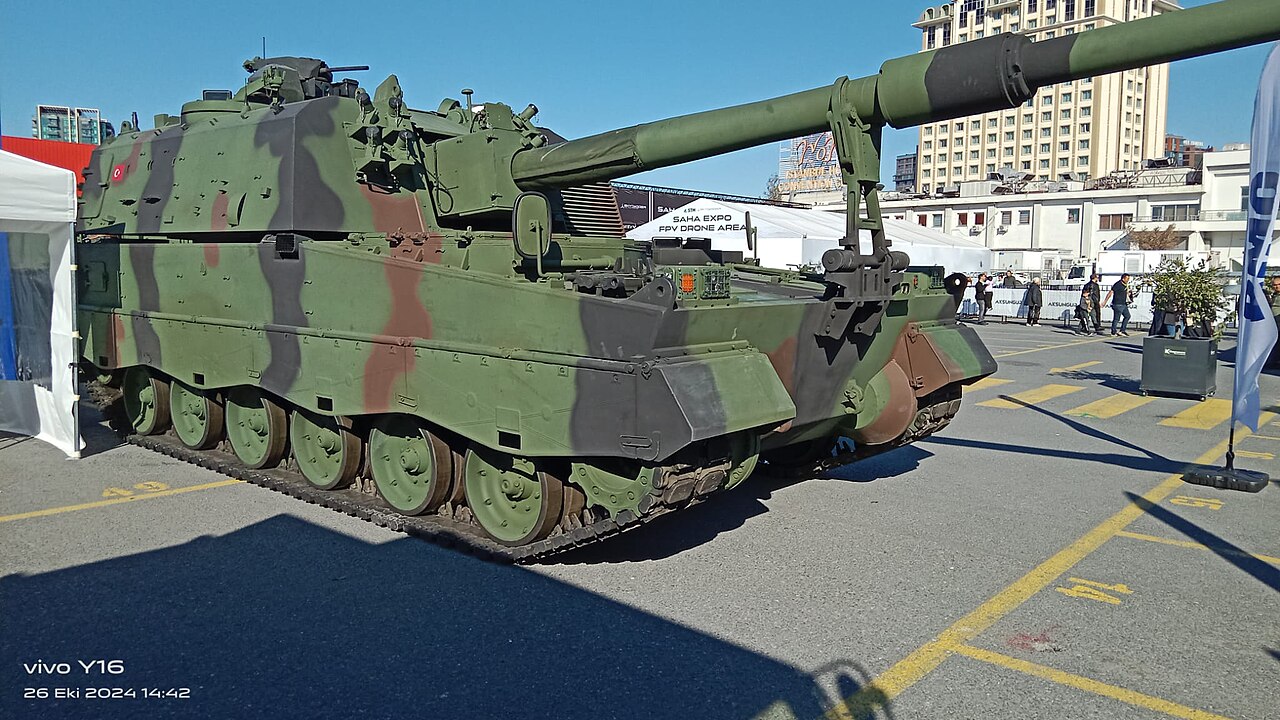
Why Tank Calibers Are So Big
Tank guns aren’t measured in mm of bullet but mm of barrel diameter:
- 105 mm: older NATO standard (M60, early Leopard 1)
- 120 mm: modern NATO standard (M1A2, Leopard 2, Altay)
- 125 mm: Russian standard (T-72, T-90, T-14)
- 152 mm: Soviet experimental (Object 195) and US ATACS planned
The actual penetrator inside might be only 22 mm thick (the dart of an APFSDS round), but the gun barrel is 120 mm.
Aircraft Cannon Calibers
| Caliber | Used On | Rate of Fire |
|---|---|---|
| 20 mm (M61 Vulcan) | F-15, F-16, F/A-18 | 6,000 rpm |
| 25 mm GAU-12 | AV-8 Harrier | 4,200 rpm |
| 27 mm Mauser BK | Tornado, Eurofighter | 1,700 rpm |
| 30 mm GAU-8 Avenger | A-10 Thunderbolt II | 3,900 rpm |
| 30 mm Gsh-30 | Su-25, Su-27 | 1,500 rpm |
The A-10’s GAU-8 30mm is famous — it fires depleted-uranium rounds that punch through tank armor.
A Kid-Friendly Analogy
Think of arrows. A normal arrow (.22) is good for rabbits. A bigger arrow (9mm) is good for deer. A spear (7.62) is good for boar. A javelin (.50 BMG) goes through cars. A tank shell (120 mm) goes through walls.
Same idea — bigger projectile = more damage but harder to carry and shoot.
Image Suggestions
- 1. Featured: Lineup of bullets .22 → .50 BMG to scale
- 2. Cartridge cutaway showing bullet, case, powder, primer
- 3. mm vs inch conversion chart
- 4. 5.56 vs 7.62 comparison
- 5. Tank shell next to rifle bullet for scale
Related Articles
- 5.56 vs 7.62 NATO — which is better?
- What is a sabot round?
- What is HEAT ammunition?
- What is a tracer round?
- What is .50 BMG?