What Is Radar Cross Section (RCS)? Stealth Measured Simply

# What Is Radar Cross Section (RCS)? Stealth Measured Simply
Quick answer: Radar Cross Section (RCS) is a number that tells you how big an object looks on radar — measured in square meters. A stealth fighter might have an RCS of 0.001 m² (size of a marble in radar terms), while a passenger plane has an RCS of 100 m² (size of a small building).
RCS is NOT the actual size of the object. A small radar reflector can have a huge RCS, and a giant stealth bomber can have an RCS like a bumblebee.
What Determines RCS?
Four main factors:
- 1. Shape — flat surfaces facing the radar = high RCS. Angled, curved = low RCS.
- 2. Size — bigger object = generally higher RCS
- 3. Materials — metal reflects strongly; radar-absorbing materials lower RCS
- 4. Frequency of radar — different RCS at different radar wavelengths
A stealth aircraft has very low RCS to typical X-band radars (the kind in most fighters), but may show much higher RCS to long-wave VHF radars.
RCS Comparison Table
| Object | Approximate RCS |
|---|---|
| Bumblebee | 0.00001 m² |
| B-2 Spirit | 0.0001 m² (bumblebee) |
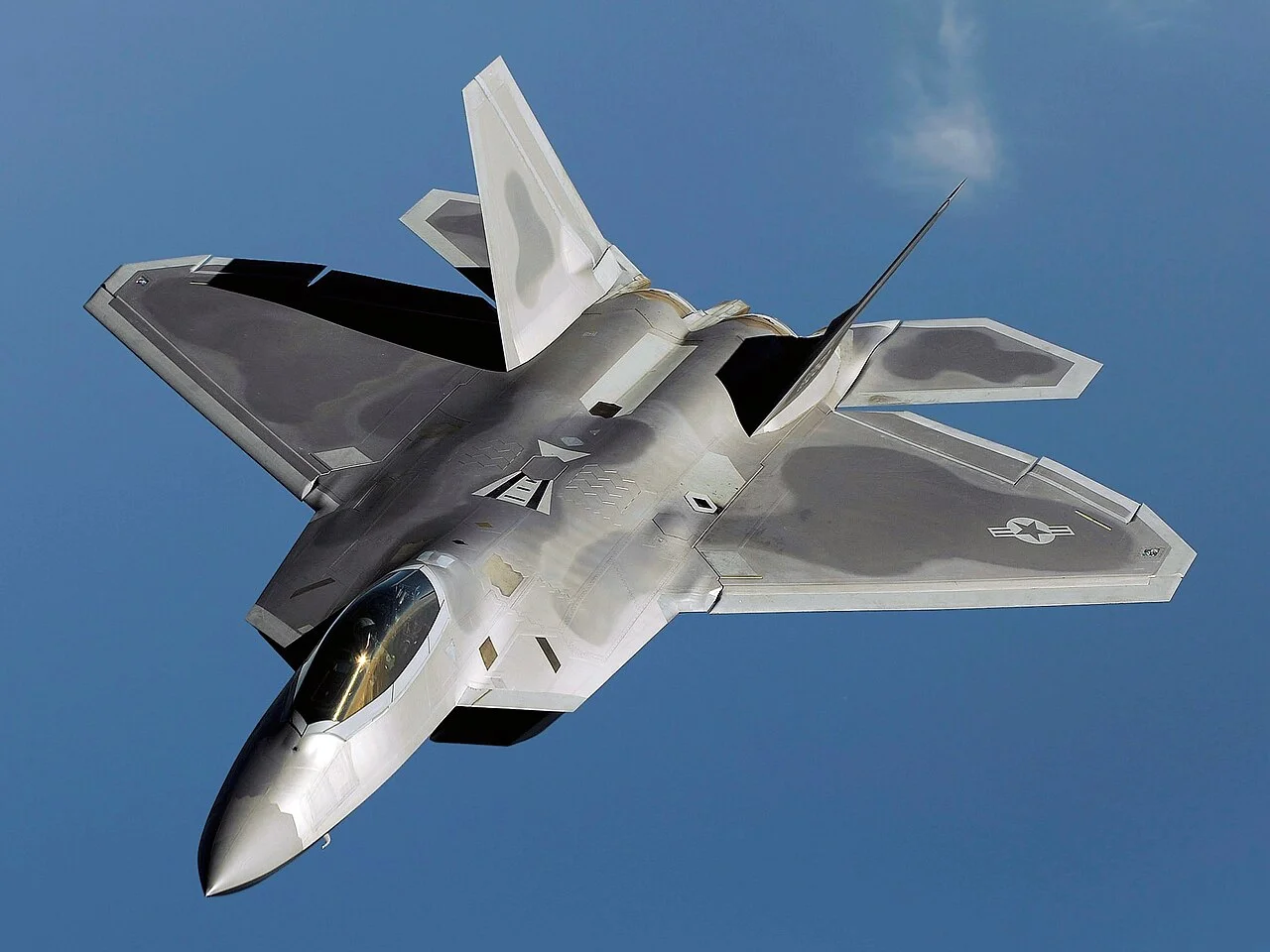
| F-22 Raptor | 0.0001 m² (bumblebee or less) |
| F-35 | 0.0015 m² (marble) |
| F-117 | 0.025 m² (golf ball) |
| Cruise missile | 0.05 m² |
| Bird (small) | 0.01 m² |
| Bird (large eagle) | 0.5 m² |
| Rafale | 0.5–1 m² |
| Eurofighter | 0.5–1 m² |
| Su-35 | 1–3 m² |
| MiG-29 | 5 m² |
| F-15 Eagle | 25 m² |
| Civilian airliner | 100 m² |
| Ship (frigate) | 1,000+ m² |
| Ship (carrier) | 100,000 m² |
Why RCS Is Measured This Way
RCS uses a strange unit: the equivalent area of a perfectly reflective sphere that would reflect the same signal.
So “1 m² RCS” doesn’t mean the object IS one square meter. It means the radar return is the same as a perfectly reflective metal ball with a cross-section of 1 m².
This is a useful unit because it lets engineers compare wildly different shapes on a single number.
The Stealth Shaping Tricks
To lower RCS, aircraft designers:
- Angle all flat surfaces so they don’t bounce radar back to source
- Align all edges parallel — bouncebacks happen at only a few angles (like flashes)
- Hide internal weapons — no external rails
- Smooth fuselage joints — no protruding bumps
- Cover engine intakes with serpentine ducts so radar can’t see the fan blades
The F-22’s intake duct is so twisted that no radar wave can reach the engine fan face.
The Importance of Frequency
Most fighter radars and SAMs use X-band (8–12 GHz) and Ku-band. Stealth aircraft optimize against these.
But VHF (30–300 MHz) and UHF (300 MHz–3 GHz) radars have wavelengths similar to aircraft features (wing edges, tail surfaces). At these frequencies, even stealth aircraft can be detected — though VHF radars give poor location accuracy and are vulnerable to jamming.
This is why Russia uses VHF radars like Nebo-M specifically to detect stealth.
RCS in Decibels — dBsm
Engineers often use dBsm (decibel relative to 1 square meter):
- 0 dBsm = 1 m²
- −20 dBsm = 0.01 m²
- −40 dBsm = 0.0001 m²
F-22 RCS is roughly −40 dBsm. F-35 is −30 dBsm. F-15 is +14 dBsm (= 25 m²).
RCS Affects Detection Range
Detection range goes with the fourth root of RCS:
- 10× smaller RCS = 1.78× less detection range
- 100× smaller RCS = 3.16× less detection range
- 10,000× smaller RCS (B-2 vs B-52) = 10× less detection range
So a B-2 might be detected at 30 km when a B-52 is detected at 300 km — but the B-2 is much harder to locate precisely.
RCS Reduction From Other Angles
RCS is direction-dependent. An aircraft might be invisible from the front but a “bowling ball” from the side or rear (engine exhaust!).
That’s why stealth aircraft attack head-on:
- F-22 and F-35 are most stealthy from the front
- F-117 was designed for forward attack profile
- Stealth bombers like B-2 are stealthy all around (whole-body design)
RCS of Ships and Tanks
- A modern stealth frigate (Visby, Zumwalt) has RCS like a small boat instead of a destroyer
- Tanks have huge RCS to ground radar but are usually hidden by trees and terrain
- New ships use sloped sides and radar-absorbing materials similar to aircraft
The USS Zumwalt destroyer has an RCS the size of a fishing boat — despite being 180 m long.
A Kid-Friendly Analogy
Imagine you’re in a dark room with a flashlight, looking for kids playing hide-and-seek.
- A kid wearing a white shirt = high RCS (easy to spot)
- A kid wearing dark camouflage = lower RCS
- A kid wearing a disco-ball outfit = enormous RCS (mirrors flash back!)
- A kid wearing stealth black clothes + dark face paint, crouched at an angle to your flashlight = very low RCS
RCS = how much of your flashlight beam bounces back to your eyes.
How RCS Is Measured
Real-world measurement happens in:
- Anechoic chambers — rooms covered in radar-absorbing foam to test small models
- Outdoor test ranges — full-size aircraft tested over distance
- In-flight measurement — exposed test flights
Each new stealth design goes through hundreds of RCS measurements before flying.
Image Suggestions
- 1. Featured: RCS comparison: bumblebee, marble, golf ball, truck
- 2. F-22 in anechoic chamber for RCS testing
- 3. RCS pattern (radial chart) showing direction-dependence
- 4. Stealth shaping diagram with reflected radar waves
- 5. Zumwalt destroyer with stealth sides
Related Articles
- What is stealth technology?
- What is radar?
- What is the F-22?
- What is AESA radar?
- What is the F-35?