Bozdoğan vs AIM-9X Sidewinder: One Rail, Two Procurement Logics

Bozdoğan and the AIM-9X Sidewinder occupy the same slot on a fighter’s wing rail, and the published data describes two remarkably similar weapons: imaging infrared seekers, wide engagement envelopes, thrust vector control. What separates them is not a specification line. It is maturity on one side and supply-chain independence on the other — and Türkiye is currently buying both.
One rail, two procurement logics
Short-range air-to-air missiles are the weapons of the moment everything has already gone wrong. The beyond-visual-range shot missed, the merge happened, and what matters now is how hard the missile can turn and how well its seeker holds a target that is throwing flares. Range figures, the number everyone reaches for first, matter least here.
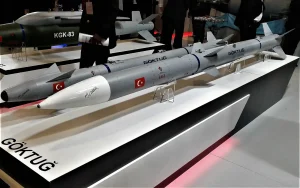
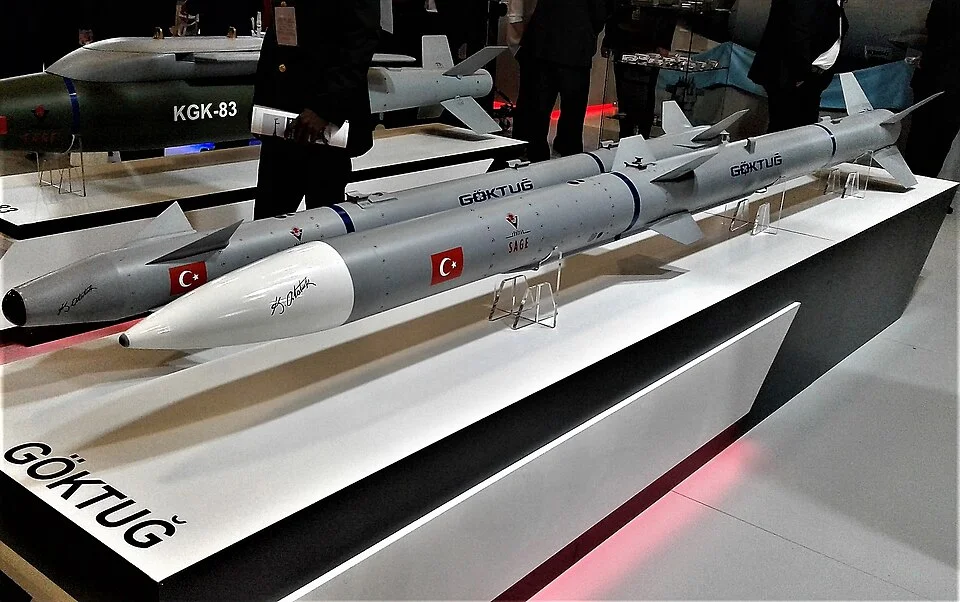
The Turkish Air Force has filled that slot with the American AIM-9 family for decades. Bozdoğan, developed by TÜBİTAK SAGE under the GÖKTUĞ programme, was built to put a domestic option in the same place. And this is where the comparison gets interesting, because the two missiles were never designed to be mutually exclusive at the hardware level.
One line on SAGE’s official product page makes the point. Bozdoğan is described as MIL-STD-1553 and MIL-STD-1760 compliant and usable with the LAU-129 launcher — the standard NATO rail that carries Sidewinders and AMRAAMs on F-16s and F-15s. The indigenous weapon does not ask the air force to rewire its fleet or stand up a parallel logistics chain. It steps into the existing standard. That is a strategic decision dressed as an engineering specification.
What each manufacturer actually claims
BOZDOĞAN
SAGE describes Bozdoğan as a highly manoeuvrable within-visual-range system equipped with advanced counter-countermeasures. The product page carries exactly one numerical performance value — a range of 25+ km — and otherwise lists capabilities in prose.
Guidance comes from a high-resolution infrared seeker offering, in SAGE’s wording, an excellent off-boresight angle, meaning the missile can be launched at targets well away from where the aircraft’s nose is pointing. All-aspect launch is claimed. Propulsion uses a high-thrust, reduced-smoke solid propellant — reduced smoke matters because a visible plume warns the target — combined with thrust vector control, which steers the motor exhaust to generate turn rates that fins alone cannot deliver. The warhead is described as an original blast-fragmentation design with a continuous fuze, backed by a fully electronic safe-arm and fire system.
Dimensions, mass and speed do not appear on the SAGE page. Figures of 3.3 m, 160 mm and 140 kg attributed to the Turkish Ministry of Industry and Technology circulate widely; the frequently repeated Mach 4 claim has no direct official basis.
Where a row in the table below says a figure was not published, that is not a claim the capability is absent. It means no verifiable number exists in open sources. No estimates were substituted for missing data.
AIM-9X Block II
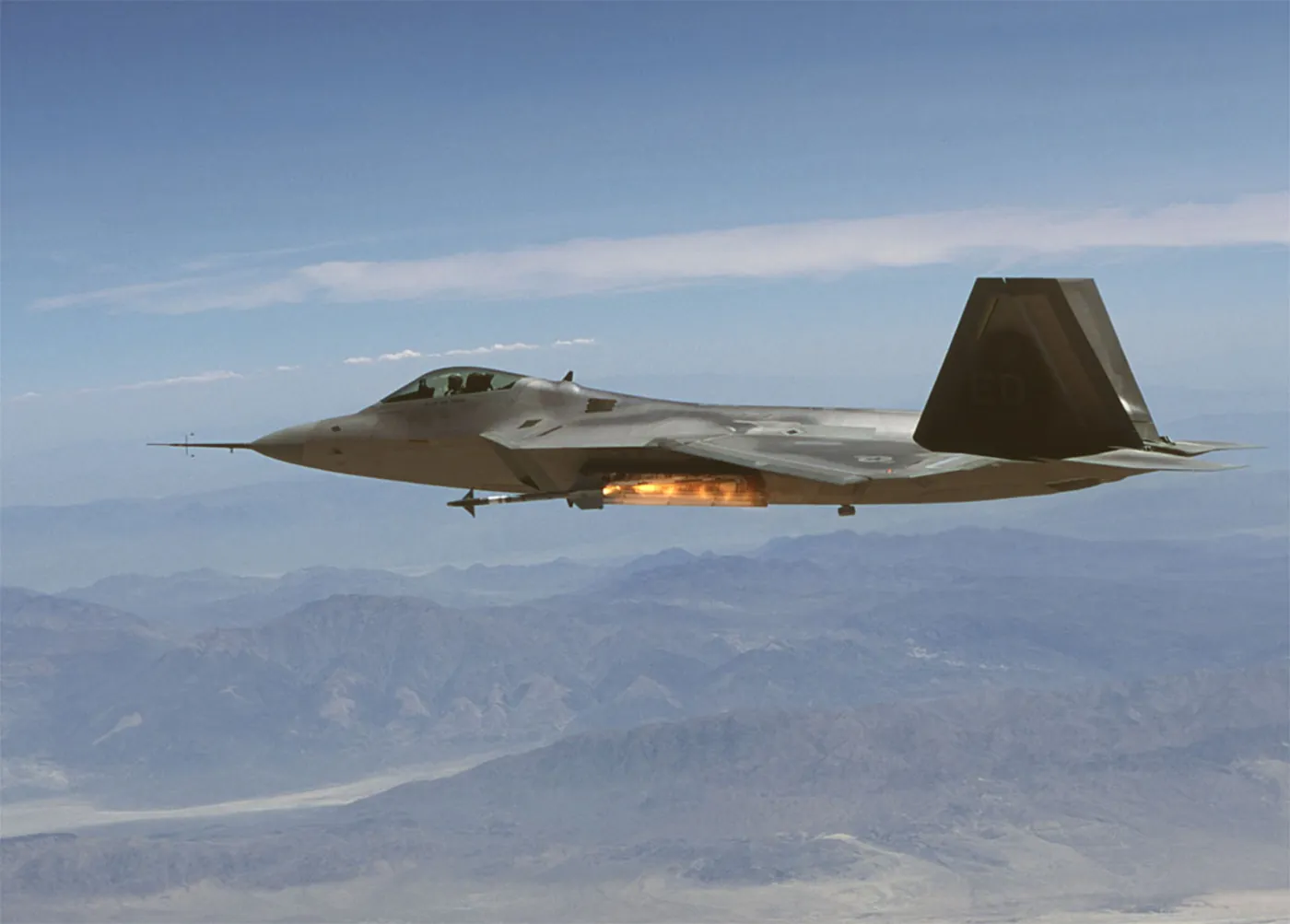
The AIM-9X is the current link in a Sidewinder lineage running back to the 1950s. RTX describes it as a US Navy-led joint programme with the Air Force, usable in air-to-air engagements and surface-launch missions without modification — the latter role realised inside the NASAMS air defence system, where the missile forms the short-range layer.
Block II’s additions are stated plainly by the manufacturer: a redesigned fuze, a digital ignition safety device improving handling and in-flight safety, updated electronics, and lock-on-after-launch capability using a new weapon datalink to support beyond-visual-range engagements. That last item is the substantive one. A missile that can be fired before it sees the target, then handed a track in flight, is doing something structurally different from a classic dogfight weapon.
The seeker is widely reported as a 128×128 element imaging infrared focal-plane array with roughly 90 degrees of off-boresight capability, paired with two-axis thrust vector control. Neither RTX nor the US Navy publishes range or speed.
Specification comparison
| Criterion | BOZDOĞAN | AIM-9X Block II |
|---|---|---|
| Class | Within-visual-range air-to-air missile (TÜBİTAK SAGE) | Short-range air-to-air missile; surface-launch capable without modification (RTX) |
| Developer | TÜBİTAK SAGE, Türkiye | RTX (Raytheon), United States |
| Programme | GÖKTUĞ air-to-air missile programme | US Navy-led joint programme with the US Air Force (RTX) |
| Declared range | 25+ km (TÜBİTAK SAGE) | Not published in official sources |
| Top speed | Not published on the SAGE product page | Not published in official sources |
| Seeker | High-resolution imaging infrared seeker with a wide off-boresight angle (TÜBİTAK SAGE) | 128×128 element imaging infrared focal-plane array; roughly 90° off-boresight (open sources) |
| Engagement envelope | All-aspect launch capability (TÜBİTAK SAGE) | All-aspect launch; compatible with helmet-mounted cueing |
| Lock-on after launch | Not stated on the SAGE product page | Datalink-enabled LOAL introduced with Block II (RTX) |
| Propulsion and control | High-thrust reduced-smoke solid propellant; thrust vector control (TÜBİTAK SAGE) | Solid-propellant rocket motor; two-axis thrust vector control |
| Counter-countermeasures | Advanced counter-countermeasure capability (TÜBİTAK SAGE) | Discrimination provided by the imaging seeker |
| Warhead | Blast-fragmentation warhead of original design; continuous fuze (TÜBİTAK SAGE) | Annular blast-fragmentation warhead; redesigned fuze in Block II (RTX) |
| Safety architecture | Fully electronic rocket motor safe-arm and fire system (TÜBİTAK SAGE) | Digital ignition safety device in Block II (RTX) |
| Length / diameter / weight | 3.3 m / 160 mm / 140 kg (Turkish Ministry of Industry and Technology; not on the SAGE page) | 3.02 m / 127 mm / about 85 kg (open sources) |
| Interface standard | MIL-STD-1553 and MIL-STD-1760; LAU-129 launcher (TÜBİTAK SAGE) | NATO-standard rail launchers, LAU-129 included |
| Known platforms | F-16 for firing trials; planned for KAAN and HÜRJET | F-15C/E, F-16, F/A-18, EA-18G, F-22, all F-35 variants, NASAMS (RTX) |
| Operators | Turkish Air Force; no export customer announced | More than 30 foreign military sales partners (RTX) |
| Service status | Firing trials completed; entering service | Block I in service since 2003; Block II still in production |
Compiled from the TÜBİTAK SAGE and RTX product pages and DSCA releases. No estimates were used where official figures are unavailable.
Where the mission concepts diverge
Read the table row by row and the two weapons track each other closely. That is not coincidence: the modern short-range missile has a settled technical grammar — imaging infrared seeker, wide launch envelope, thrust vectoring, fragmentation warhead — and both designs are written in it.
The divergence sits in the ecosystem around each missile. The AIM-9X is held by more than 30 export partners, has been in service since 2003 and works from a fighter rail or a ground-based launcher without modification. In 2025 alone the US State Department cleared Block II sales to Denmark, Norway and the NATO Support and Procurement Agency. Within NATO the missile functions as a de facto common standard, with all the logistics and training economies that implies.
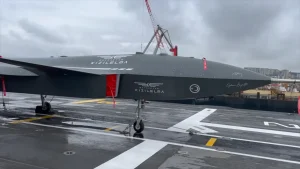
Bozdoğan offers something the AIM-9X structurally cannot: a weapon with no external authorisation attached to it. Where a missile may be carried, on which platform, and against which target is not purely a technical question, and Türkiye’s procurement experience over the past fifteen years — removal from the F-35 programme, assorted export-licence delays — has made that concrete rather than theoretical. Integration freedom follows from the same logic: putting GÖKTUĞ weapons on KAAN, HÜRJET or an uncrewed platform is Ankara’s decision alone. The GÖKDOĞAN shot from KIZILELMA in November 2025 is what that freedom looks like in practice.
What the published record supports
- AIM-9X: two decades of accumulated service data, more than 30 operators, multi-platform and surface-launch use, and datalink lock-on-after-launch confirmed by the manufacturer.
- Bozdoğan: a declared 25+ km range, thrust vector control, advanced counter-countermeasures, and NATO-standard interfaces that avoid a parallel logistics chain.
- Unresolved for Bozdoğan: production volume, operational maturity, and whether a datalink or LOAL capability exists but is undisclosed.
- Unresolved for both: real-world performance under electronic warfare and countermeasures is never published, which is the boundary of any open-source comparison.
What it means for Türkiye
Building an air-to-air missile is among the harder problems in defence engineering: an infrared seeker, high-dynamic guidance algorithms and thrust vector control all have to work together in a package the size of a fence post. The number of countries that can assemble that combination domestically is small, and Türkiye has joined it.
The interface choice matters as much as the physics. By designing Bozdoğan around the LAU-129, SAGE kept the indigenous weapon inside NATO standards — easing the transition on the existing F-16 fleet and, in any future export scenario, sparing a customer from rebuilding its own infrastructure.
Then there is the fighter argument. KAAN can only be an air-superiority aircraft in any meaningful sense if the weapons it carries are also sovereign; otherwise independence ends at the weapons rack. GÖKTUĞ supplies the missile side of that equation. And the continuing AIM-9X purchases are not a contradiction but transition management: an indigenous system entering service does not empty the existing magazine overnight, and running both lines in parallel spreads risk while capability holds.
Assessment
Asking which missile is better pushes past what open sources can support. Both are built around imaging infrared seekers, wide launch envelopes and thrust vector control, and the published figures do not permit a meaningful ranking on those headings.
They differ in terms of use case. The AIM-9X is a mature, interoperable weapon whose Block II datalink and lock-on-after-launch widen the engagement window of a short-range round. Bozdoğan builds a different equation around freedom of employment, integration autonomy and a domestic supply chain.
Taking operator choices into account, the most telling data point is that Türkiye is running both lines at once. Sustaining an existing capability while an indigenous one accumulates operational maturity suggests these systems address different mission concepts rather than cancelling each other out.
Can Bozdoğan replace the AIM-9X on Turkish F-16s?
The interface was clearly designed with that in mind. TÜBİTAK SAGE lists Bozdoğan as MIL-STD-1553 and MIL-STD-1760 compliant and compatible with the LAU-129 launcher — the standard NATO rail that carries both Sidewinder and AMRAAM on the F-16 and F-15. In other words, the Turkish missile slots into the existing standard rather than building a parallel ecosystem around itself. How quickly it displaces stockpiled Sidewinders is a separate question of production volume.
How far can each missile fly?
SAGE publishes a single performance figure for Bozdoğan: 25+ km. Neither RTX nor the US Navy has released an official range for the AIM-9X, and figures circulating in open sources are not officially confirmed. For short-range weapons the catalogue number is a weak comparator anyway: the achievable envelope shifts with launch altitude, closure rate and aspect angle.
Is Türkiye still buying AIM-9X missiles?
Yes. On 14 May 2025 the US State Department approved a foreign military sale to Türkiye covering 60 AIM-9X Block II all-up-round missiles and 11 tactical guidance units, at an estimated $79.1 million. Ankara is therefore fielding an indigenous missile and continuing to procure the American one at the same time — the two lines have not been framed as mutually exclusive.
What can the AIM-9X do that Bozdoğan is not documented as doing?
Lock-on after launch. RTX states that Block II adds a new weapon datalink enabling the missile to be fired before it has acquired the target, then cued onto it in flight. SAGE’s Bozdoğan page contains no corresponding datalink or LOAL claim. Whether that reflects an absent capability or an undisclosed one cannot be resolved from open sources.
Which aircraft will carry Bozdoğan?
Firing trials were flown from the F-16. GÖKTUĞ weapons are intended for Türkiye’s indigenous platforms, including the KAAN fighter and the HÜRJET trainer/light combat aircraft. On 30 November 2025 the family’s beyond-visual-range member, GÖKDOĞAN, was fired from the uncrewed KIZILELMA combat aircraft and hit its target — an event TÜBİTAK SAGE announced as a world first.
Related coverage
- KAAN munitions: the ROKETSAN and SAGE weapons package
- KAAN technical specifications: engine, radar and dimensions
- What is HÜRJET, Türkiye’s indigenous jet trainer?
- What is Bayraktar KIZILELMA, Türkiye’s uncrewed combat aircraft?
- Turkey’s defence industry: the landmark projects of the last 25 years
- AKINCI downed a Chinese-built CH-95 over Sudan with an EREN missile
Sources and verification note
- TÜBİTAK SAGE — BOZDOĞAN within-visual-range air-to-air missile product page — Range, seeker, thrust vector control, warhead, MIL-STD and LAU-129 compatibility
- TÜBİTAK SAGE — statement on BOZDOĞAN and GÖKDOĞAN firing trials, 19 October 2025 — Official confirmation that both missiles completed demanding firing trials
- TÜBİTAK SAGE — GÖKDOĞAN fired from KIZILELMA, 30 November 2025 — Official account of the first air-to-air missile launch from the uncrewed combat aircraft
- RTX / Raytheon — AIM-9X SIDEWINDER Missile product page — Programme structure, 30-plus FMS partners, platform list, Block II changes and NASAMS surface launch
- Defense Security Cooperation Agency — Türkiye: AIM-9X Sidewinder Block II Missiles — The 14 May 2025 approval: 60 missiles, 11 tactical guidance units, an estimated $79.1 million
- Defense Security Cooperation Agency — 2025 AIM-9X Block II approvals for Denmark, Norway and NSPA — European procurement decisions illustrating how widely the missile is held across NATO
Only manufacturer and official government sources were used. Where an official figure was unavailable, no estimate was substituted; those rows are marked explicitly.
Editor’s note: this is a mission-concept comparison, not a ranking. The two missiles reflect different procurement logics and different levels of operational maturity. Figures reflect open official sources as of publication; programme status can change.