What Is the DEARSAN OPV-76? The $160 Million Turkish OPV That Put Nigeria’s Navy on Watch in the Gulf of Guinea

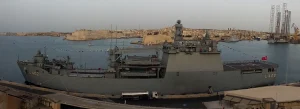
A $160 million contract for two offshore patrol vessels delivered to Nigeria’s Navy — and a Turkish private-sector shipyard that most international procurement officials had never heard of before the ink dried. DEARSAN’s OPV-76 is the vessel that put the Tuzla-based yard on the West African naval map. At 76 metres, it is purpose-built for the task that Nigeria needs done most urgently: credible offshore presence in the Gulf of Guinea, where piracy against tankers and offshore platforms has made the waterway one of the most dangerous maritime zones on the planet.
What is an OPV — and why does Nigeria need one?
An Offshore Patrol Vessel (OPV) is a purpose-designed warship for extended operations beyond the coastal zone: patrolling the Exclusive Economic Zone (EEZ), interdicting illegal trafficking, conducting anti-piracy operations, and coordinating maritime search and rescue. Smaller than a corvette in armament and complexity, an OPV trades combat depth for range, endurance, and economics — it keeps a flag on the water for weeks at a time at a fraction of the cost of a full warship.
Nigeria’s requirement is direct: the Gulf of Guinea accounts for a substantial share of global piracy incidents. Oil platforms, tankers, and supply vessels operating off the Niger Delta are routine targets. Credible offshore deterrence demands a platform that can stay on station, not one that has to return to harbour every three days.
OPV-76 specifications
| Parameter | Value |
|---|---|
| Length | 76 metres |
| Builder | DEARSAN Shipyard, Tuzla / Istanbul |
| Customer | Nigerian Navy |
| Hulls delivered | 2 |
| Contract value | ~USD 160 million |
| Platform type | Offshore Patrol Vessel (OPV) |
Full weapons fit and electronics suite details are not disclosed in open-source reporting.
The contract and its significance
At approximately $160 million for two hulls, the DEARSAN–Nigeria contract represents one of the largest single-award values in Turkish private-sector naval exports. Both vessels have been delivered. Several factors make this deal notable beyond its headline number:
- It established DEARSAN as a reference supplier in Sub-Saharan Africa — a market where European yards (Fincantieri, Damen, CMN) have historically dominated;
- It demonstrated that Turkish OPV designs are competitive at a price point accessible to African naval programmes with constrained budgets;
- It proved DEARSAN’s ability to manage a full export contract lifecycle — design, construction, delivery, and post-delivery support — for a demanding customer at range.
Gulf of Guinea context
The International Maritime Bureau consistently ranks the Gulf of Guinea among the world’s top-three piracy hotspots. Armed robbery at anchor, crew kidnappings, and attacks on offshore support vessels represent a chronic threat to the regional economy — Nigeria alone loses an estimated billions of dollars annually to oil theft and associated maritime crime. The OPV-76 enters service in an environment where its presence is not ceremonial.
DEARSAN’s position in Turkish naval exports
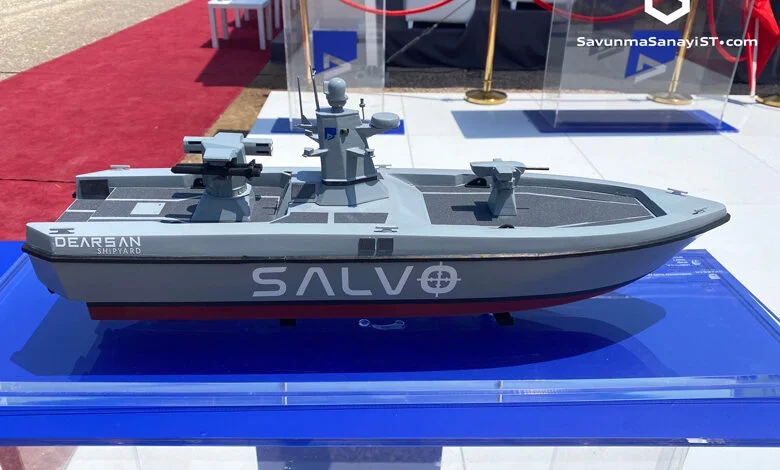
DEARSAN — Deniz Araçları Sanayii A.Ş. — specialises in small-to-medium naval vessels from its facility in Tuzla, Istanbul. Its export catalogue includes the SALVO SIDA patrol vessel and the OPV-76. The Nigeria contract is the yard’s highest-value export to date and its clearest proof of large-platform delivery capability.
Competitive context
In the 76-metre OPV segment, DEARSAN competes against established European suppliers:
- Damen (Netherlands): The world’s most prolific OPV supplier by hulls delivered;
- CMN (France): Strong West African market presence, particularly Aviso 400 and Vigilante series;
- Fincantieri (Italy): Active in African naval programmes with technology-transfer offers;
- TKMS (Germany): MEKO A-100 and OPV-adjacent platforms.
DEARSAN’s competitive position rests on Turkey’s price advantage relative to Western European shipbuilders, shorter delivery timelines, and a demonstrably responsive post-contract support posture.
Assessment
The OPV-76 is the vessel that validated DEARSAN as a credible exporter at the large-platform tier. The $160 million Nigeria contract was not won on brand recognition — it was won on specification, price, and delivery credibility. Both hulls delivered means the reference is clean. For procurement officials across West Africa and the Gulf evaluating OPV programmes, DEARSAN now appears on the shortlist where it did not before.
Sources
- DEARSAN Shipyard — Official website: dearsan.com
- SSB (Presidency of Defence Industries): ssb.gov.tr
- NavalNews: navalnews.com
- Dearsan (official) — DEARSAN: Dearsan (official) — OPV-76 programme for the Nigerian Navy
- GlobalSecurity.org — Nigerian Navy: globalsecurity.org