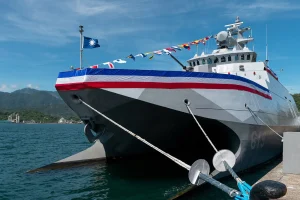
Yonca Shipyard: the composite-hull builder behind 170 fast craft in 11 countries

Most navies assessing fast interceptors still frame the decision as a hull-material
trade-off: steel or aluminium, with composite treated as the exotic option. Yonca Shipyard has
spent nearly four decades arguing the opposite case, and has 170-plus delivered hulls across 11
countries to put behind it.
Aeronautical origins
The yard was established in Istanbul in 1986 by Dr Ekber Onuk, an aeronautical engineer, together
with his partner Şakir Yılmaztürk. That background is not incidental. Weight-to-strength
optimisation is the founding problem of aircraft design, and it is the same equation that governs
planing-hull performance. Dr Onuk remains vice chairman of the board.
The design that opened the market was the Onuk MRTP-15, which won a competitive tender; the first
hull was launched in June 1998.
The MRTP family
The product range covers eight distinct fast patrol and fast attack designs, running from the
12.65 m MRTP 12 to the 52 m MRTP 49. Spanning that range on a single design philosophy is the
yard’s principal commercial argument: a customer operating harbour-security craft and offshore
patrol boats can stay with one builder, one hull technology and one support chain.
The highest-production member is the MRTP 16 fast interceptor craft, with 59 units built and
delivered. Recipients include the United Arab Emirates, Malaysia, Qatar, Oman, Ukraine, Turkish
Customs Enforcement and Turkish health authorities.
76.4 knots, fully loaded
An MRTP 16 interceptor recorded 76.4 knots (roughly 141.5 km/h) at full payload. The qualifier
carries the technical weight. Light-ship speed figures are routine marketing in this segment;
sustained speed with mission load embarked is the number that survives contact with an operational
tasking.
Export record
Exports have gone to Georgia, the United Arab Emirates, Pakistan and Malaysia among others.
Public figures put cumulative deliveries at more than 170 boats to 15 government agencies across 11
countries. Coast guards and customs enforcement bodies dominate that customer base, and their
requirement set – high dash speed, low maintenance burden, long hull life – maps directly onto what
a composite hull delivers.
Sancar and the unmanned turn
The yard’s move into unmanned systems is the Sancar armed unmanned surface vessel. The hull is
built from advanced composite and equipped by Yonca, with mission software supplied by HAVELSAN.
The design is intended to support anti-surface warfare and mine countermeasure tasking.
According to Janes reporting from NAVDEX 2025, the yard is developing a larger 22 m variant based
on the MRTP 20 hull, targeting sea keeping up to Sea State 5 and a range exceeding 500 nautical
miles. That growth path addresses the standard structural criticism of small USVs: useful payload
and endurance are limited far more by hull volume than by autonomy software.
Factbox
| Yard | Yonca-Onuk Shipyard (Yonca Shipyard) |
|---|---|
| Founded | 1986, Istanbul |
| Founders | Dr Ekber Onuk and Şakir Yılmaztürk |
| First hull | Onuk MRTP-15, launched June 1998 |
| Product range | Eight designs; MRTP 12 (12.65 m) to MRTP 49 (52 m) |
| Highest production | MRTP 16 fast interceptor craft, 59 units |
| Speed record | 76.4 knots at full payload (MRTP 16) |
| Deliveries | 170+ boats to 15 government agencies in 11 countries |
| Export markets | Georgia, UAE, Pakistan, Malaysia and others |
| Unmanned platform | Sancar AUSV; mission software by HAVELSAN |
| Hull material | Advanced composite |
Questions readers ask
What does MRTP stand for in practice?
It is the yard’s type designation for its fast patrol and attack craft family. The number
approximates hull length in metres.
Why composite rather than aluminium?
Lower structural weight for a given strength yields higher speed on the same powerplant, and the
absence of galvanic corrosion reduces through-life maintenance in high-tempo coast guard use.
Who supplies Sancar’s autonomy?
Mission software comes from HAVELSAN; the hull and equipment fit are Yonca’s.
How large is the new Sancar variant?
Janes reported a 22 m design based on the MRTP 20 hull, aiming at Sea State 5 capability and more
than 500 nautical miles of range.
Sources: Yonca Shipyard product pages, IDEF and SAHA EXPO exhibitor records, Janes reporting from
NAVDEX 2025. Delivery and performance figures reflect manufacturer statements and open sources.