Dutch Navy Bets on Low-Cost Interceptors: Destinus Hornet B2 Goes to Sea


The Netherlands Ministry of Defence has contracted Destinus to develop a kinetic counter-UAS capability for the Royal Netherlands Navy, the two sides confirmed on 24 August 2026. The work will deliver Hornet B2 interceptors and integrate them aboard several Dutch warships.
Structured as a Concept Development and Evaluation programme, the effort also covers logistics support and the groundwork for a possible initial operating capability. Completion is scheduled for the second quarter of 2027 — an unusually compressed timeline by European procurement standards.
The arithmetic that forced the decision
Navies operating in the Red Sea and the Black Sea have spent three years learning an uncomfortable lesson: the engagement may succeed while the economics fail. Firing a multimillion-euro air defence missile at a drone that cost a few thousand dollars wins the fight and loses the campaign, because magazines empty faster than industry can refill them.
Destinus CEO Mikhail Kokorich framed the programme in exactly those terms, arguing that low-cost aerial threats have inverted the economics of naval air defence and that no navy can sustainably trade premium missiles against cheap threats arriving in volume.
Hornet B2 is not a replacement for existing shipborne air defence. It is an additional layer, designed to preserve high-end effectors for targets that genuinely require them.
Missile readiness, aircraft endurance
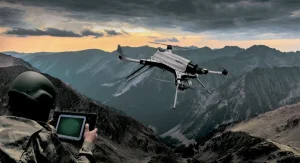
The interceptor departs from conventional missile architecture. A rocket booster ejects it from a sealed canister; folding wings then deploy and the vehicle transitions to electric cruise flight. Destinus describes the result as missile-like readiness combined with aircraft-like range and endurance, at a cost per engagement well below traditional interceptors.
Targeting relies on electro-optical and infrared sensors, with AI-assisted processing in the terminal phase. Engagement authority stays with a human operator. The canister approach allows dense deck stowage and equally supports ground vehicles and fixed sites. The earlier Hornet B1 was credited with an operational range beyond 70 kilometres and a payload of roughly three kilograms, sitting between VSHORAD and SHORAD.
Operators inside the design loop
Royal Netherlands Navy personnel will take part throughout development, helping define requirements for the interceptor itself, its shipboard integration, logistics and operating procedures. Kokorich said developing the capability with COMMIT and the navy from day one means the system will be shaped by the people who will depend on it.
A pattern, not an outlier
Destinus signed a memorandum of understanding earlier in August with Denmark’s Cubedin and Odense Maritime Technology to package Hornet interceptors into standard 10ft and 20ft containerised mission modules. Containerisation would let smaller hulls carry a counter-drone layer without a purpose-built launcher installation.
The Dutch programme, the Danish modules and parallel European work on cheap interceptors all point the same way. After the Red Sea engagements, the doctrine of answering every threat with the most expensive available effector is being quietly retired.
Neither unit cost nor the specific ships involved were disclosed. The programme’s 2027 output will indicate whether a two-year concept-to-capability cycle is realistic for naval air defence.