What Are TCG Bayraktar and TCG Sancaktar? Turkey’s Largest Amphibious Warships Explained

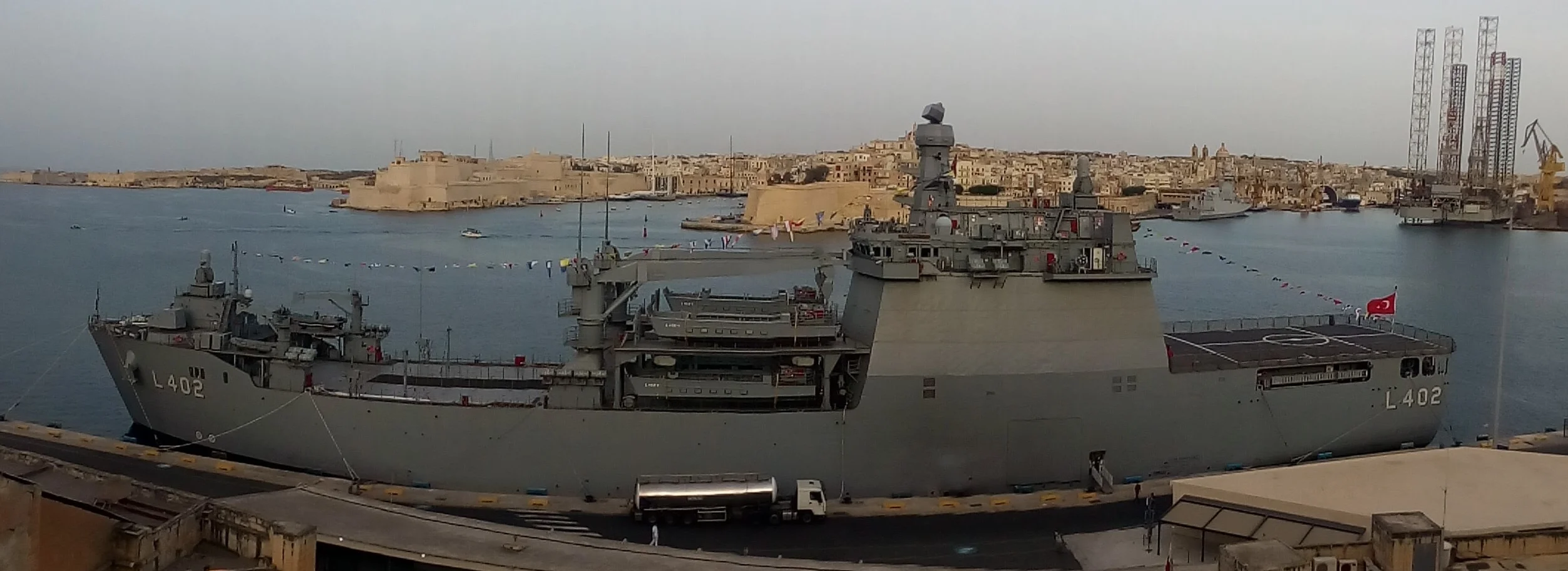
On a July morning in Malta’s Grand Harbour, two grey hulls drew the eye of every naval observer present. TCG Bayraktar (L-402) and TCG Sancaktar (L-403) — Turkey’s Bayraktar-class landing ship tanks — were transiting the Mediterranean, quietly demonstrating that a NATO member on Europe’s southeastern flank had joined the short list of nations capable of projecting armoured force across open water. At 138.75 metres, they are the largest and most capable amphibious platforms the Turkish Navy has ever commissioned.
Origins and contract
The programme was born from a recognition that Turkey’s amphibious force — built around ageing LCT and LCVP craft — could not project credible power at operational range. The Undersecretariat for Defence Industries (SSM) contracted Anadolu Shipyard in Tuzla, Istanbul, on 16 June 2011. Both hulls were built to a design that prioritises command capability, heavy vehicle carriage, and seakeeping over sprint speed.
Specifications
| Parameter | TCG Bayraktar (L-402) | TCG Sancaktar (L-403) |
|---|---|---|
| Hull length | 138.75 m | |
| Launched | 2015 | 2016 |
| Commissioned | 2017 | 2018 |
| Propulsion | 4 × MTU diesel engines, 2,880 kW each | |
| Generators | 4 × 800 kW | |
| Builder | Anadolu Shipyard, Tuzla/İstanbul | |
Combat systems and sensors
The electronics suite reflects the level of integration Turkey now demands from major warship programmes:
- Thales Smart-S Mk2 3D radar: Long-range air and surface search and tracking. A proven NATO-standard sensor also fitted to Turkish frigates and corvettes, enabling networked air-picture sharing.
- ASELSAN LPI navigation radar: Low Probability of Intercept design masks the ship’s emissions from enemy electronic-warfare systems — an increasingly standard requirement for high-value platforms operating in contested waters.
- SeaSentor torpedo countermeasure system: Acoustic decoy launcher that detects and deflects torpedo threats. Underscores the platform’s design as a ship expected to operate in multi-threat environments, not merely in benign sea-lanes.
Full details of armament fits and command-and-control systems are not published in open sources, consistent with Turkish Navy practice for operational platforms.
Amphibious role
The LST designation means exactly what it says: these ships beach-land or off-load tanks and armoured vehicles across a ramp, in addition to carrying personnel and cargo. The step-change over Turkey’s previous LCVP and LCT fleet is not just tonnage — it is range, seakeeping, and command headroom. Each ship has a helicopter operating deck (hangar capacity not formally specified in public sources), a command centre, and the logistics depth to sustain sustained amphibious operations.
The practical effect: Turkey can now embark an armoured battle group in Tuzla and disembark it on a contested beach across the Eastern Mediterranean or Black Sea without relying on a third country’s organic sealift.
Operational record
Since commissioning, both vessels have participated in Turkish Navy exercises and have been photographed at ports across the Mediterranean during NATO-related taskings. Detailed operational history is not released in open domain — standard for a navy operating close to multiple contested zones. The Grand Harbour transit photographs (from which the Valletta harbour images originate) provided one of the cleaner public records of the ships in operational condition.
Role in Turkey’s layered amphibious structure
The Bayraktar class now occupies the middle tier of Turkey’s amphibious order of battle:
- TCG Anadolu (L-400) — a 232-metre LHD commissioned in 2023, the flagship of Turkish amphibious power, capable of embarking F-35B in a potential future configuration.
- TCG Bayraktar / Sancaktar — the working LSTs that go where the LHD cannot: shallower approaches, tighter harbours, faster turnaround tasking.
- LCT / LCVP craft — the shore-to-shore last mile, operating off the LST and LHD as needed.
This is no longer a light coastal force. Turkey now has a structured, layered amphibious capability — and the Bayraktar class is its load-bearing middle tier.
International context
At 138.75 metres the Bayraktar class sits comfortably in the mid-tier LST bracket alongside Russia’s Ropucha class (~113 m) and above legacy Alligator-class hulls. It does not compete in tonnage with the US Navy’s Harpers Ferry-class LSD at 186 m, but it was never designed to. The design goal was credible regional power projection by a NATO ally — that goal has been met.
Sources
- Bayraktar-class landing ship tank — Wikipedia: en.wikipedia.org
- Anadolu Shipyard — Official website: anadolushipyard.com
- Savunma Sanayii Başkanlığı (SSB): ssb.gov.tr
- Naval News — Anadolu Shipyard: Naval News — TCG Bayraktar and TCG Sancaktar class — independent naval coverage
- NavalNews: navalnews.com