What Is SALVO SİDA? Turkey’s First Armed Unmanned Surface Vehicle, Explained

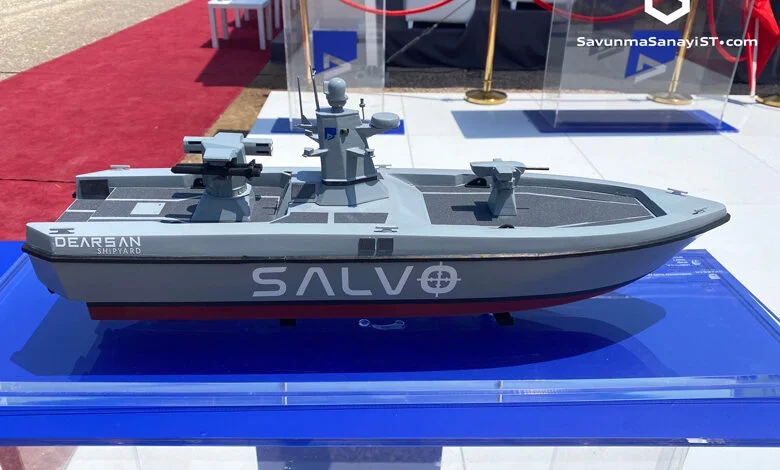
On 28 August 2025 a 14.79-metre unmanned boat completed its acceptance trials in the Sea of Marmara and was handed over to the Turkish Naval Forces Command under hull number TCB-1401. Guided from a shore control station 11 kilometres away, it had already put guided missiles and a stabilised heavy machine gun on target during live-fire tests. With SALVO SİDA, Turkey is no longer a consumer of armed unmanned surface vehicle (USV) technology — it is a producer.
What is SALVO SİDA?
SALVO is an armed unmanned surface vehicle (USV) developed by DEARSAN Shipyard under a contract with Turkey’s Presidency of Defence Industries (SSB). The platform was co-developed with ASELSAN and ROKETSAN and is the first armed USV to enter the Turkish Navy’s inventory. Its Turkish acronym, SİDA (Silahlı İnsansız Deniz Aracı), translates directly as Armed Unmanned Sea Craft.
What does it do?
SALVO’s mission catalogue covers a wide arc of naval warfare tasks:
- Intelligence, surveillance and reconnaissance (ISR)
- Surface warfare — active engagement of enemy surface vessels
- Asymmetric warfare — countering fast-boat threats
- Mine countermeasures (MCM)
- Electronic warfare
- Anti-submarine warfare support
- Harbour and infrastructure protection
A single platform covering this range of roles eliminates crew risk across all of them and allows a given budget to cover multiple threat scenarios simultaneously.
Technical specifications
| Parameter | Value |
|---|---|
| Length | 14.79 m |
| Beam | 3.83 m |
| Draft | 0.75 m |
| Max speed | 45–60 knots (engine-option dependent) |
| Propulsion | Twin waterjet, diesel engines |
| Primary weapon | UNIROBOTICS TRAKON LITE RCWS — 12.7 mm stabilised |
| Guided munitions | CİRİT 70 mm laser-guided rocket; L-UMTAS anti-ship missile |
| Air-defence | SUNGUR surface-to-air missile system |
| Alt weapon | ROKETSAN YALMAN missile turret |
| Sensor suite | Mast-mounted electro-optical (EO) system |
| Control range | 11 km (shore station; test-verified) |
| Control nodes | Ground vehicle, command centre, frigate/corvette/amphibious ship |
| Hull number (Turkish Navy) | TCB-1401 |
The live-fire test: 11 km, moving target, hit
During acceptance trials in the Sea of Marmara, SALVO was operated from a shore control station 11 kilometres distant and successfully engaged moving maritime targets with both the missile system and the machine gun. That control radius matters: 11 km covers harbour-defence perimeters comfortably and approaches the line-of-sight horizon, supporting over-the-horizon engagements when paired with a relay node.
All-Turkish weapon stack
SALVO’s armament draws entirely from Turkish suppliers: ASELSAN for the stabilised gun system (in its STAMP lineage), ROKETSAN for CİRİT and L-UMTAS guided munitions and SUNGUR for air defence, UNIROBOTICS for the TRAKON LITE remote weapon station. The TRAKON LITE is modular — the baseline 12.7 mm configuration can be swapped to 5.56 mm, 7.62 mm or a 40 mm grenade launcher per mission.
Turkey’s USV ecosystem
SALVO operates within a growing Turkish unmanned maritime industry. Other programmes per open sources:
- ULAQ USV (Meteksan Savunma / Ares Shipyard) — earlier Turkish armed USV demonstrator
- SANCAR (Yonca Shipyard) — under development
- RD-09 — different configuration
SALVO’s distinction: it is the first armed USV accepted into Turkish Navy inventory — past the test range and into operational service.
Global peers
Armed USVs are among the fastest-growing categories in naval procurement. Notable platforms per open sources:
- Protector USV (Israel, Rafael/Elbit) — in Israeli Navy service, multiple export customers
- Sea Hunter / MUSV (USA, DARPA/ONR) — large-scale autonomous endurance platform
- MANTAS T-38 (USA, MARTAC) — speed-focused, modular payload
- Devil Ray T-38 (USA) — special-operations carrier
Turkey’s advantage is concrete: SALVO is already in service with live weapons, tested against moving targets. Several competitor programmes remain in earlier development cycles.
Export potential
Armed USVs are among the most exportable defence items of the 2020s: no crew risk for the buyer’s political calculus, relatively low unit cost, universal applicability to harbour security, EEZ patrol and asymmetric-threat scenarios. The Turkish Navy reference is the strongest possible credential. No confirmed SALVO export order has appeared in open sources to date.
Assessment
SALVO SİDA compresses what matters about Turkey’s current naval moment into 14.79 metres: domestic hull, domestic weapons, domestic control architecture, operating Navy serial number. It is not a demonstrator. It is not a prototype. It is TCB-1401 — a commissioned warship without a crew, carrying guided missiles, tested at sea. In the unmanned maritime warfare segment, Turkey arrived.
Sources
- Dearsan (official) — DEARSAN SALVO: Dearsan (official) — SALVO USV firing tests successfully performed
- Dearsan (official) — SALVO live-fire: Dearsan (official) — SALVO firing ceremony successfully conducted
- Presidency of Defence Industries (official) — SALVO inventory entry: Presidency of Defence Industries (official) — Unmanned Surface Vessel programme
- MaviVatan — SALVO technical data: mavivatan.net