World’s Largest Unmanned Surface Vessel Manufacturers: Magura’s Lesson, Saronic’s Speed, MARLIN’s First (2026)

Asking who leads the unmanned surface vessel market means looking at the defense industry’s youngest, fastest-moving sector — one whose rules were written not by shipbuilders but by a war. Ukraine’s Magura V5, at under $300,000 a unit, proved the class’s combat value by striking billion-dollar warships in the Black Sea. In America, venture-backed Saronic built a family stretching from the Corsair to the 55-meter Marauder and broke the sector’s speed record by taking the 16-meter Mirage from design to water in under a year. And Türkiye is one of this market’s earliest players: ULAQ became the country’s first armed unmanned surface vessel, firing a guided missile back in 2021, while the Sefine-ASELSAN MARLIN formally entered the Turkish Navy’s inventory in January 2024 under the TCB prefix — among the first USVs anywhere to be commissioned into a navy with that status. Following our artillery systems file, Envanter Medya compares the world’s USV makers across program maturity, combat record, production tempo and ecosystem breadth.
Editorial note: This ranking is an editorial research product compiled by Envanter Medya from publicly available data; it is not an official international ranking. In a young market most builders do not disclose production counts; this file relies on verifiable program data. Sources are listed at the end.
The research at a glance
“Largest” by which measure?
The classic answers — revenue, tonnage, user base — do not yet work in the USV market: the sector is so young that most builders won their first serial contracts within the last three years. This file uses four yardsticks instead: combat record (has the system been used in real operations?), inventory status (has a navy formally commissioned it?), production tempo (is an annual capacity disclosed?) and ecosystem breadth (how many classes are in the product line?). The segments are also settling: kamikaze/strike craft (Magura, ALBATROS-S, ULAQ KAMA), armed patrol USVs (ULAQ, MARLIN, SANCAR, Seagull, Protector), logistics-reconnaissance craft, and large autonomous vessels (Marauder, the US Navy’s LUSV program).
By combat record: the Black Sea wrote the rules
The class proved itself in the Black Sea. The Magura V5, developed by Ukraine’s military intelligence directorate (HUR) — 5.5 meters long, under a tonne, with an 800-kilometer range and a 42-knot top speed — struck or sank multiple ships in operations against Russia’s Black Sea Fleet. The real revolution is the cost asymmetry: a roughly $273,000 craft hunting platforms thousands of times more expensive. That record rewrote procurement lists worldwide; from the US Navy’s attack-USV programs to Europe’s new tenders, the trigger was the Black Sea experience.

By production tempo: Silicon Valley puts to sea
The market’s second shock came from America, where defense startup Saronic carried venture-capital speed into boatbuilding. Its 7-meter Corsair went from prototype to production contract in under twelve months; the 16-meter Mirage launched in July 2026 less than a year after design began, and the 55-meter Marauder extends the family to three classes. Textron’s Lightfish reconnaissance craft set the serial-production bar with a ~$250,000 unit price and a disclosed capacity of 250 vessels a year. In Israel, Elbit’s Seagull and Rafael’s Protector — among the class’s oldest serial products — export as mature systems with modular mission packages.
Different indicator types on one chart: the dark bar is annual production capacity (units); light bars are development speed (months). Magura and Turkish annual output figures are undisclosed and excluded.
Verified programs
| Builder | Country | Systems | Verified program indicator | Data type |
|---|---|---|---|---|
| HUR / Ukrainian industry | Ukraine | Magura V5, Sea Baby | The class’s only extensive combat record: multiple ships struck in the Black Sea; ~$273K unit cost, 800 km range; production counts under wartime secrecy | T |
| Saronic | USA | Corsair, Mirage, Marauder | Corsair from prototype to production contract in <12 months; Mirage from design to launch in <1 year (July 2026); three-class family with the 55 m Marauder | R |
| Rafael | Israel | Protector | Among the oldest serial USVs; in service with the Israeli and Singaporean navies; combat use on record | R/T |
| Turkish ecosystem 🇹🇷 ARES+Meteksan, Sefine+ASELSAN, Havelsan+Yonca-Onuk, Dearsan | Türkiye | ULAQ, MARLIN, SANCAR, ALBATROS-S, SALVO | MARLIN commissioned into the navy under the TCB prefix in January 2024 — among the first USVs anywhere with that status; ULAQ fired a guided missile in 2021 as Türkiye’s first armed USV; ALBATROS-S kamikaze swarm and SALVO in naval trials; 4+ builders, 5+ classes | R |
| Elbit Systems | Israel | Seagull | Modular USV with anti-submarine and mine-countermeasure packages; trialed by multiple navies | R/T |
| Textron Systems | USA | Lightfish, CUSV | Lightfish at ~$250K unit price, 250-vessel annual capacity; CUSV serves the US Navy’s mine-countermeasure program | R/T |
| Austal + US yards | USA | LUSV/MUSV, Ranger | Large autonomous vessel (LUSV) program advancing through prototypes (Ghost Fleet); serial contracts phased | R/T |
| ST Engineering | Singapore | Venus family | Patrol and MCM duties with the Singapore Navy; phased entry into service | R/T |
| Chinese builders | China | JARI-USV etc. | Production and inventory data not disclosed | D |
Data types: R = official/company statement, T = credible industry reporting, D = insufficient data. Because no builder’s revenue can be cleanly attributed to USVs, the revenue criterion was dropped from this file’s index.
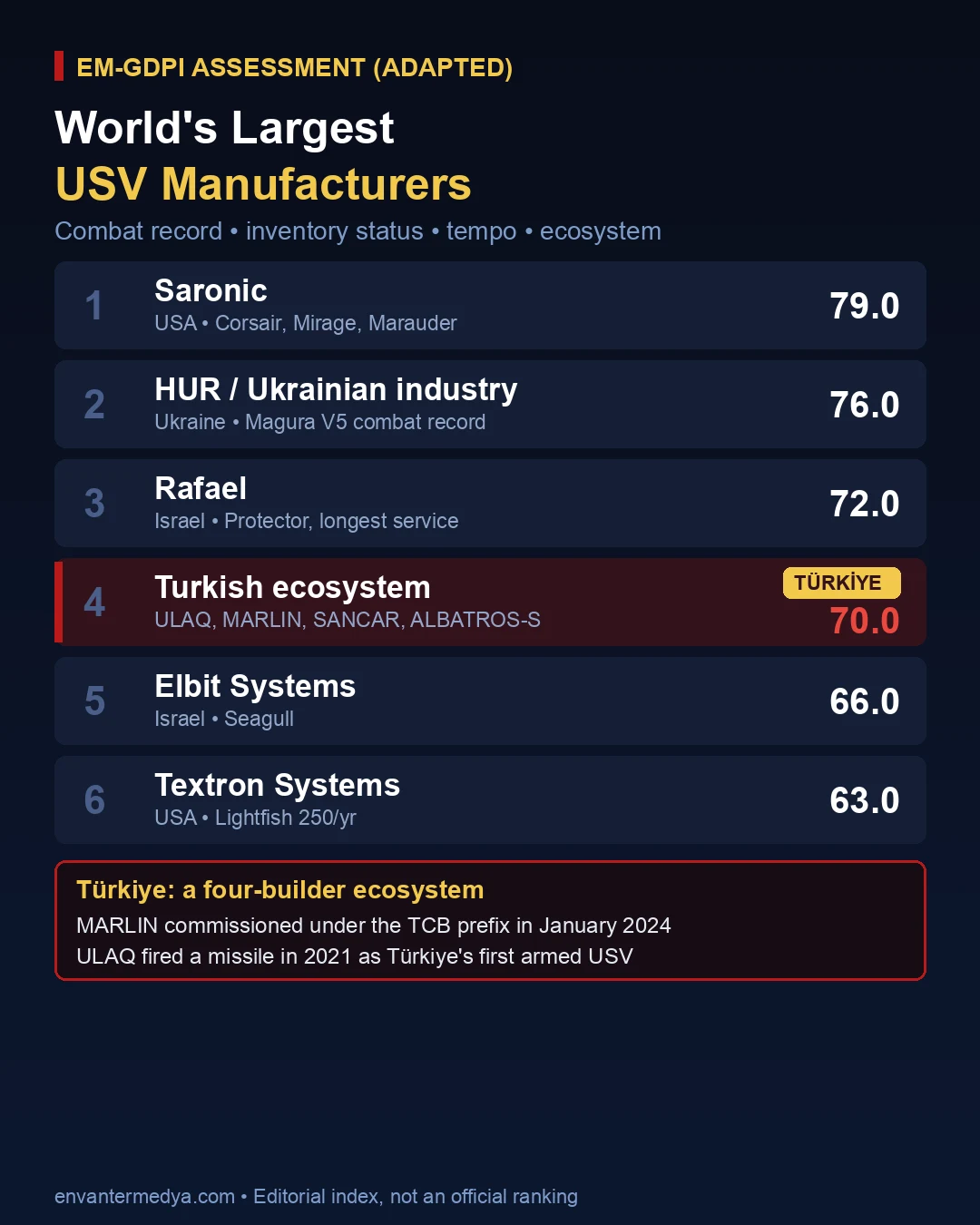
The Envanter Medya Assessment: EM-GDPI (adapted)
The series’ nine-criterion index was adapted for this young market: the revenue criterion was removed, and combat record, inventory status, production tempo, ecosystem breadth, technology, exports and growth were rescaled to 100 points. Chinese builders were not scored for lack of data. This table carries more uncertainty than our mature-sector files and is the ranking most likely to change at annual update.
An editorial, adapted index — not an official ranking. Score gaps are narrow and may shift at annual update given the market’s pace. The Turkish ecosystem is marked separately.
What the assessment says: Saronic leads on building a three-class family and serial production infrastructure at record speed; Ukraine ranks second as holder of nearly all the class’s real combat record. Rafael stands on the longest service history, and the Turkish ecosystem makes the top four on a builder base of rare breadth and formal inventory status. These four different models — startup speed, wartime necessity, mature product, ecosystem — also map where the market may turn next.
Where does Türkiye stand?
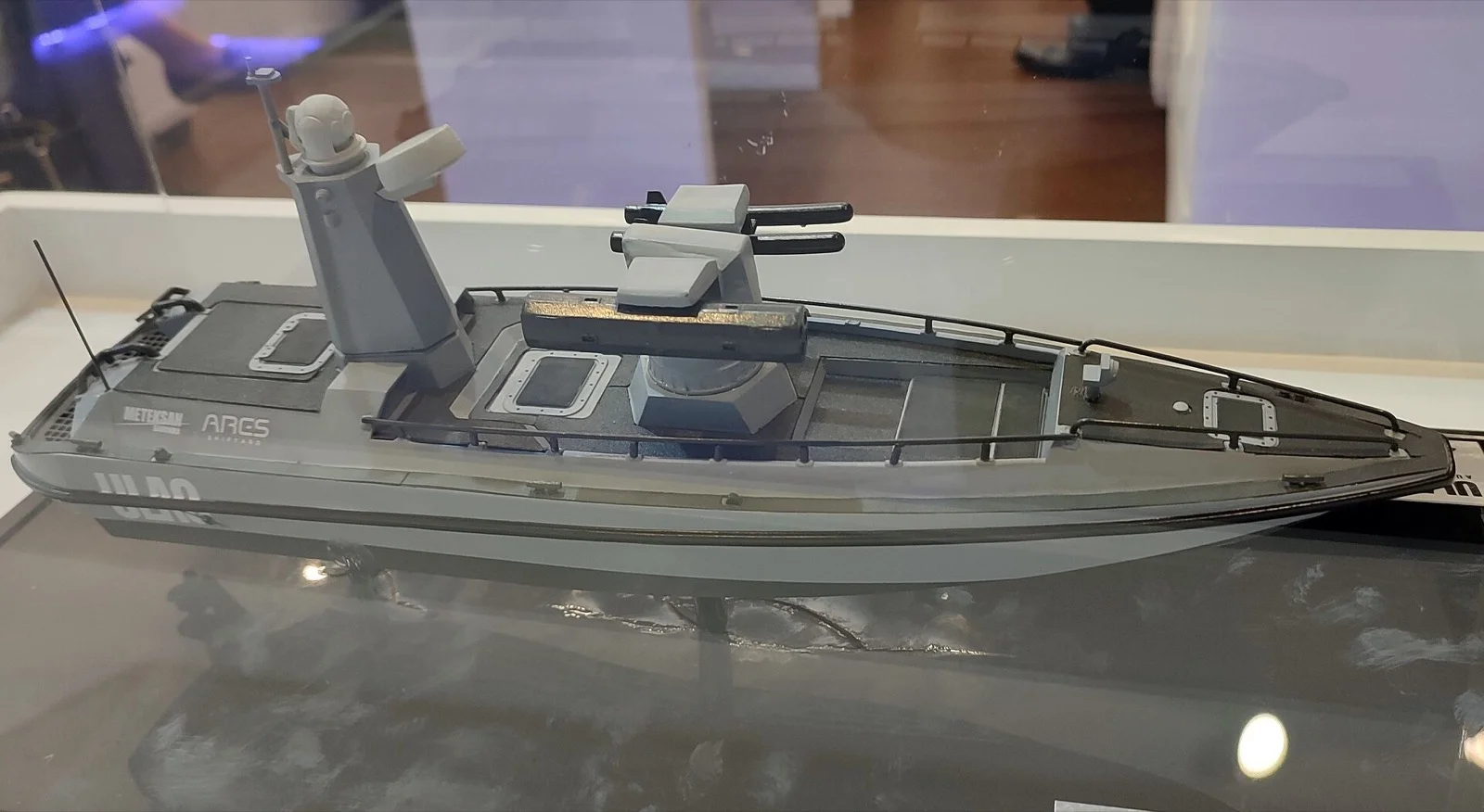
Türkiye built one of the world’s earliest and broadest USV ecosystems. ULAQ — developed jointly by ARES Shipyard and Meteksan Defence — became the country’s first armed USV by successfully firing a Cirit missile in 2021, and has since grown into a family with reconnaissance, electronic warfare and kamikaze (KAMA) variants. The Sefine Shipyard-ASELSAN MARLIN was formally commissioned into the Turkish Navy as “TCB Marlin” in January 2024 — among the first USVs in the world taken into a navy’s inventory under a service prefix. The ASELSAN-Sefine ALBATROS-S kamikaze swarm and the Havelsan-Yonca-Onuk SANCAR widen the table, and Dearsan’s SALVO has served in naval exercises.
Where is Türkiye behind?
Let the data speak: Turkish USVs have no combat record — against Magura’s Black Sea log and the Protector’s operational history, that costs points on the index’s heaviest criterion. No annual production capacity has been disclosed either; against Textron’s 250-a-year bar and Saronic’s serial investment, Turkish output remains low-volume. Nor has an export contract been announced. Against that, three data points support optimism: a four-builder ecosystem removes single-company dependency, MARLIN’s inventory status makes Türkiye a doctrinal pioneer, and the TCG Anadolu and MİR swarm projects place USVs at the center of the navy’s concept. For the broader naval picture, see our naval shipbuilders file.
How this research was prepared
Data year: Program data from official announcements and credible industry reporting, January 2024 – August 2026. Scope: Surface unmanned vessels (USV); autonomous underwater vehicles (AUV/UUV) are out of scope. Missing data: Most builders do not disclose production counts; revenue could not be attributed and was dropped from the index; Chinese builders were not scored. EM-GDPI (adapted): Criteria rescaled for this market; the index carries more uncertainty than mature-sector files.
| Builder | Data reliability | Note |
|---|---|---|
| Saronic, Textron, Turkish ecosystem | A/B | Official announcements current; unit breakdown limited |
| HUR/Ukraine, Rafael, Elbit, ST Engineering | B | Program data partly public; wartime/security secrecy |
| Chinese builders | D | No reliable current data; not assessed |
Frequently asked questions
Who is the world’s largest USV manufacturer?
The market is too young for one answer: Saronic leads in production infrastructure, Ukraine (Magura) in combat record, Rafael in service history and Türkiye in ecosystem breadth. Saronic tops Envanter Medya’s adapted index.
Why does the Magura V5 matter so much?
A roughly $273,000 craft struck warships thousands of times more expensive in the Black Sea, proving the class’s combat value — that cost asymmetry is what turned the world’s navies toward USVs.
What is ULAQ?
Developed by ARES Shipyard and Meteksan Defence, ULAQ became Türkiye’s first armed unmanned surface vessel by firing a Cirit missile in 2021; reconnaissance, electronic warfare and kamikaze (KAMA) variants followed.
What makes MARLIN special?
The Sefine-ASELSAN MARLIN was formally commissioned into the Turkish Navy as “TCB Marlin” in January 2024 — among the first USVs in the world taken into a navy’s inventory under a service prefix.
What does Saronic build?
The 7-meter Corsair, the 16-meter Mirage (launched in July 2026 less than a year after design began) and the 55-meter Marauder — a three-class autonomous vessel family.
What separates kamikaze craft from armed USVs?
Kamikaze craft (Magura, ALBATROS-S, ULAQ KAMA) destroy by impact and are expendable; armed USVs (ULAQ, MARLIN, Protector) fire missiles or gun stations and return to task.
Where does the US Navy’s large autonomous vessel program stand?
The LUSV program has been tested through prototypes such as Ranger (Ghost Fleet Overlord); serial contracts are proceeding in phases.
Has Türkiye exported USVs?
No publicly verified export contract has been announced; talks with several countries continue at trade shows. This file does not count unverified talks as exports.
What is ALBATROS-S?
The ASELSAN-Sefine kamikaze swarm system — a concept built on coordinated multi-craft attack, tested in naval trials.
What about China’s USVs?
Projects such as the JARI-USV are exhibited, but production and inventory data are not disclosed; this research does not assess unverifiable data.
What missions do USVs perform?
Reconnaissance and surveillance, patrol, mine countermeasures, anti-submarine warfare, electronic warfare, logistics and strike. See the Defense Atlas for platform profiles.
Sources and methodology notes
This study is an editorial research product prepared by Envanter Medya by cross-checking publicly available official company data, institutional reports, contract and delivery records and industry sources. Principal sources:
- Naval News (July 2026) — Saronic Mirage’s under-a-year launch, the three-class family
- Magura V5 program records — technical data, unit cost, Black Sea operations
- TCB Marlin records — commissioning into the Turkish Navy in January 2024
- Meteksan Defence / ARES official data — the ULAQ family and its missile firings
- Drone & Defense sector map — Textron Lightfish price/capacity, builder inventory
- ASELSAN official announcements — ALBATROS-S swarm, MARLIN sensor/weapon integration
Last updated: August 24, 2026. This is a living research page, updated as contract and operational records arrive. This file closes the series’ five-part second wave (fighters, helicopters, submarines, artillery, USVs). For the full series, see the 2026 Global Defense Industry Report.