





World’s Largest Unmanned Ground Vehicle Manufacturers: THeMIS’s Breach Lane, BARKAN’s Swarm (2026)


The unmanned wave that reshaped air and sea has reached the ground — more slowly and more cautiously, for a technical reason. A drone flies into empty sky; an unmanned ground vehicle (UGV) faces ditches, mud, broken terrain and hundreds of objects it must identify. Even so, 2026 was the year the class matured. Estonia’s Milrem Robotics keeps the THeMIS as Europe’s most widely fielded military ground robot, and a module unveiled in March 2026 lets it clear a breach lane up to 54 meters long. Rheinmetall’s Mission Master family was delivered to the US Marine Corps and expanded with an armed reconnaissance variant. And Türkiye is early and ambitious here: HAVELSAN’s BARKAN entered the inventory in 2023 and went into mass production, while BARKAN 3 — unveiled in May 2026 — arrived with an AI-enabled combat management system aimed at swarms of dozens of robots. Following our military satellite file, Envanter Medya compares the world’s UGV builders across inventory status, production maturity, mission breadth and autonomy.
Editorial note: This ranking is an editorial research product compiled by Envanter Medya from publicly available data; it is not an official international ranking. In a young market most builders do not disclose production counts; this file relies on verifiable program and inventory data. Sources are listed at the end.
The research at a glance
“Largest” by which measure?
The UGV market is the second-youngest in this series, and classic yardsticks fail here too: almost no builder discloses annual output, and revenue cannot be separated. This file uses four measures: inventory status (has an army formally taken it on strength?), production maturity (prototype or serial?), mission breadth (logistics, reconnaissance, armed support, breaching, casualty evacuation) and autonomy level (remote control, follow-me, or swarm?). The classes are settling too: light logistics “mules” (THeMIS, Mission Master), armed support platforms (BARKAN, UKAP, ROOK), heavy combat robots (Ripsaw M5, TRX) and special-mission vehicles.
What “serial production” means here: a phrase that means hundreds a year in aviation describes tens in the UGV world. No builder in this class has reached three-digit annual output yet — which is why this file scores production maturity rather than production count.
By inventory status: Europe’s most widely fielded ground robot
The real test of a UGV is whether an army takes it on strength and pushes it down to units. By that measure Estonia’s THeMIS (Tracked Hybrid Modular Infantry System) is Europe’s clearest example: a tracked, hybrid, modular architecture that adapts from logistics support to reconnaissance. It was among the first Western ground robots sent to Ukraine — and therefore among the platforms generating the most battlefield data. With the H-POMBS module unveiled in March 2026, THeMIS can now clear anti-personnel mines and obstacles remotely, opening lanes up to 54 meters: the concrete example of ground robots moving from “pack mule” to combat engineer.
By production maturity: Mission Master and BARKAN
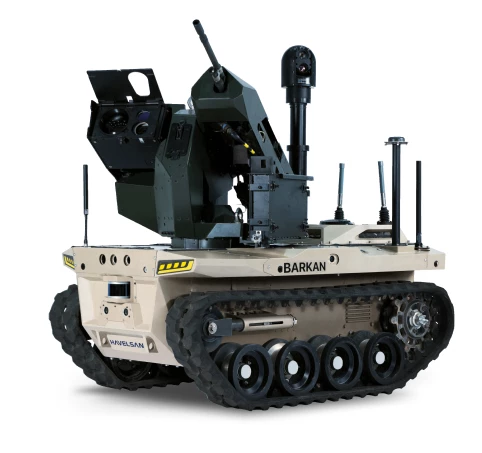
In Germany, Rheinmetall’s Mission Master family spans three hull types (SP, XT, CXT) — one of the broadest product lines in the class — and grew in 2026 with an armed reconnaissance variant. The system has been delivered to the US Marine Corps, and German Army “cargo mule” evaluations judged the class mature enough for procurement. In Türkiye, HAVELSAN’s BARKAN entered the inventory in 2023 as a medium-class autonomous ground vehicle and then moved into mass production — one of the few platforms in this class with a serial production decision behind it. BARKAN 3, unveiled at SAHA Expo in May 2026, marks the leap: an AI-enabled combat management system intended to run swarms of dozens of robots. BARKAN has also demonstrated firing varied munition types and launching a kamikaze UAV from its back — a ground robot doubling as an air vehicle carrier, one of the class’s most striking capabilities.
Verified programs
| Builder | Country | Systems | Verified indicator | Data type |
|---|---|---|---|---|
| Milrem Robotics | Estonia | THeMIS, Type-X | Europe’s most widely fielded military ground robot; sent to Ukraine; H-POMBS module clears lanes up to 54 meters (March 2026); heavy-class Type-X in development | R/T |
| Rheinmetall | Germany | Mission Master SP/XT/CXT | Delivered to the US Marine Corps; armed reconnaissance variant added in 2026; judged procurement-ready in German Army evaluations | R |
| HAVELSAN 🇹🇷 | Türkiye | BARKAN, BARKAN 3 | Entered the inventory in 2023 and moved to mass production; demonstrated varied munition firing and kamikaze UAV launch; BARKAN 3 (May 2026): swarms of dozens + AI-enabled combat management system | R |
| Textron Systems | USA | Ripsaw M5, M3 | Leading platform in the heavy combat robot class; in US Army robotic combat vehicle trials | R/T |
| General Dynamics Land Systems | USA | TRX | Tracked heavy UGV; candidate in US Army robotic combat vehicle programs | R/T |
| Elbit Systems | Israel | ROOK, PROBOT | Armed and logistics variants; trialed by multiple armies | R/T |
| Israel Aerospace Industries | Israel | REX MK II | Armed support/logistics vehicle with field use on record | R/T |
| Katmerciler + FNSS + ASELSAN 🇹🇷 | Türkiye | UKAP, İZHA, weapon-station UGVs | Katmerciler’s armed UKAP serves with security forces; FNSS’s İZHA opens the unmanned amphibious armored vehicle segment; ASELSAN supplies the weapon stations and autonomy packages that form the ecosystem’s spine | R/T |
| Chinese builders | China | Sharp Claw, VU-T10 | Production and inventory data not disclosed | D |
Data types: R = official/company statement, T = credible industry reporting, D = insufficient data. Because no builder’s revenue can be cleanly attributed to UGVs, the revenue criterion was dropped from this file’s index.
By mission breadth: who can do what?
Five mission types counted: logistics carriage, reconnaissance-surveillance, armed support, mine/obstacle breaching, casualty evacuation. For modular platforms, the mission packages announced by the builder were counted (T label). The Turkish platform is marked separately.
The Envanter Medya Assessment: EM-GDPI (adapted)
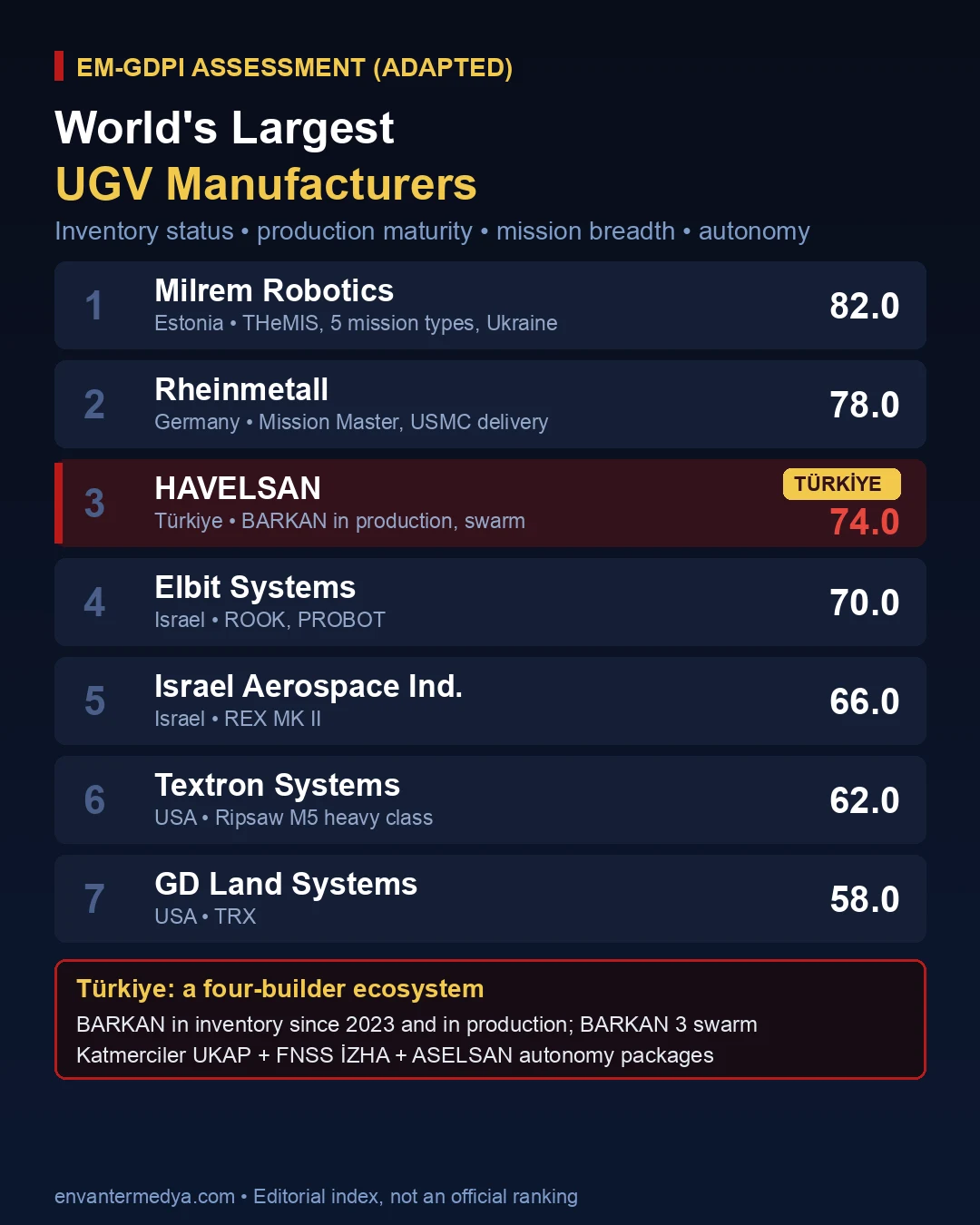
The series’ nine-criterion index was adapted for this young market: the revenue criterion was dropped, and inventory status, production maturity, mission breadth, autonomy level, field/combat record, exports and growth were rescaled to 100 points. Chinese builders were not scored for lack of data. This table carries more uncertainty than our mature-sector files.
An editorial, adapted index — not an official ranking. The revenue criterion was removed; Chinese builders were not scored. The Turkish company is marked separately.
What the assessment says: Milrem leads on a modular architecture covering all five mission types and on the data accumulated in Ukraine. Rheinmetall ranks second on a three-hull product line and the US Marine Corps delivery; HAVELSAN takes third on inventory status, a serial production decision and its claim on the swarm concept — one of the Turkish defense industry’s highest placements in this series. That position comes less from technological claims than from the fact of being fielded: BARKAN is past the prototype stage, in the inventory and in production.
Where does Türkiye stand?
Türkiye has built a multi-vendor UGV ecosystem, much as it did with unmanned surface vessels. At its center is HAVELSAN’s BARKAN: in the inventory since 2023, in mass production, and demonstrated firing varied munition types and launching a kamikaze UAV from its back. BARKAN 3, unveiled in May 2026, targets the swarm concept — dozens of robots moving together under an AI-enabled combat management system, the most advanced item on the class’s global agenda. The ecosystem’s other links: Katmerciler’s armed UKAP serves with security forces; FNSS’s İZHA opens a new segment as an unmanned amphibious armored vehicle; and ASELSAN supplies the remote weapon stations and autonomy packages that form the common spine of nearly every Turkish UGV.
Where is Türkiye behind?
Let the data speak: no verified export contract for a Turkish UGV has been announced — the clearest gap against Milrem’s European footprint and Rheinmetall’s US Marine Corps delivery. There is no Turkish product in the heavy combat robot class (the Ripsaw M5 / TRX tier above ten tonnes); BARKAN sits in the medium class. Nor do Turkish platforms yet field a proven breaching module like the THeMIS H-POMBS. Against that, three data points support optimism: inventory status and a serial production decision place Türkiye in the class’s fielded minority; the multi-vendor ecosystem removes single-company dependency; and BARKAN 3’s swarm concept chases a capability nobody has fielded yet — meaning Türkiye is competing here, not following.
How this research was prepared
Data year: Program and inventory data from official announcements and credible industry reporting, January 2024 – August 2026. Scope: Military unmanned ground vehicles; unmanned air and surface vehicles are covered in separate files; civil/industrial robots are out of scope. Missing data: Most builders do not disclose production counts; revenue could not be attributed and was dropped from the index; Chinese builders were not scored. EM-GDPI (adapted): Criteria rescaled for this market.
| Builder | Data reliability | Note |
|---|---|---|
| Milrem, Rheinmetall, HAVELSAN | A/B | Official announcements current; unit breakdown limited |
| Elbit, IAI, Textron, GDLS, Katmerciler/FNSS | B | Program data partly public; trial and procurement stages mixed |
| Chinese builders | D | No reliable current data; not assessed |
Frequently asked questions
Who is the world’s largest UGV manufacturer?
The market is young enough that there is no single answer: Milrem Robotics (THeMIS) leads on mission breadth and footprint, Rheinmetall on product line and the US delivery, HAVELSAN on inventory status and the swarm concept. Milrem tops Envanter Medya’s adapted index.
What is the THeMIS?
Estonia’s Milrem Robotics tracked, hybrid, modular unmanned ground vehicle — Europe’s most widely fielded military ground robot and among the first Western platforms sent to Ukraine.
What does the THeMIS breaching module do?
The H-POMBS module, unveiled in March 2026, clears anti-personnel mines and obstacles remotely, opening lanes up to 54 meters.
What is BARKAN?
HAVELSAN’s medium-class autonomous unmanned ground vehicle; it entered the Turkish inventory in 2023 and moved into mass production. It has demonstrated firing varied munition types and launching a kamikaze UAV.
What is different about BARKAN 3?
Unveiled at SAHA Expo in May 2026, BARKAN 3 targets swarms of dozens of robots running under an AI-enabled combat management system.
How many Mission Master versions are there?
Rheinmetall’s family spans three hull types (SP, XT, CXT) and expanded in 2026 with an armed reconnaissance variant. The system has been delivered to the US Marine Corps.
What missions do UGVs perform?
Logistics carriage, reconnaissance and surveillance, armed support, mine and obstacle breaching, and casualty evacuation. Modular platforms adapt one hull to several roles.
How many Turkish companies build UGVs?
At least four: HAVELSAN (BARKAN), Katmerciler (UKAP), FNSS (İZHA unmanned amphibious armored vehicle) and ASELSAN (weapon stations and autonomy packages) — one of the broadest national ecosystems in the class.
Have Turkish UGVs been exported?
No publicly verified export contract has been announced. This file does not count unverified talks as exports.
Why did ground robots spread more slowly than drones?
Technical difficulty: a drone flies into empty sky, while a ground vehicle faces ditches, mud, broken terrain and hundreds of objects it must identify. Autonomous navigation is far harder on land.
Who builds heavy combat robots?
Textron’s Ripsaw M5 and General Dynamics’ TRX lead the class, both evaluated in US Army robotic combat vehicle programs. Türkiye has no product in this tier.
What about China’s UGVs?
Platforms such as Sharp Claw and VU-T10 are exhibited, but production and inventory data are not disclosed; this research does not assess unverifiable data. See the Defense Atlas for platform profiles.
Sources and methodology notes
This study is an editorial research product prepared by Envanter Medya by cross-checking publicly available official company data, program announcements and industry sources. Principal sources:
- The Defense Post (March 2026) — the THeMIS H-POMBS breaching module and its 54-meter lane
- Rheinmetall official product page — the Mission Master family and armed reconnaissance variant
- Military Embedded Systems — Mission Master delivery to the US Marine Corps
- Breaking Defense (May 2026) — BARKAN 3’s unveiling, swarm concept and AI combat management system
- HAVELSAN official product page — BARKAN’s inventory entry and mass production
- Shephard Media — BARKAN’s varied munition firing and steps toward swarming
Last updated: August 25, 2026. This is a living research page, updated as program and procurement announcements arrive. The next file in the series examines the world’s largest electro-optical system manufacturers. For the full series, see the 2026 Global Defense Industry Report.