World’s Largest Military Satellite Manufacturers: Starshield’s Tempo and Türkiye’s Eleven-Nation Club (2026)

No corner of the defense industry has shifted power as sharply in three years as military space. For decades this was the domain of a handful of prime contractors building expensive platforms one at a time; now serial production is winning. SpaceX’s military line, Starshield, had launched roughly 245 satellites by July 2026 — more than traditional builders deliver in a decade — and in May 2026 won the US Space Force’s $2.29 billion contract for a space data network. In Europe, the Airbus Defence and Space–Thales Alenia Space pairing remains the address for sovereign communications satellites: Poland’s national defense satellite went to that partnership in April 2026, Spain’s SpainSat NG-III in July. And Türkiye entered the table by crossing a threshold: TÜRKSAT 6A, launched on 8 July 2024 with more than 80 percent domestic content, put the country inside the club of eleven nations able to build their own communications satellite. Following our unmanned surface vessel file, Envanter Medya compares the world’s military satellite builders across production tempo, contract volume, capability breadth and technology.
Editorial note: This ranking is an editorial research product compiled by Envanter Medya from publicly available data; it is not an official international ranking. Much of military space is classified; this file relies only on verifiable contract and launch records. Sources are listed at the end.
The research at a glance
“Largest” by which measure?
Military space differs from every other sector in this series in one respect: the answer to “who is largest” moved because the meaning of the word changed. The classic model was large GEO satellites built one at a time, costing hundreds of millions and lasting a decade; the new model is serially produced, cheap, short-lived LEO constellations flying in the hundreds. Measuring both with one ruler misleads. This file uses four yardsticks: production tempo (how many satellites a year?), contract volume (the scale of disclosed military programs), capability breadth (communications, reconnaissance, early warning, navigation, electronic intelligence) and technological sovereignty.
By production tempo: serial production won
Space’s biggest rupture in three years is the satellite ceasing to be an artefact and becoming a product. Starshield is the clearest evidence: by early July 2026 roughly 245 satellites had been launched with 241 remaining in orbit, four early prototypes disposed of. That tempo alone exceeds the number of military satellites traditional primes deliver in a decade — and the reward followed. In May 2026 the US Space Force awarded SpaceX a $2.29 billion contract for a low-Earth-orbit network intended to function as a military internet in space, placing the Starshield variant at the center of that architecture.
Reading this table: Satellite count alone does not equal capability. One six-tonne GEO communications satellite can do what hundreds of small LEO satellites cannot — and the reverse is equally true. Count measures industrial throughput; contract volume measures a program’s strategic weight. They are separate yardsticks and are scored separately here.
Different classes shown on one chart and not comparable: the SDA and Starshield rows count small LEO satellites; the SpainSat and TÜRKSAT rows count multi-tonne GEO communications satellites. The chart shows a difference in industrial scale, not capability. The Turkish program is marked separately.
By contract volume: Europe’s sovereign satellite duo
In large GEO military communications satellites the market clusters around two European groups: Airbus Defence and Space and Thales Alenia Space (a joint venture of Thales, 67 percent, and Leonardo, 33 percent). The pair won two major sovereign programs in 2026. In April they signed — with Poland’s RADMOR — an industrial cooperation agreement to develop a geostationary defense telecommunications satellite for the Polish Ministry of Defence; in July, Spain’s Hisdesat awarded the same pair the industrial contract for SpainSat NG-III, expanding the country’s secure military communications architecture. Both programs are the concrete expression of Europe’s search for sovereign space capability: every state that wants less dependence on American networks knocks on the door of its own GEO satellite.
Verified programs
| Builder | Country | Key programs | Verified indicator | Data type |
|---|---|---|---|---|
| SpaceX (Starshield) | USA | Starshield, SDN backbone | ~245 satellites launched, 241 in orbit (July 2026); $2.29B space data network contract (May 2026); both builder and launch provider | R/T |
| Lockheed Martin | USA | GPS III, Next-Gen OPIR, SDA layers | Prime in navigation and early warning; among SDA Transport Layer builders | R |
| Airbus Defence and Space | Europe | SpainSat NG, Poland’s national satellite, Pléiades, Skynet | Poland sovereign defense satellite agreement (Apr 2026); SpainSat NG-III contract (31 Jul 2026); builder of GÖKTÜRK-1 | R |
| Northrop Grumman | USA | SDA layers, early warning | Among Transport and Tracking Layer contractors; significant classified work | R/T |
| Thales Alenia Space | France-Italy | SpainSat NG, Poland satellite, CERES, Sicral | Thales 67% – Leonardo 33% joint venture; partner with Airbus on both sovereign programs | R |
| Boeing | USA | WGS, O3b mPOWER | Prime builder of wideband military communications (WGS) | R/T |
| L3Harris | USA | SDA Tracking Layer, hypersonic tracking | Contractor on missile-tracking satellites; growing smallsat line | R/T |
| TUSAŞ + TÜBİTAK UZAY 🇹🇷 | Türkiye | TÜRKSAT 6A, İMECE, GÖKTÜRK-2 | TÜRKSAT 6A: launched 8 Jul 2024, over 80% domestic content, put Türkiye in the eleven-nation club; indigenous İMECE observation satellite in orbit; TUSAŞ’s satellite integration and test center (USET) operational | R |
| CASC / CAST | China | Yaogan, Beidou | Production and mission data not disclosed | D |
| Roscosmos contractors | Russia | Bars-M, GLONASS | No reliable production data published since sanctions | D |
Data types: R = official/company statement, T = credible industry reporting, D = insufficient data. Because military space revenue cannot be separated in company accounts, the revenue criterion was dropped from this file’s index.

By capability breadth: who covers which layer?
Five mission areas counted: communications, reconnaissance/observation, early warning, navigation, electronic intelligence (ELINT). Counted from public programs; classified work could change the picture (T label). The Turkish institutions are marked separately.
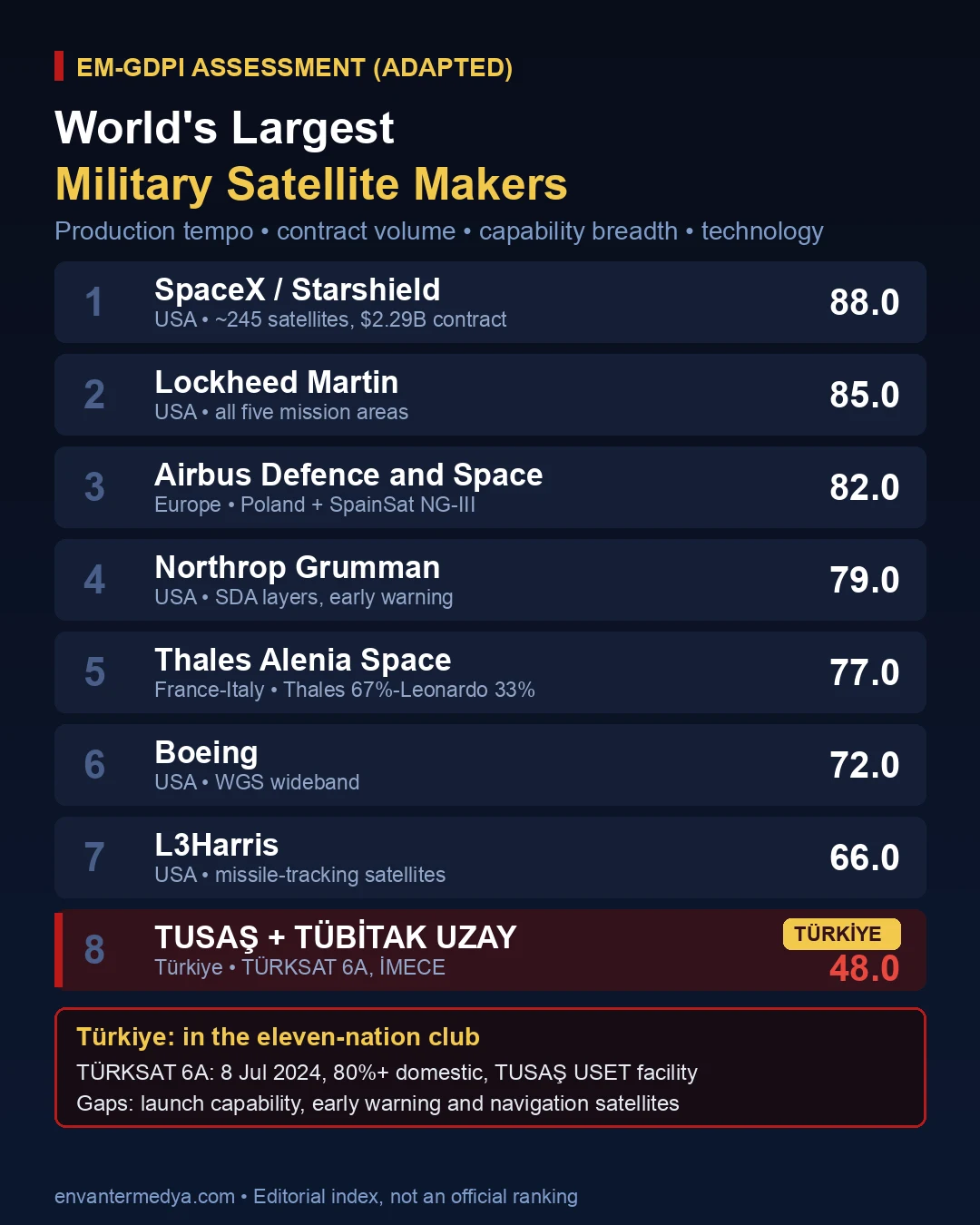
The Envanter Medya Assessment: EM-GDPI (adapted)
The series’ nine-criterion index was adapted for this sector: the revenue criterion was dropped because space activity cannot be separated from company revenue, and production tempo, contract volume, capability breadth, technology, capacity, international programs and growth were rescaled to 100 points. Chinese and Russian builders were not scored for lack of data — which does not mean they build no military satellites; no data, no score.
An editorial, adapted index — not an official ranking. The revenue criterion was removed. CASC and Russian builders were not scored. The Turkish institutions are marked separately.
What the assessment says: SpaceX leads on a production tempo no rival approaches and on the cost advantage of being both builder and launch provider — though its coverage of just two mission areas caps the score. Lockheed Martin ranks second as the only company contracting across all five mission areas; Airbus and Thales Alenia hold the gate of the sovereign satellite market. TUSAŞ and TÜBİTAK UZAY’s 48 points are a threshold photograph: production tempo and contract volume score low because Türkiye builds fewer than one satellite a year — but technology and growth scored in the upper band thanks to membership in the eleven-nation club.
Where does Türkiye stand?
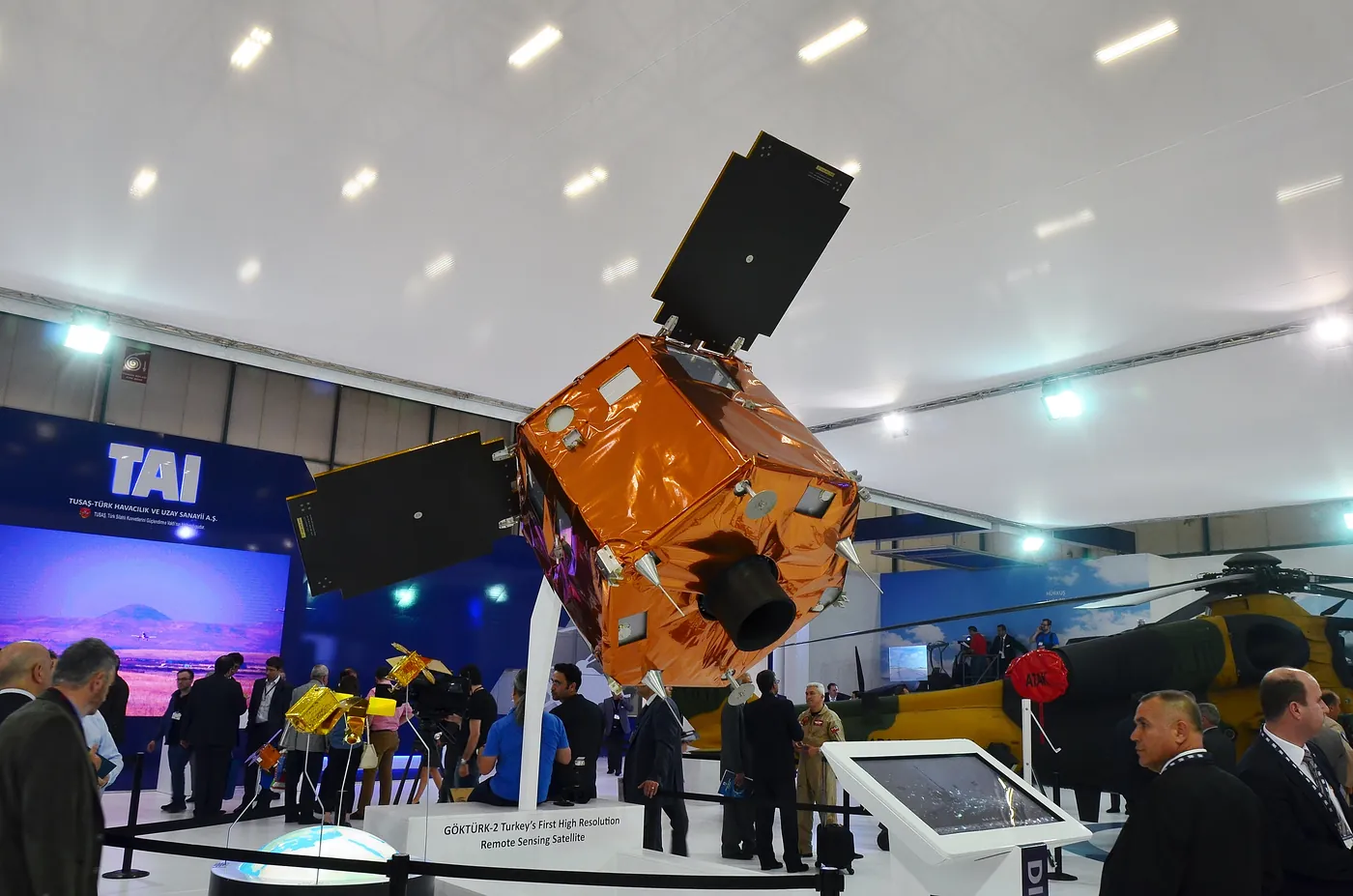
Türkiye’s satellite story is one of the clearest threshold-crossings in this series. TÜRKSAT 6A, launched on 8 July 2024, became the first communications satellite designed, built and tested in Türkiye, with domestic content above 80 percent — putting the country, in President Erdoğan’s words, among “the eleven nations capable of producing their own communications satellite.” The satellite was integrated at TUSAŞ’s Space Systems Integration and Test Center (USET) in Ankara with subsystem and payload contributions from TÜBİTAK UZAY. A line was also established on the observation side: the indigenous İMECE satellite is in orbit and TÜBİTAK UZAY’s GÖKTÜRK-2 has served for over a decade. Türkiye can now build its own satellites in two mission areas — communications and reconnaissance.
Where is Türkiye behind?
Let the data speak, without overstatement: Türkiye’s military satellite output runs below one satellite a year while SpaceX launches hundreds in the same period. There is no launch capability — every Turkish satellite including TÜRKSAT 6A reached orbit on a foreign rocket, and the national space launch system remains in development. The highest-resolution link in the reconnaissance fleet, GÖKTÜRK-1, is Airbus-built. There are no early warning or navigation satellites and no military constellation, and no satellite has been exported. Against that, three data points support optimism: TÜRKSAT 6A’s domestic content means a line, not a one-off; the USET facility provides serial integration capacity; and İMECE moved the observation side to indigenous design too.
How this research was prepared
Data year: Contract and launch data from official announcements and credible industry reporting, January 2024 – August 2026. Scope: Ten groups building military satellites; civil-commercial satellite production noted only in a military context; launch vehicles are out of scope. Missing data: Classified program details and CASC/Russian builder data are not public and were not estimated. Company space revenue could not be separated, so the revenue criterion was removed. EM-GDPI (adapted): Criteria rescaled for this sector; the index carries more uncertainty than our mature-sector files.
| Builder | Data reliability | Note |
|---|---|---|
| Airbus DS, Thales Alenia, TUSAŞ/TÜBİTAK UZAY | A | Official contract and program announcements current |
| SpaceX, Lockheed, Northrop, Boeing, L3Harris | B | Program data partly public; classified work limits breakdown |
| CASC/CAST, Roscosmos contractors | D | No reliable current data; excluded from the index |
Frequently asked questions
Which company is the world’s largest military satellite manufacturer?
It depends on the measure: SpaceX (Starshield) leads by a wide margin on production tempo, Lockheed Martin on capability breadth as the only prime across all five mission areas, and the Airbus–Thales Alenia Space pairing on sovereign GEO communications satellites. SpaceX tops Envanter Medya’s adapted index.
What is Starshield?
SpaceX’s military satellite line, built on Starlink infrastructure. By early July 2026 roughly 245 satellites had been launched, with 241 in orbit. In May 2026 it won the US Space Force’s $2.29 billion space data network contract.
Can Türkiye build its own satellites?
Yes. TÜRKSAT 6A, launched on 8 July 2024, is the first communications satellite designed and built in Türkiye, with more than 80 percent domestic content — placing the country among the eleven nations able to build their own.
Who built TÜRKSAT 6A?
The satellite was integrated at TUSAŞ’s Space Systems Integration and Test Center (USET) in Ankara, with subsystem and payload contributions from TÜBİTAK UZAY. It was launched on a foreign rocket.
What is İMECE?
An indigenous Earth observation satellite developed by TÜBİTAK UZAY — evidence that Türkiye has moved to domestic design on the reconnaissance side as well.
What is the SDA Transport Layer?
The US Space Development Agency’s military data network layer in low Earth orbit. More than 300 satellites were ordered across the first two tranches under multi-vendor contracts; the third tranche was folded into the new Space Data Network program.
What satellites did Poland and Spain order?
Poland’s Ministry of Defence geostationary defense communications satellite went to Airbus DS, Thales Alenia Space and Poland’s RADMOR in April 2026; Spain’s Hisdesat signed the SpainSat NG-III contract with Airbus and Thales Alenia Space on 31 July 2026.
Does Türkiye have launch capability?
Not yet in service — every Turkish satellite including TÜRKSAT 6A was launched on a foreign rocket. This is one of the clearest gaps in this file.
Is GÖKTÜRK-1 indigenous?
No; GÖKTÜRK-1 is an Airbus-built reconnaissance satellite. GÖKTÜRK-2 was produced in Türkiye with TÜBİTAK UZAY and TUSAŞ.
How many military satellites do China and Russia build?
No reliable public data exists. This research declines to publish unverifiable figures; CASC and Russian builders were excluded from the index for that reason.
Does satellite count equal capability?
No. One large GEO communications satellite can do what hundreds of small LEO satellites cannot, and vice versa. Count and capability breadth are scored separately here.
What missions do military satellites perform?
Communications, reconnaissance/observation, early warning (missile detection), navigation (GPS/Galileo) and electronic intelligence. See the Defense Atlas for platform profiles.
Sources and methodology notes
This study is an editorial research product prepared by Envanter Medya by cross-checking publicly available official company and institutional data, contract announcements, launch records and industry sources. Principal sources:
- SpaceNews (May 2026) — SpaceX’s $2.29B space data network contract; SDA Transport Layer’s 300+ satellites
- Via Satellite — the Space Force award and Starshield’s place in the architecture
- Airbus press release (April 2026) — Poland sovereign defense satellite partnership
- Via Satellite (August 2026) — SpainSat NG-III industrial contract (31 July 2026)
- TÜBİTAK UZAY — TÜRKSAT 6A commissioning
- TUSAŞ official product page — TÜRKSAT 6A production and the USET facility
- Türksat — 6A entering the production stage and its domestic content
Last updated: August 25, 2026. This is a living research page, updated as contract and launch announcements arrive. The next file in the series examines the world’s largest unmanned ground vehicle manufacturers. For the full series, see the 2026 Global Defense Industry Report.