NATO Sends AWACS to Poland After Russian Projectiles Cross Border

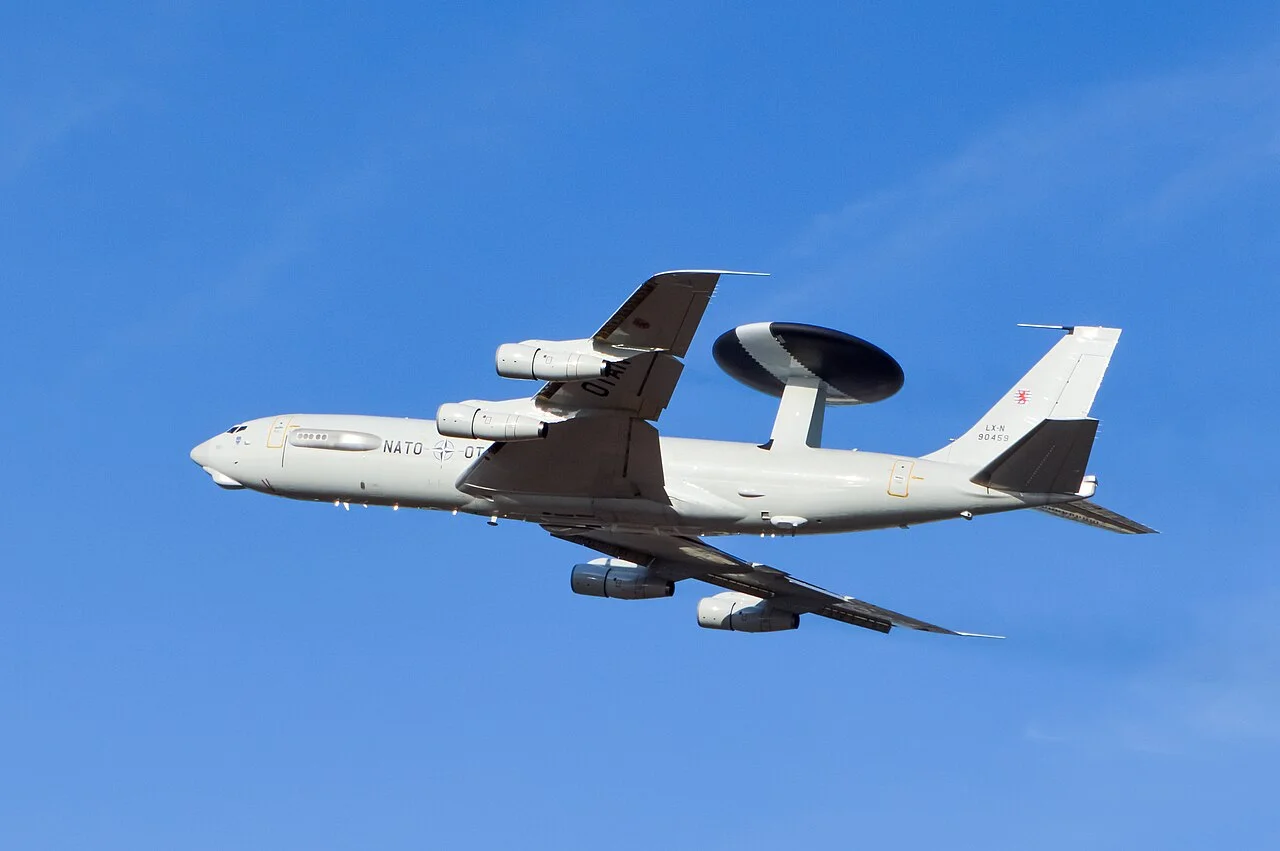
NATO has agreed to reinforce air surveillance over Poland with an AWACS early-warning aircraft after two missiles and a drone entered Polish airspace last Friday. The decision, authorised by Supreme Allied Commander Europe General Alexus Grynkewich, was the main concrete outcome of an emergency North Atlantic Council meeting held in Brussels on Monday at Poland’s request after it sought stronger air surveillance and defence on the alliance’s eastern flank.
The incursion coincided with a large-scale Russian attack on Ukraine and with Coalition of the Willing exercises under way in Poland involving military personnel from several European countries. Polish officials say the overlap in timing warrants serious security analysis, while stressing that no definitive evidence shows the projectiles were aimed at the exercises themselves.
AWACS’s role and NATO’s current fleet
NATO operates 14 AWACS aircraft based at Geilenkirchen in Germany. The long-range radar carried on the aircraft’s fuselage builds a shared air picture, passes that information to command centres and units, and can help direct fighter aircraft when needed. These aircraft have monitored the alliance’s eastern flank regularly since Russia’s full-scale invasion of Ukraine in 2022.
General Grynkewich is also assessing whether additional assets are needed for deterrence and defence in Poland and elsewhere on the eastern flank. Poland has separately requested fighter cover from allied nations, though no definitive agreement to deploy F-35s to the country has been announced at this stage.
Statements from the parties involved
Polish deputy defence minister Paweł Zalewski described the outcome as “a demonstration of solidarity among NATO members,” saying the response should be proportionate but firm enough to prevent Russia from reading inaction as weakness, while stressing that any measures should remain defensive. Prime Minister Donald Tusk called the incident “a probable Russian provocation” and said Warsaw expects a coordinated response from its allies.
NATO Secretary General Mark Rutte, speaking alongside German Chancellor Friedrich Merz in Berlin, identified Russia as the source of the projectiles, linked the incident to the war in Ukraine, and called it “unacceptable.” Rutte added that investigators are still examining whether the airspace violation was deliberate.
A test of alert procedures
The episode is being treated as a real test of NATO’s alert, identification and interception procedures. Polish authorities view the timing alongside the Ukraine strikes and the Coalition of the Willing drills as worth serious security scrutiny, though officials are careful to note that this overlap does not by itself prove the projectiles targeted the exercises. Similar airspace violations in Poland late last year prompted NATO to launch its Eastern Sentry surveillance mission.
Context for Türkiye and the eastern flank
Türkiye is part of the alliance structure that operates NATO’s 14 AWACS aircraft, which also periodically fly missions over Turkish airspace. The Poland episode renews attention on the importance of air surveillance along the alliance’s eastern and south-eastern flanks, and on how NATO’s limited AWACS fleet is allocated across simultaneous crisis areas — a resource-planning question that continues to be debated among member states as European allies gradually take on more responsibility within the Naples-based command structure.
Sources
Infodefensa, “La OTAN refuerza la vigilancia aérea de Polonia con un avión Awacs tras los últimos incidentes con proyectiles rusos,” 24 November 2026 — primary source for official statements and the timeline of events used in this report.