Gulf Artillery and MLRS: A Fragmented Fleet Meets a Localisation Push

Week 13 of the Gulf Defence Procurement Analysis series.
Executive Summary
Artillery and multiple-launch rocket systems (MLRS) form the most nationally fragmented equipment category examined so far in this series. Where Gulf states have tended to converge on two or three dominant suppliers for air defence, standoff missiles or main battle tanks, tube and rocket artillery fleets across the six Gulf Cooperation Council states draw on at least six distinct national origins at once. Qatar operates 24 Panzerhaubitze 2000 (PzH2000) tracked self-propelled howitzers acquired from Germany, with 12 due to be swapped back to the German Army in exchange for 12 wheeled RCH 155 systems built on the Boxer chassis, alongside a Turkish T-155 Fırtına/Fırtına-II order signed in 2019 whose unit numbers remain undisclosed. Saudi Arabia fields a mixed inventory of American M109, Chinese PLZ-45 and French CAESAR self-propelled howitzers plus Brazilian ASTROS II rocket artillery, while pursuing localisation of ammunition and, eventually, platforms under the General Authority for Military Industries (GAMI) and Saudi Arabian Military Industries (SAMI). The United Arab Emirates, having already built an indigenous wheeled-armour base documented elsewhere in this series, signed a cooperation agreement with South Korea’s Hanwha Aerospace and the Abu Dhabi-based Generation 5 Holding at Eurosatory 2026 to explore a Gulf manufacturing hub for the K9 Thunder self-propelled howitzer. Bahrain, by contrast, still relies on an ageing fleet of 38 M110A2 self-propelled howitzers and 18 M198 towed guns with no announced replacement programme. Layered onto this picture is the entry of new suppliers: Russia used the World Defense Show in Riyadh in January 2026 to unveil the Sarma 300 mm MLRS on a KAMAZ-63501 8×8 chassis, though no Gulf order has been confirmed. The result is a category where supplier diversification, rather than convergence around a single preferred system, defines the current procurement environment.
Operational Context
Gulf interest in modern tube and rocket artillery has been shaped less by a single threat scenario than by three overlapping requirements. The first is counter-battery and close fire support experience drawn from the Saudi- and Emirati-led intervention in Yemen, which exposed gaps in sustained ammunition supply and highlighted the value of extended-range, precision-guided artillery munitions over unguided legacy stock. The second is a deterrence logic aimed at Iran and Iran-aligned actors, in which rocket artillery with ranges beyond 100 km complements, rather than substitutes for, the standoff anti-ship and land-attack missile programmes covered earlier in this series; artillery rocket systems offer a lower-cost, more readily replenished strike option against fixed targets than cruise missiles. The third is fleet age. Bahrain’s M110A2s and M198s, and significant portions of Saudi Arabia’s towed gun inventory, trace back to 1980s and 1990s acquisitions, and the absence of a clear replacement timeline in several states reflects budget prioritisation toward air defence and armoured vehicles rather than a judgement that artillery modernisation is unnecessary.
Ammunition, rather than launch platforms, has emerged as the more urgent localisation target. Saudi Arabia’s own procurement literature identifies large-calibre artillery and tank ammunition, alongside missile and rocket systems, as an early and operationally critical localisation priority, reflecting both the recurring nature of ammunition demand and the strategic risk of depending on external suppliers during a sustained campaign. This mirrors a pattern already visible in Gulf standoff-missile and loitering-munition procurement: platforms arrive first through direct purchase, while the harder industrial question of assured ammunition supply is addressed through separate, longer-dated localisation programmes.
Comparative Analysis
The regional inventory splits into four groups: legacy Western imports with no announced modernisation (Bahrain’s M110A2/M198), diversified multi-origin fleets that hedge across suppliers (Saudi Arabia’s M109/PLZ-45/CAESAR/ASTROS II mix), first-generation localisation or co-production experiments (the UAE’s Hanwha/Generation 5 Holding K9 agreement), and direct Turkish or German purchases that sit outside any of the above (Qatar’s Fırtına-II and its parallel PzH2000-for-RCH155 exchange with Berlin). No two GCC states have converged on the same combination of platform and supplier, a divergence sharper than the pattern already documented for Gulf main battle tanks or 8×8 armoured vehicles.
| State | Platform | Origin / Type | Contract / Inventory | Status (2026) |
|---|---|---|---|---|
| Qatar | PzH2000 | Germany, tracked 155mm/L52 SPH | 24 in service | 12 units to be exchanged with Germany for 12 RCH 155 |
| Qatar | RCH 155 | Germany, Boxer-based wheeled SPH | 12 units (PzH2000 exchange) | Transition underway, delivery schedule unconfirmed |
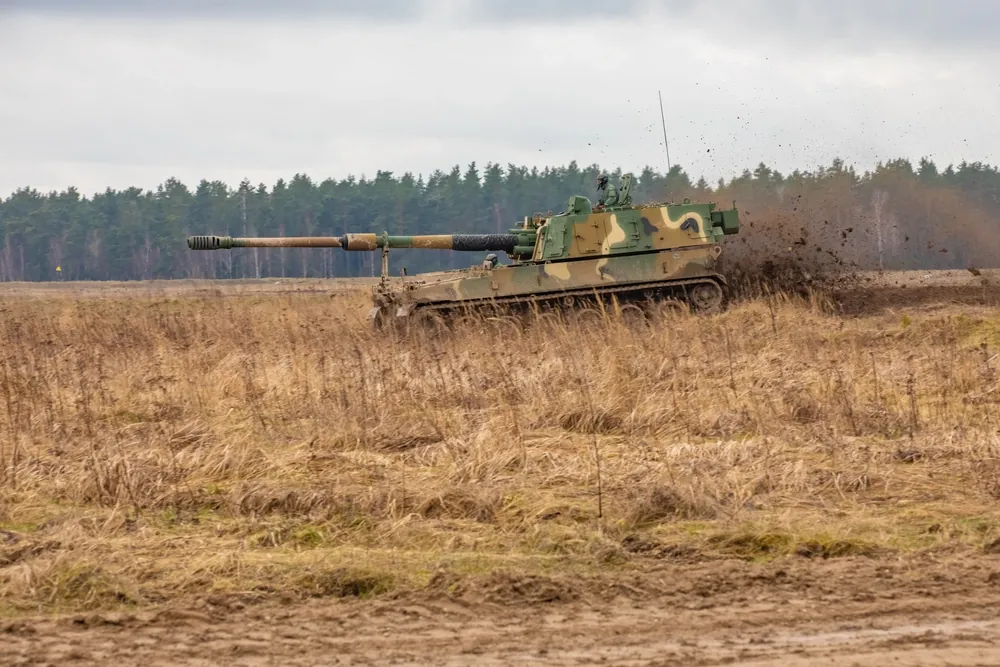
| Qatar | T-155 Fırtına / Fırtına-II | Turkey, tracked 155mm SPH | Contract signed 2019; unit total undisclosed | In delivery; some powerpacks sourced via Ukraine |
| Saudi Arabia | M109 / PLZ-45 / CAESAR / M198 | US / China / France, mixed SPH & towed | Mixed fleet; exact totals vary by source | In service, no single replacement programme announced |
| Saudi Arabia | ASTROS II | Brazil, wheeled MLRS | Approximately 60 units historically supplied | In service, legacy |
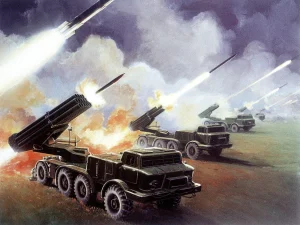
| Saudi Arabia (exhibited) | Sarma | Russia, 300mm MLRS on KAMAZ-63501 8×8 | Unveiled World Defense Show Riyadh, January 2026 | No confirmed order |
| UAE | G6 Rhino / M109 / AH4 | South Africa / US / China, mixed SPH & towed | Legacy fleet | In service |
| UAE | K9 Thunder (planned local production) | South Korea, Hanwha, tracked 155mm SPH | Cooperation agreement, Eurosatory 2026, Generation 5 Holding | Manufacturing hub proposed; not yet in production |
| Bahrain | M110A2 / M198 | US, tracked SPH & towed | 38 M110A2, 18 M198 | Ageing; no announced replacement |
| Regional export offer | Gürhan (formerly E-Fırtına) | Turkey, hybrid tracked SPH | Export-oriented alternative to Fırtına | Marketed; no confirmed Gulf contract |
| Regional export offer | TRG-300 Tiger (Kasırga) | Turkey, Roketsan guided 300mm MLRS | Range approximately 120km | Marketed; no confirmed new Gulf contract |
The Qatar-Germany PzH2000/RCH155 exchange is the most structurally unusual data point in the table: it represents used Gulf equipment flowing back into a NATO European inventory in part-exchange for a newer platform, the reverse of the typical direction of Gulf arms flows, and it illustrates how a state with an already diversified fleet (PzH2000 alongside an incoming Turkish system) can use a swap arrangement to manage fleet size without a conventional new-build order. Saudi Arabia’s pattern is different in kind: rather than swapping between two suppliers, Riyadh has accumulated four or five artillery families concurrently, a hedging approach consistent with its parallel diversification across air defence and armoured vehicle suppliers documented elsewhere in this series, and one that increases through-life sustainment cost in exchange for reduced dependence on any single OEM or government export licence.
Procurement Considerations
Three considerations stand out for buyers and suppliers alike. The first is that localisation pressure is being applied to ammunition ahead of platforms. Saudi Arabia’s domestic content target, set at more than 50 percent of total military procurement by 2030 under Vision 2030, was reported at roughly a fifth to a quarter of total spend as of 2024-25 depending on the measurement basis cited, and large-calibre artillery ammunition has been explicitly identified as an early localisation priority. Suppliers offering an ammunition co-production or licensing package alongside a platform sale are therefore better positioned in Saudi competitions than those offering hardware alone.
The second is powertrain and component supply-chain exposure. Qatar’s Fırtına-II order has depended in part on 5TDFMA-series engine powerpacks sourced through Ukraine’s state defence conglomerate, a dependency that predates the war in Ukraine and illustrates a broader point applicable to any imported tracked platform: engine and transmission sourcing, not the armament itself, is frequently the binding constraint on delivery schedules and export availability. Turkish industry has responded by developing the Gürhan as an alternative hybrid-drive design intended to reduce reliance on the same powerpack supply chain, though it has yet to secure a confirmed Gulf order.
The third is the entry of a non-traditional supplier. Russia’s decision to premiere the Sarma MLRS in Riyadh rather than at a European or Asian show signals that Moscow views the Gulf, and Saudi Arabia specifically, as a market where high defence spending and an active localisation drive could offset the diplomatic friction of a NATO-adjacent state buying Russian rocket artillery. Whether that translates into an actual order is a separate question from whether the platform is being marketed there, and the distinction matters for readers assessing supplier-diversification claims in Gulf defence coverage generally.
Outlook
Three developments are worth tracking over the coming procurement cycle. The UAE-Hanwha K9 cooperation agreement is the clearest test of whether the co-production model already established for wheeled armoured vehicles can be replicated for tracked artillery; a maturing manufacturing line would mark the first Gulf-based production of a South Korean artillery platform and could position the UAE as a re-export hub within the wider Gulf and African markets already served by Emirati wheeled-vehicle exports. Saudi Arabia’s ammunition localisation programme is likely to progress faster than any platform localisation effort, given the lower technical barrier to entry and the recurring nature of demand, and its progress will be a better predictor of which OEMs retain long-term Saudi business than platform specifications alone. Finally, Qatar’s parallel operation of German PzH2000/RCH155 and Turkish Fırtına-II fleets, rather than a consolidation around one supplier, may prove to be the more representative Gulf pattern going forward: smaller GCC states appear increasingly willing to run mixed fleets that spread political and industrial risk across suppliers, even at the cost of more complex sustainment, a trend this series will continue to track as further Gulf artillery and rocket-system contracts are confirmed.