Type 004 vs. USS Gerald R. Ford: How China’s Next Carrier Compares With America’s Newest Supercarrier

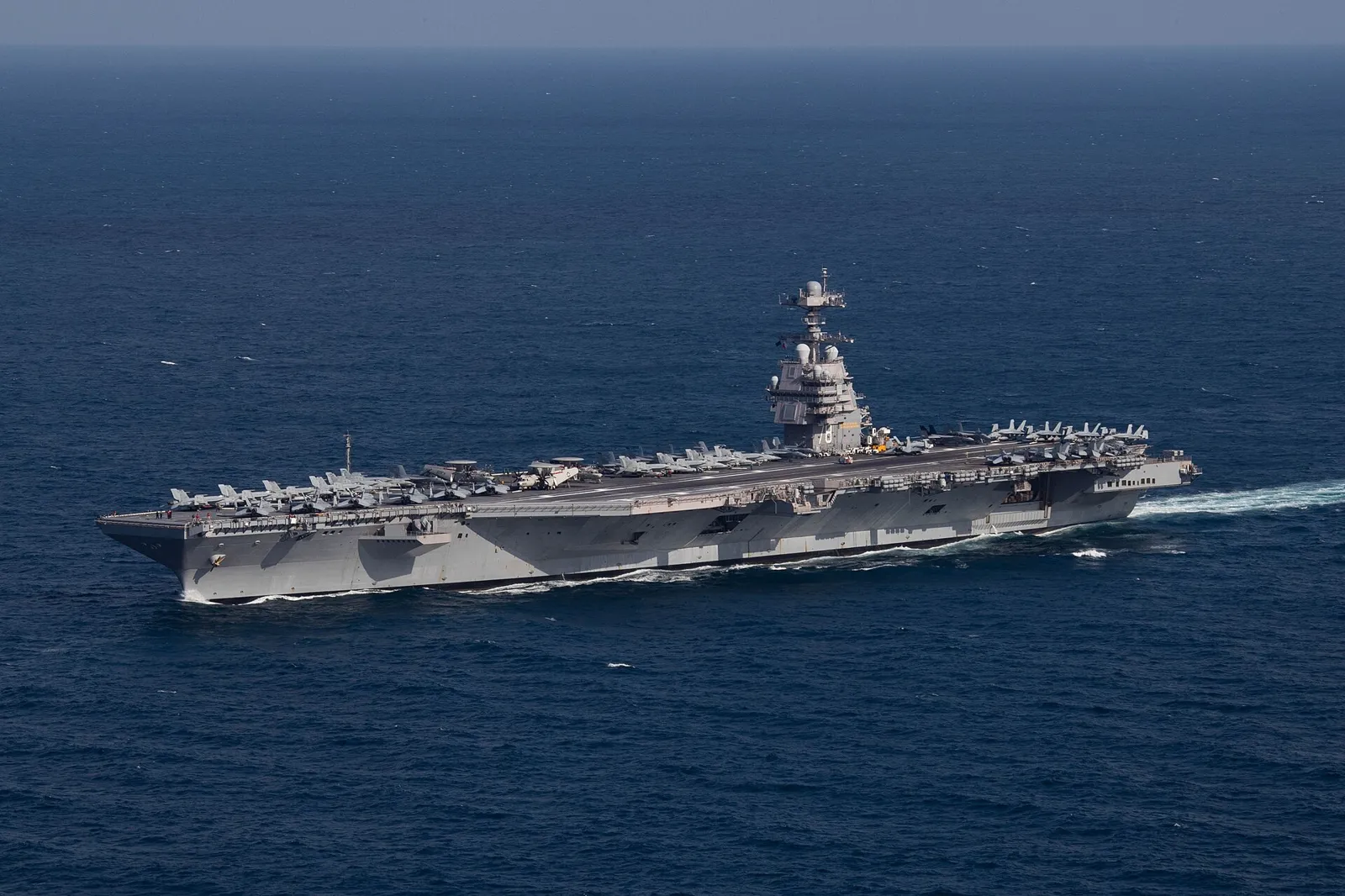
New satellite analysis of China’s fourth aircraft carrier has pushed one comparison to the front of the debate: how close is the Type 004 to the USS Gerald R. Ford, the lead ship of the US Navy’s newest carrier class? The Center for Strategic and International Studies (CSIS) has identified two roughly 15-by-15-metre compartments inside the Chinese hull that resemble shielded reactor spaces, and several analysts now describe the ship as Ford-sized. Here is what can and cannot be said with confidence.
Propulsion: two reactors each?
The Ford is powered by two Bechtel A1B reactors, which generate roughly three times the electrical output of the Nimitz-class plant. That surplus is what makes the electromagnetic launch system and future high-power sensors practical. CSIS’s identification of two reactor-like compartments on the Type 004 suggests a similar two-reactor layout, though the institute stops short of confirming nuclear propulsion. Chinese naval reactor work is linked to a land-based prototype associated with the 701st Research Institute, but its maturity is unknown outside China.
Flight deck and catapults
The Ford carries four Electromagnetic Aircraft Launch System catapults and Advanced Arresting Gear. China’s Fujian introduced electromagnetic catapults with three tracks; analysts expect the Type 004 to move to four. Equal catapult numbers would put the two designs on similar footing for sortie generation on paper. In practice, the Ford’s own EMALS and arresting gear needed years of fixes before reaching reliable rates, and there is no reason to expect China to avoid a learning curve of its own.
| USS Gerald R. Ford (CVN-78) | Type 004 (assessed) | |
|---|---|---|
| Status | In service since 2017 | Under construction, Dalian |
| Propulsion | Two A1B nuclear reactors | Likely nuclear, two reactor-like compartments (CSIS) |
| Catapults | Four EMALS | Four electromagnetic expected |
| Length | About 333 m | Described as comparable to Ford; not officially disclosed |
| Air wing | F/A-18E/F, F-35C, E-2D, EA-18G | Expected J-35, KJ-600, drones |
Size: Ford-class or larger?
Some commentators, including aviation site MigFlug, argue the Type 004 may end up larger than the Ford. Measurements from commercial imagery of a hull still in the dock are approximate, and Beijing has released no figures. Displacement numbers above 100,000 tonnes are speculative. What the imagery does show is that China has moved from the medium-sized Liaoning and Shandong to a hull class that is in the same league as the American supercarrier.
Air wing and sensors
The Ford’s air wing is built around the F/A-18E/F Super Hornet, the F-35C, the E-2D Hawkeye and the EA-18G Growler, with the MQ-25 tanker drone joining. China’s equivalent package would center on the J-35 stealth fighter and the KJ-600 early warning aircraft, both already seen on the Fujian. The PLA Navy is also experimenting with catapult-launched combat drones such as the GJ-21, tested from the amphibious assault ship Sichuan in October.
Analysis: hardware parity is not operational parity
On paper, a nuclear Type 004 with four electromagnetic catapults would narrow the design gap with the Ford class. The operational gap is a different matter. The US Navy has run nuclear carriers continuously since USS Enterprise in 1961 and has built its deck culture, maintenance cycles and escort doctrine over generations. China will be operating its first nuclear plant at sea while simultaneously expanding toward a reported goal of nine carriers by 2035.
For regional navies in Japan, Australia, India and Southeast Asia, the more immediate question is endurance. A nuclear carrier is not tied to replenishment ships for its own fuel, which widens the areas where China could sustain a carrier group. That is a strategic shift even if the Type 004 never matches the Ford’s sortie rates.
FAQ
Is the Type 004 bigger than the Ford?
Analysts describe it as comparable and possibly larger, but no official dimensions exist.
Does China operate nuclear surface ships today?
No. The Type 004 would be China’s first nuclear-powered surface warship if CSIS’s assessment is correct.