China’s Carrier Ambitions: GJ-21 Stealth Drone Flies From Type 076 Sichuan as Beijing Eyes Nine Carriers by 2035

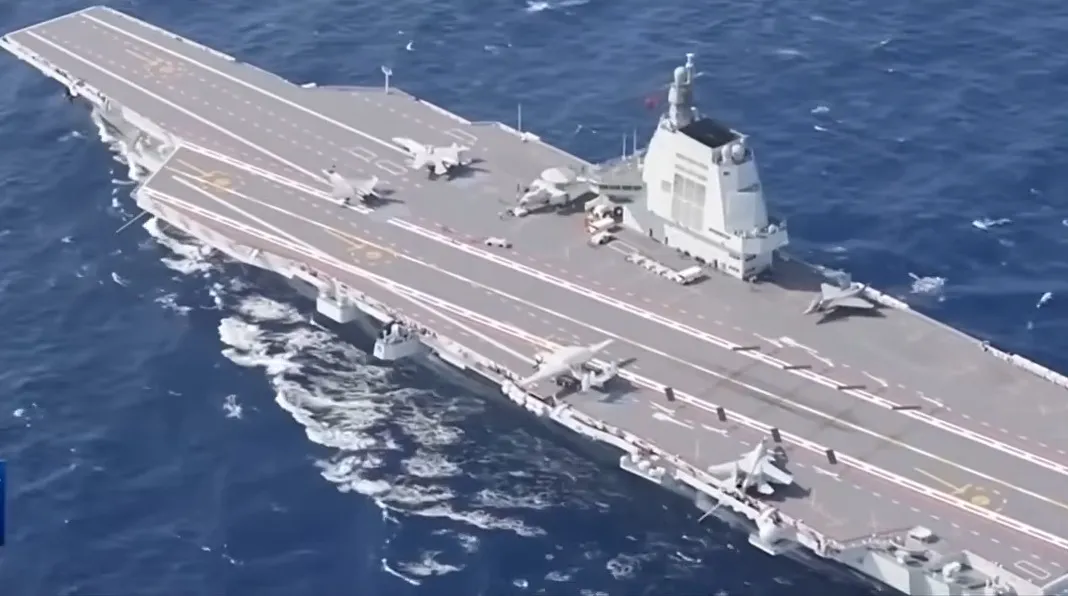
China’s navy says its GJ-21 stealth combat drone has completed its first electromagnetic catapult launch and arrested landing aboard the Type 076 amphibious assault ship Sichuan, a milestone the People’s Liberation Army Navy confirmed on October 30. The announcement, followed by fresh Western analysis this month, adds a new piece to a carrier build-up that the Pentagon says is aimed at fielding nine carriers by 2035.
A drone carrier unlike any other
The Sichuan, launched in Shanghai in December 2024, is a roughly 40,000-tonne amphibious assault ship with a feature no other ship of its type has: a single electromagnetic catapult and three arresting wires. Two side elevators connect the hangar to a full-length flight deck. Western navies operate amphibious ships with helicopters, tiltrotors or short-takeoff jets; China has built one that can launch and recover fixed-wing aircraft conventionally.
The GJ-21 is a naval derivative of the GJ-11 flying-wing combat drone. Reported modifications include reinforced landing gear, a nose-gear launch bar to engage the catapult shuttle and an arresting hook. Chinese state media did not release flight imagery, sortie rates or launch weights, so independent verification remains limited. USNI News and other outlets reported the claim based on the PLA Navy statement.
Why it matters
A catapult-launched stealth drone gives an amphibious group organic reconnaissance and strike capability without needing a full carrier. Analysts have linked the concept to scenarios such as an amphibious operation near Taiwan, where drones could scout and suppress defences ahead of landing forces. That is an assessment by outside observers, not an official Chinese statement.
The nine-carrier goal
The Pentagon’s annual report on Chinese military power, released in December 2025, says Beijing intends to have nine aircraft carriers by 2035. China currently operates three: the Liaoning, the Shandong and the Fujian. A fourth, the Type 004, is under construction in Dalian and is assessed by CSIS as likely nuclear-powered. Reaching nine within a decade would mean building at least two hulls in parallel, a pace that Chinese yards have the capacity to meet.
| Ship | Type | Launch method | Status |
|---|---|---|---|
| Liaoning | Type 001 | Ski-jump | In service |
| Shandong | Type 002 | Ski-jump | In service |
| Fujian | Type 003 | Three electromagnetic catapults | In service |
| Type 004 | Supercarrier | Four catapults expected | Under construction |
| Sichuan | Type 076 LHD | One electromagnetic catapult | Trials |
Analysis: hulls are the easy part
A Naval War College analyst quoted by USNI cautioned that the nine-carrier goal does not mean all nine will be operational by 2035. Air wings, trained pilots, escorts, replenishment ships and overseas logistics are the real constraints. Drones help on one of those fronts: an unmanned air wing can be expanded faster than a pilot cadre, and losses do not cost aircrew.
For the United States and its allies, the Sichuan matters because it blurs categories. A navy that can turn amphibious ships into small drone carriers can spread airpower across more decks, complicating targeting. Japan and South Korea, which operate or plan their own light carriers and large-deck amphibious ships, are watching the GJ-21 tests closely, as is Turkey, whose TCG Anadolu pioneered the drone-carrier concept with the Bayraktar TB3.
FAQ
Has the GJ-21 flight been independently verified?
No imagery of the launch has been released. The milestone is based on the PLA Navy’s statement.
How many carriers does China operate?
Three in service, with a fourth under construction and a goal of nine by 2035, according to the Pentagon.