Singapore Swaps Harpoon for Locally Built Blue Spear on Formidable-Class Frigates

The Republic of Singapore Navy is retiring the US-built Harpoon from its Formidable-class frigates in favour of Blue Spear, a missile manufactured in Singapore. The swap is a concrete example of the city-state’s push to reduce dependence on foreign suppliers for strategic weapons.
At a Glance
- Blue Spear replaces the RGM-84C Harpoon aboard the Formidable class.
- The missile is managed by Proteus Advanced Systems, a 50/50 joint venture between IAI and ST Engineering established in 2020.
- Production takes place in Singapore.
- The export variant is quoted at roughly 290 km; industry sources cite up to 320 km for the Singaporean configuration.
- It is subsonic with an ultra-low sea-skimming profile, using an active radar seeker and inertial navigation.
- A two-way datalink allows in-flight course correction.
- Blue Spear has also been selected as the primary strike weapon for the future Victory-class multi-role combat vessels.
How the Change Surfaced
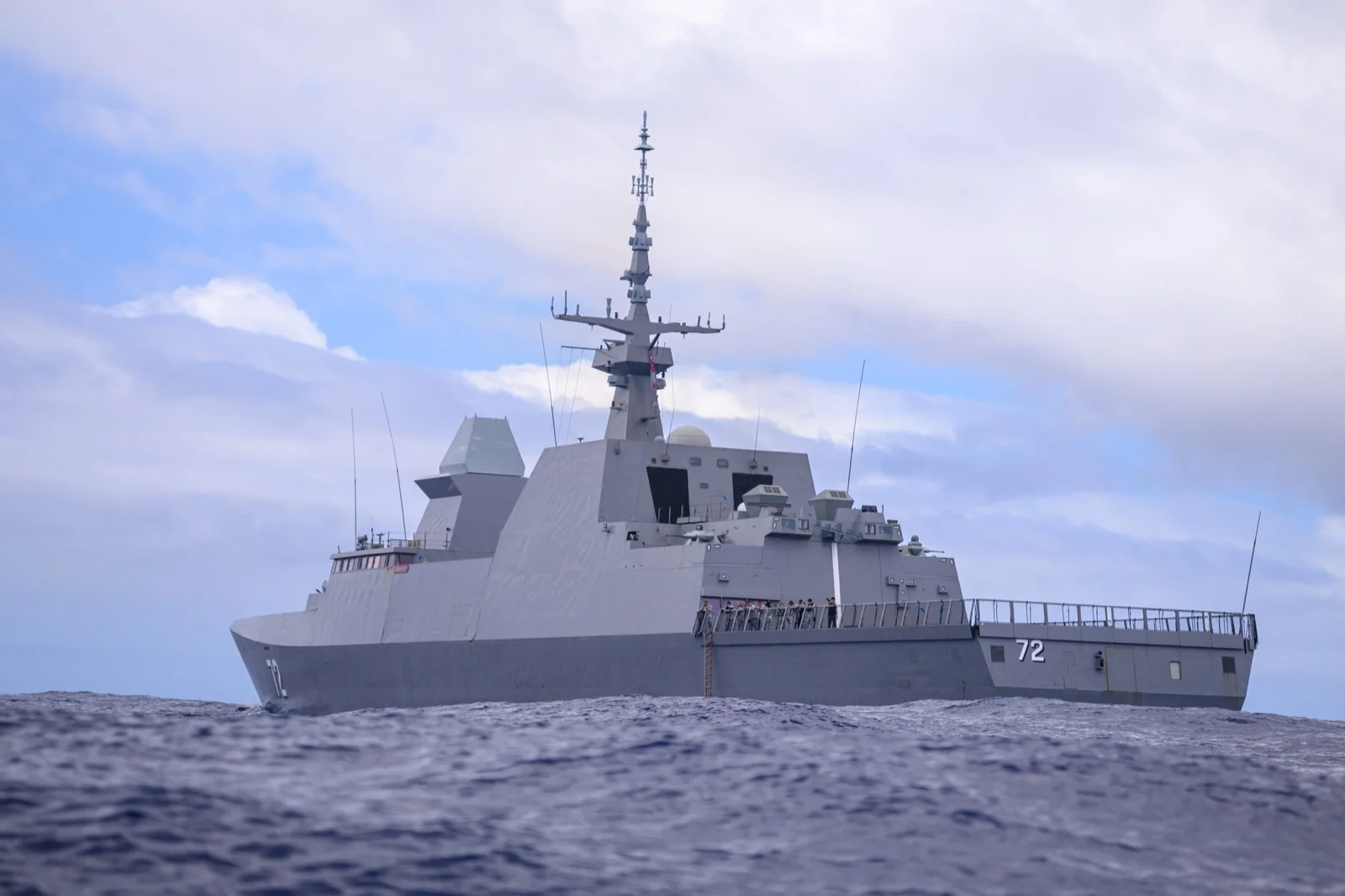
Blue Spear’s integration onto the Formidable class was first announced at the IMDEX defence exhibition in 2023. The system was seen aboard ship this week: missile canisters were visually confirmed on RSS Steadfast, the class’s third vessel, which is scheduled to open for public tours at the Tokyo International Cruise Terminal on 21-22 August 2026.
Singapore’s defence ministry has issued no separate statement confirming that integration is complete, so how far the conversion has progressed across the class remains unclear. The available evidence points to at least one ship having made the change.
Inside Blue Spear
Blue Spear is an anti-ship missile managed by Proteus Advanced Systems, the joint venture set up in 2020 by Israel Aerospace Industries and Singapore’s ST Engineering. The partnership is structured 50/50 and the missile is manufactured in Singapore.
The weapon is subsonic and flies an ultra-low sea-skimming profile. That approach is meant to delay entry into the target’s radar horizon for as long as possible, compressing reaction time. Terminal guidance comes from an active radar seeker, with inertial navigation used through the cruise phase.
What separates Blue Spear from older weapons in its class is the two-way datalink. The missile can receive updated target information in flight, be re-routed, and if required be reassigned to a different target. Terrain-following capability also makes it usable against land targets — so it is not purely an anti-ship weapon but a limited land-attack one as well.
On range, the export variant is quoted at roughly 290 kilometres, sitting just below the 300-kilometre threshold of the Missile Technology Control Regime. Industry sources suggest Singapore’s own configuration reaches up to 320 kilometres, a figure that has not been officially confirmed.
The Formidable Class and the Case for Change
Singapore’s six Formidable-class frigates derive from the French Navy’s La Fayette design and are built around a reduced radar signature hull form. Armed with Aster surface-to-air missiles, the class ranks among the most capable surface combatants in Southeast Asia.
Retiring Harpoon rests on two arguments. The technical one is that the RGM-84C belongs to a generation that has fallen behind the current threat environment in both range and datalink capability. The strategic one is that Singapore has long pursued moving the supply chain for critical weapons into its own industry. Switching to a locally produced missile removes exposure to export licence constraints and to foreign dependency in spares and stock management.
The Regional Read
Where the South China Sea meets the Strait of Malacca, an anti-ship missile with 290 kilometres of reach covers meaningful water. Singapore’s search for influence over a wide maritime area from a very small landmass is the logic behind the choice.
Selecting Blue Spear as the primary strike armament for the Victory-class multi-role combat vessels signals that this is not an interim fix but the navy’s standard for decades to come.
Why It Matters
Anti-ship missile ranges are climbing across the Asia-Pacific and supply chains are localising. A small but technologically capable navy replacing a standard American system with domestic production is a marker that the region’s traditional supplier hierarchy is loosening.
Frequently Asked Questions
Who builds Blue Spear?
It is managed by Proteus Advanced Systems, the 50/50 IAI and ST Engineering joint venture formed in 2020, with manufacturing in Singapore.
What exactly is its range?
Roughly 290 km is quoted for the export variant. Up to 320 km is cited for Singapore’s own configuration, though this has not been officially confirmed.
Is it only used against ships?
No. Terrain-following capability allows employment against land targets as well.
Sources
- Proteus Advanced Systems / IAI corporate material — Blue Spear ownership structure and system characteristics.
- IMDEX 2023 official exhibition announcements — First disclosure of the Formidable-class integration decision.
- Military Leak (13 August 2026) — Visual confirmation aboard RSS Steadfast and the Tokyo port visit schedule.