Spain Launches Drone Interceptor BANDIT-X from ASCOD HMC

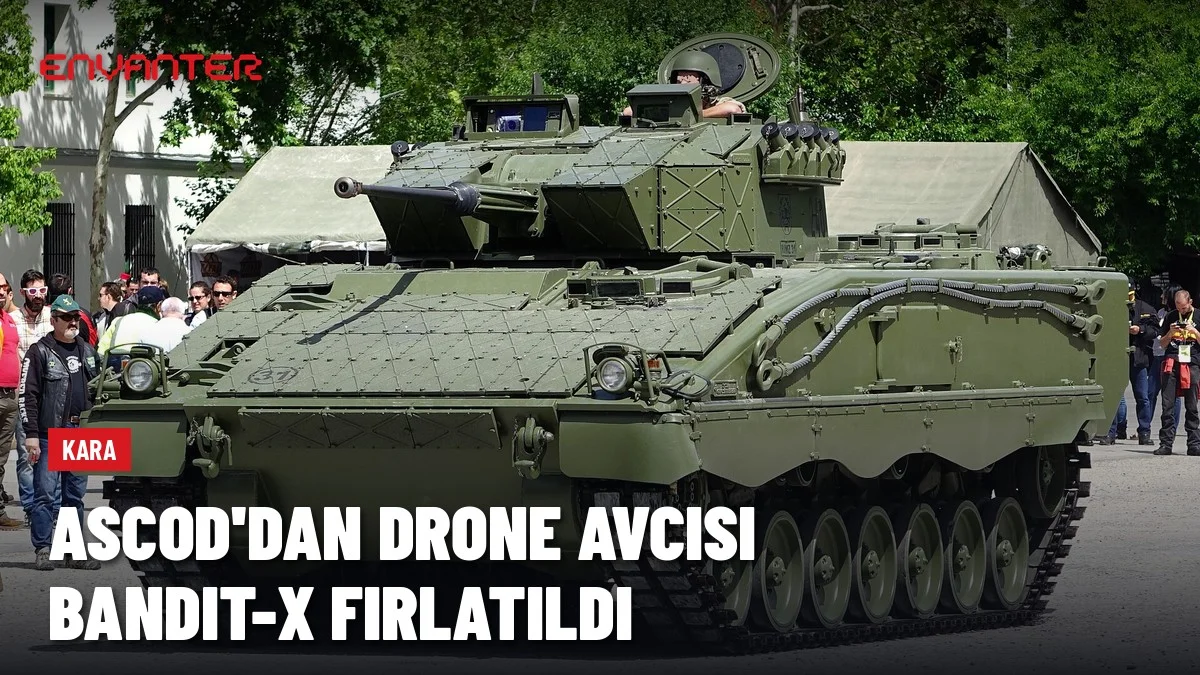
Spanish companies ARMMO Defense Technologies and GDELS Santa Bárbara Sistemas have turned the ASCOD HMC armored vehicle into a launch platform for the autonomous drone interceptor BANDIT-X. The integration was demonstrated at the ATLAS 26 exercise in Huelva, under the direction of the Spanish Army’s Air Defense Artillery Command. The news was reported by defensa.com on October 27, 2026.
The two companies had signed a memorandum of understanding (MoU) to combine armored-vehicle engineering with autonomous air-defense and Counter-UAS technology. The ATLAS 26 demonstration was the first concrete result of that partnership: the integration, launch and flight of BANDIT-X from an ASCOD HMC.
BANDIT-X: Technical Profile
| Spec | Value |
|---|---|
| Speed | Over 360 km/h (target: 420 km/h) |
| Endurance | 20–25 minutes |
| Operational range | 40–50 km (mission-dependent) |
| Navigation | Autonomous nav. in degraded/denied GNSS environments |
| Other | Electronic-warfare resilience, autonomous terminal guidance, NATO NSN catalog number |
ASCOD HMC: A Mission-Swappable Platform
The ASCOD HMC (Heavy Mission Carrier), developed by Santa Bárbara Sistemas, is a multi-purpose, modular, scalable armored platform. It can quickly swap mission equipment for roles including fire support, heavy recovery, mine-laying, ground-based air defense (GBAD), artillery (in the Nemesis configuration), logistics, electronic warfare, medical evacuation and Counter-UAS protection. The BANDIT-X integration is the latest example of that flexibility, following a similar demonstration with the Skorpion 2 counter-mine system shown at Eurosatory. The platform’s open digital architecture, NEVA, is built to the NATO Generic Vehicle Architecture (NGVA) standard, easing the integration of new systems.
Senior Attendance
The demonstration drew representatives from the Army, Navy and Air and Space Force. Senior attendees included Admiral Manuel Teodoro López Calderón, Spain’s Chief of the Defense Staff (JEMAD), and Admiral Pierre Vandier, NATO’s Supreme Allied Commander Transformation (SACT). The presence of senior Spanish and NATO military leadership signals that the demonstration was framed not merely as an industry event but as an alliance-level capability showcase.
Two Complementary Industrial Capabilities
GDELS Santa Bárbara Sistemas, part of General Dynamics European Land Systems, brings an industrial base specialized in armored-vehicle manufacturing and integration, with facilities in Trubia and Alcalá de Guadaíra. ARMMO Defense Technologies is a Spanish company developing UAV, UGV (ground) and USV (surface naval) autonomous systems and electronic-warfare solutions from a facility exceeding 30,000 square meters in Zafra, Badajoz. BANDIT-X also took part in multinational NATO experimentation activities in Slovakia during 2026.
Why It Matters
The ability to launch an autonomous drone interceptor from an armored vehicle lets ground units defend against UAV threats while on the move, without depending on fixed air-defense systems. That capability speaks directly to one of the sharpest lessons of the war in Ukraine: the growing threat small, inexpensive drones pose to armored formations. Because the ASCOD family is already widely fielded across NATO, including in Austria and Spain, this integration could in principle spread to existing fleets relatively quickly.
Türkiye has not publicly announced a comparable Counter-UAS integration for its own armored vehicle families, such as Tulpar, Kaplan or Pars. Even so, this Spanish demonstration stands as another data point in a broader NATO-wide trend: turning armored platforms into mobile air-defense nodes.
Sources
- defensa.com — “Santa Bárbara Sistemas y ARMMO convierten el ASCOD HMC en una plataforma de lanzamiento de interceptores de drones,” José María Navarro García, October 27, 2026 — primary source for the demonstration, company statements, specifications and attendees.