A Drone That Carries IRIS-T Into the Sky: Cobra 600 Completes Its First Flight

Air defence economics have been broken for a while: intercepting a cheap threat with an expensive missile is a trade nobody can sustain indefinitely. On 21 August 2026, a German attempt to bend that curve got off the ground. The Cobra 600, developed by Bremen-based Polaris Raumflugzeuge with Diehl Defence under the AirLAS — Airborne Launch and Attack System — project, completed its first flight, covering more than 20 kilometres.
It is a launcher, not a fighter
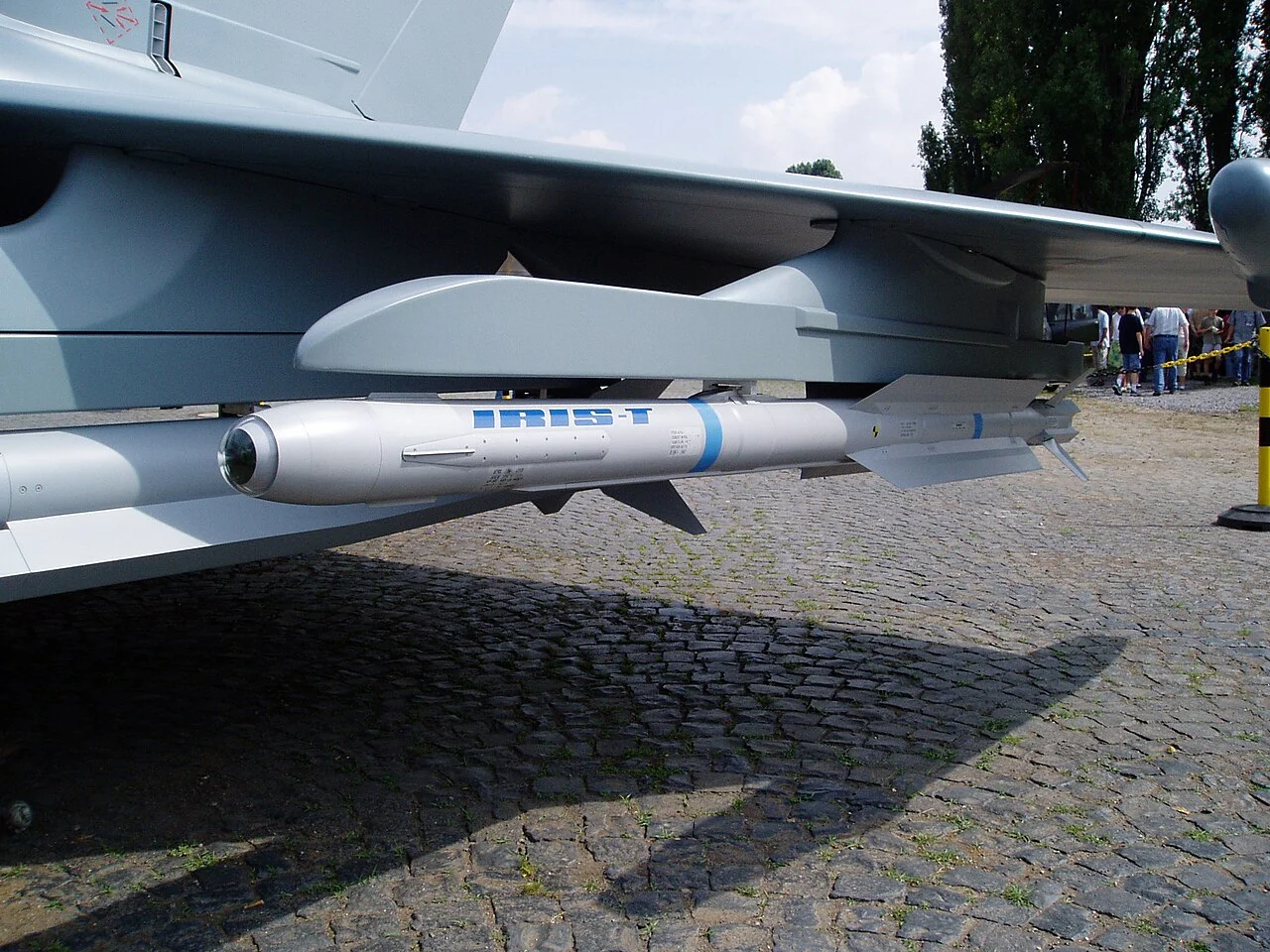
The easiest mistake with Cobra 600 is to read it as a combat drone. It is not. It is a missile rail that flies. The vehicle carries no radar, no electro-optical turret, no seeker of its own. All target acquisition is done by the infrared seeker of the IRIS-T air-to-air missile it carries.
An operator flies the vehicle remotely, positions it, and releases the weapon. What that buys is geometry: IRIS-T’s roughly 25-kilometre engagement envelope is transported tens of kilometres from the launch point. An angle or an altitude that a ground-based battery simply cannot reach becomes reachable.
Technical profile
- Length: 600 centimetres — hence the name
- Take-off weight: over 600 kilograms
- Propulsion: two or four JetCat P1000-PRO micro-turbojets, each producing 113 kg of thrust
- Configuration: delta wing
- Weapon: IRIS-T air-to-air missile
- Control: remote operator, teleoperated
The propulsion choice tells you the whole cost philosophy. Instead of a military-standard turbofan, the design clusters micro-turbojets matured in the industrial and hobby market. Pushing all sensing onto the missile follows the same logic: the dumber the vehicle, the cheaper it is, and the more of them you can build.
Which threats it is aimed at
Polaris and Diehl position the system against high-altitude targets: cruise missiles, balloons and reconnaissance aerostats, high-flying uncrewed aircraft. These sit in an awkward gap — too high or too distant for short-range ground-based air defence, too cheap to justify scrambling a fighter.
Ukraine and the Red Sea made that gap impossible to ignore. Spending a multi-million-dollar interceptor on a few-thousand-dollar target is an exchange rate that loses wars slowly. Concepts like Cobra 600 exist to narrow it.
Where the concept is weak
The cost advantage defines the limits. With no onboard sensors, the vehicle is entirely dependent on external cueing — a ground radar, an AEW aircraft, some other platform to find the target and position the launcher. Without a networked architecture it does nothing on its own.
The second limit is teleoperation itself. If the operator link is jammed in a contested environment, mission continuity becomes questionable. Until autonomous mission continuation is added, employment on an electronic-warfare-heavy front may be constrained.
The third is that IRIS-T is not a cheap missile. Driving the vehicle cost down still leaves the expended round expensive. The gain here is geometry and reach, not a wholesale collapse in cost per engagement.
Programme status
AirLAS was formalised in June 2025. Further test flights are planned over the coming months. Notably, there is no German Ministry of Defence contract behind the work — it is industry-funded. Diehl Defence reports that at least one foreign country has expressed interest.
That pattern is increasingly common in Europe: rather than waiting for a formal requirement, companies self-fund a low-cost solution and try to convince the customer with hardware that already flies. It compresses development timelines dramatically compared with the traditional procurement cycle — and it puts the commercial risk on the manufacturer.
Germany’s layered air defence picture
Germany has spent heavily on air defence: IRIS-T SLM batteries, Arrow 3, Patriot recapitalisation and the European Sky Shield Initiative. All of it rests on interceptors that are expensive and finite. Cobra 600 proposes a cheap, numerous layer underneath that pyramid. The absence of a ministry contract shows the requirement has not yet been written; the fact that industry has funded it this far shows the need is being felt in the field.
Sources
- Diehl Defence and Polaris Raumflugzeuge statements on the AirLAS project
- Opex360, 24 August 2026
- IRIS-T product documentation, Diehl Defence