Leonardo DRS launches cxMHR C-band radar, starts initial production

Leonardo DRS has launched cxMHR, a fully digital C-band AESA radar for integrated air and missile defense, and says initial production is already under way. The company unveiled the system at AUSA 2026 in Washington, claiming detection of drones and loitering munitions beyond 90 km and transport aircraft beyond 330 km.
A containerized radar on one truck
The announcement came in a Leonardo DRS press release dated October 12, 2026, timed to the opening of the Association of the U.S. Army’s Annual Meeting and Exposition. cxMHR stands for C-Band Extended Multi-Mission Hemispheric Radar. The company describes it as software-defined and fully digital, built specifically for integrated air and missile defense (IAMD) rather than the short-range tactical role where its predecessors made their name.
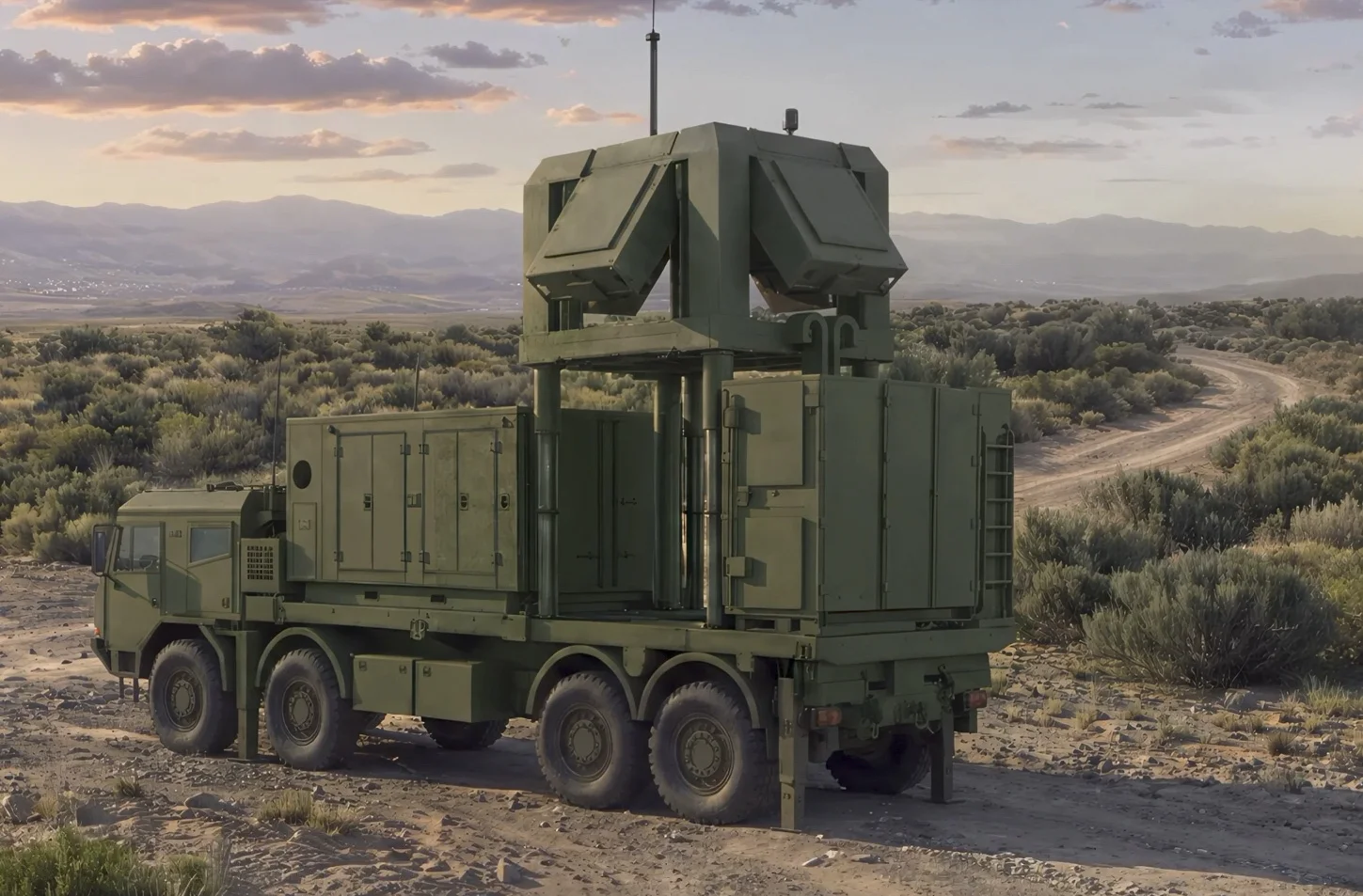
Everything needed to run the sensor sits in a single ISO container: four AESA antenna faces, an Identification Friend or Foe (IFF) unit, command-and-control equipment and supporting peripherals. That container can move by air, land or sea and can be fielded on one vehicle. The official photo released with the announcement shows the array mounted on the bed of a multi-axle tactical truck.
Because the four fixed faces point in different directions, the radar provides continuous 360-degree hemispheric coverage without mechanical rotation. Leonardo DRS says it can detect, track and identify tactical ballistic missiles, cruise missiles, rockets and unmanned aircraft at the same time.
Range claims, AI tracking and open interfaces
The published figures cover two target classes. Against UAS and loitering munitions, detection range is given as beyond 90 km; against transport-size aircraft, beyond 330 km. No separate figure was released for ballistic or cruise missiles, and all numbers are manufacturer claims rather than results from published government testing.
Tracking and classification rely on AI-enabled processing, which DRS says delivers fire-control-quality tracks, extended detection range and rapid target updates. In practice, fire-control quality means the tracks are precise enough to cue interceptors or guns directly, not just to populate a common air picture.
The radar follows the Pentagon’s Modular Open Systems Approach (MOSA). Supported interfaces listed in the release include FAAD, Medusa, Sapient, Lattice, Asterix, MICAD and RAFT. That mix spans U.S. Army short-range air defense command and control, the Asterix surveillance data format common across NATO air forces, and commercial battle-management software such as Anduril’s Lattice.
From RADA’s tactical radars to IAMD
cxMHR is the latest member of the Multi-Mission Hemispheric Radar family developed by Leonardo DRS RADA Technologies. The line traces back to Israeli radar maker RADA Electronic Industries, which merged with Leonardo DRS in an all-stock deal that closed on November 28, 2022, leaving Italy’s Leonardo S.p.A. with 80.5% of the combined company. RADA’s U.S. engineering and manufacturing operation in Germantown, Maryland, now operates as DRS RADA Technologies.
According to Leonardo DRS product pages, the baseline MHR is an S-band, GaN-based pulse-Doppler radar, while the nMHR moves to X-band and the ieMHR refines the original design. The family supports U.S. Army and Marine Corps counter-UAS, counter-rocket, artillery and mortar (C-RAM) and maneuver short-range air defense missions. On the Army’s Stryker-based M-SHORAD Increment 1, the mission equipment package configured by Leonardo DRS includes the RADA MHR, with General Dynamics Land Systems integrating it onto the vehicle.
The move to C-band and the explicit IAMD framing push the family toward longer ranges and a broader threat set than its tactical siblings. The release does not say where cxMHR will be built, who the first customer is or when deliveries will begin.
Why a mid-tier sensor matters now
“The cxMHR gives our customers a deployable, single-vehicle capability that delivers persistent 360-degree surveillance, long-range detection, and fire-control-quality tracking against today’s most challenging air threats,” said Max Cohen, senior vice president and general manager of Leonardo DRS RADA Technologies.
Mixed raids of cheap drones, cruise missiles and ballistic missiles in Ukraine and the Middle East have made multi-threat tracking from a single, mobile sensor a priority for many armies. In the U.S. Army’s layered structure, there is demand for transportable sensors that sit between maneuver-focused M-SHORAD and fixed-site defenses such as Indirect Fire Protection Capability (IFPC). Leonardo DRS has not tied cxMHR to a specific program, but positions it for expeditionary and fixed-site air defense, force protection and engagement support. NATO members on the eastern flank, from the Baltic to the Black Sea, are pursuing similar relocatable, network-ready radars.
The radar is on display with the rest of the MHR family at booth 6341, Hall D, through October 14.
Sources
- Leonardo DRS, “Leonardo DRS Launches cxMHR, a Fully Digital C-Band Radar for Integrated Air and Missile Defense,” official press release via GlobeNewswire, October 12, 2026 — launch, initial production, specifications, ranges, interfaces, Max Cohen quote, photo. investors.leonardodrs.com
- Leonardo DRS, “Leonardo DRS Announces Closing of Merger With RADA,” official press release, November 28, 2022 — merger date and ownership split. investors.leonardodrs.com
- Leonardo DRS, MHR and nMHR product pages, official — family bands and programs supported. leonardodrs.com
- Congressional Research Service, “U.S. Army’s Maneuver Short-Range Air Defense (MSHORAD) System,” official — M-SHORAD Inc 1 mission equipment package with MHR. congress.gov
- Defence Industry Europe and Zona Militar, October 13, 2026 — non-official reports of the release, used for cross-checking.