A Third US Carrier Is Heading to the Middle East: USS Theodore Roosevelt Makes Its Last Stop in Singapore

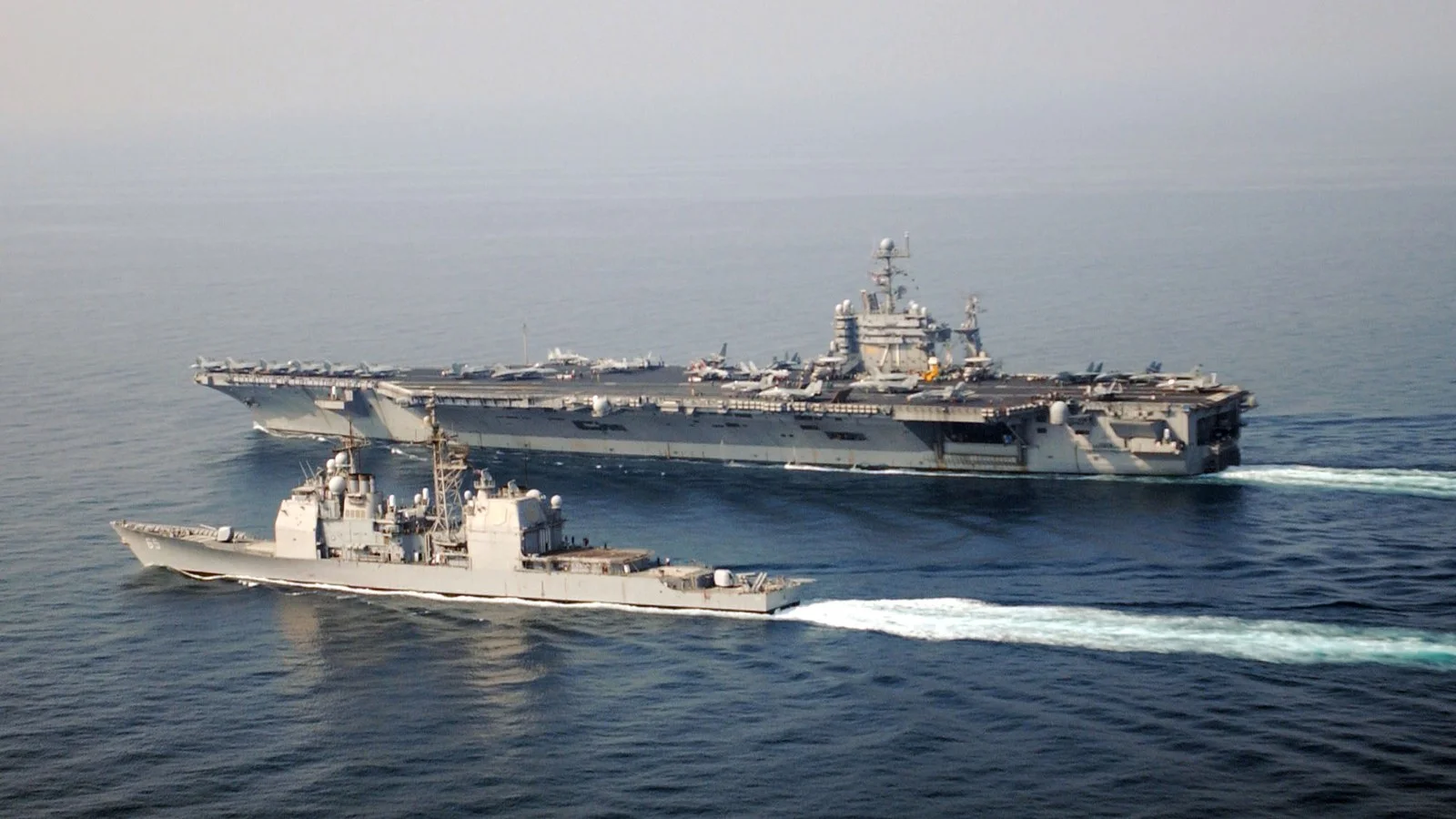
Once the Theodore Roosevelt strike group reaches the Middle East, the US will have three carrier strike groups in the region at once for the first time since 2019 — a build-up read as preparation for a possible new move against Iran.
The nuclear-powered aircraft carrier USS Theodore Roosevelt (CVN-71) moored at Singapore’s Changi Naval Base late on November 5, local time, the last stop on its route to the Middle East. It was the first time the carrier broadcast its position publicly via AIS since leaving Yokosuka on October 19.
The guided-missile cruiser USS Chosin and guided-missile destroyers USS Paul Hamilton and USS Decatur, all escorting Theodore Roosevelt, reached the same port within a few hours of each other. US officials said the strike group would spend a few days in Singapore and would not enter CENTCOM’s area of responsibility before mid-November.
Ahead of the group lies a transit north through the Strait of Malacca and then west across the Indian Ocean, a leg expected to take one to two weeks. For comparison, USS George Washington covered the same route in roughly a week back in August.
The Roosevelt group’s deployment is being linked to President Donald Trump’s threats to renew military action against Iran following the November 3 midterm elections. According to the Wall Street Journal, US forces struck Iran’s Qeshm Island on November 2; US officials described the strike as defensive, while Trump told Fox News it was “just a minor attack.”
Once the strike group reaches the Middle East, it will join USS George H.W. Bush — already on station in the 5th Fleet area of responsibility for 220 days — and USS George Washington, which left Yokosuka on what was meant to be a routine Pacific patrol and has now been kept in theater for 167 days. That will give the US three carrier strike groups operating simultaneously in the region for the first time since 2019.
Navy sources say Theodore Roosevelt has kept up a steady exercise tempo en route. The group completed exercise Keen Sword 27 with five allied navies on October 29, refueled from fleet oiler USNS Tippecanoe the next day, and conducted an underway replenishment with the Royal Australian Navy’s HMAS Stalwart on November 4.
The Makin Island Amphibious Ready Group, carrying more than 2,200 Marines, is also headed to the Middle East alongside the carrier group and is expected to relieve the Boxer ARG, which is nearing eight months deployed. Navy and Marine Corps leadership have repeatedly said the fleet needs at least 40 amphibious ships against a current inventory of 31.
Analysts read the move as CENTCOM shaping the battlespace ahead of a possible order to act. Of the US Navy’s 11 aircraft carriers, three are currently deployed, three are working up, three are in maintenance, one is in post-deployment availability, and one — the future USS John F. Kennedy — has yet to enter the fleet.
Cmdr. Brian Garcia, the weapons officer aboard George Washington, which is already in theater, said the carrier has AGM-84H/K SLAM-ER missiles and GBU-31(V)4/B JDAMs fitted with BLU-109 penetrator warheads ready aboard, and needs no further preparation for potential missions. That detail underscores that the carrier strike groups already in the region are postured not just to deter, but to strike if ordered.
On the US West Coast, USS Ronald Reagan and USS Carl Vinson remain in maintenance and certification cycles, while on the East Coast USS Gerald R. Ford is in a post-deployment availability due to finish by March 2027 and USS Harry S. Truman has just begun a refueling and complex overhaul. Together, this picture shows how Theodore Roosevelt’s deployment is stretching an already-tight global carrier posture.
USS Dwight D. Eisenhower returned to Naval Station Norfolk on November 5 after a one-day underway period. USS Nimitz has been operating at an undisclosed Atlantic location since October 27 with Carrier Air Wing 1, running certification drills; student aviators were landing T-45 Goshawk trainers aboard her on November 4. The newest Ford-class carrier, USS John F. Kennedy (CVN 79), is not yet operational: it returned to Norfolk on November 5 after 13 days at sea, during which an F-35C made the first arrested landing on a Ford-class carrier in mid-October. Kennedy is expected to join the fleet in spring 2027, around the time Nimitz begins deactivation.
The amphibious fleet is similarly stretched: of the Navy’s nine amphibious assault ships, two are deployed, one is forward-deployed, two are preparing for upcoming deployments in port, and four are in maintenance. Analysts note that CENTCOM routinely rotates cruisers and destroyers between strike groups and independent deployments, meaning strike group composition can shift quickly. The total naval build-up in the region will directly shape Washington’s options should a decision on Iran be made in the coming weeks.
Sources
- The War Zone, “USS Theodore Roosevelt Arrives In Singapore, Last Stop Before Third Strike Group Reaches The Middle East,” November 6, 2026, https://www.twz.com/sea/uss-theodore-roosevelt-arrives-in-singapore-last-stop-before-third-strike-group-reaches-the-middle-east — primary source for the strike group’s movements and regional context.