Quantum Systems Goes to Sea with Seavex and Subvex

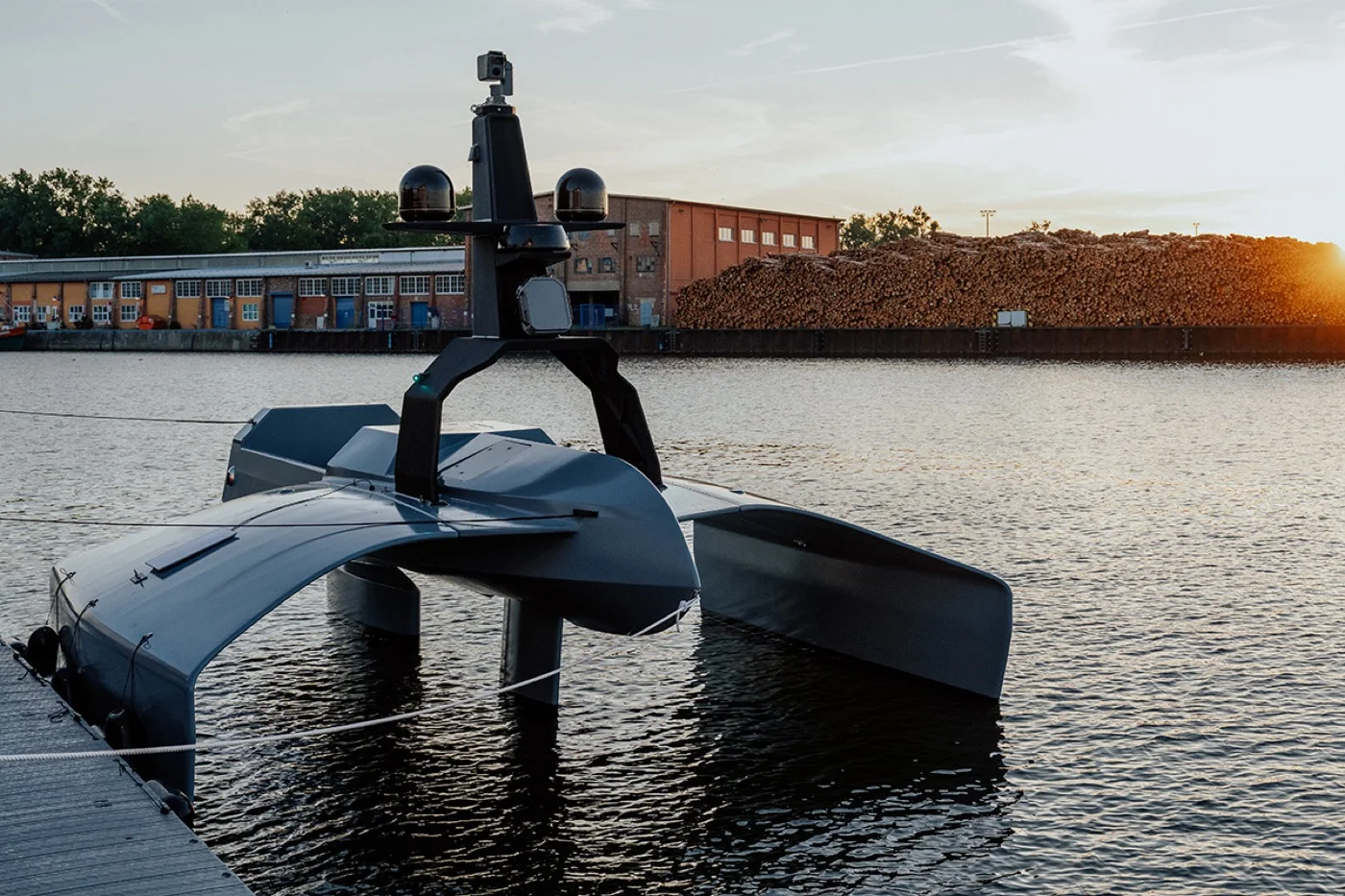
Quantum Systems has spent most of its existence building things that fly. On 14 September the German manufacturer announced it was going to sea, unveiling two platforms in Portugal alongside a NATO maritime exercise: Seavex, an unmanned surface vessel rated for two months on station, and Subvex, an underwater vehicle capable of operating at 6,000 metres.
One software architecture, three domains
Both systems plug into MOSAIC UXS, the company’s common mission software. Co-CEO and founder Florian Seibel framed the launch in those terms: “With Seavex and Subvex integrated into MOSAIC UXS, we are building one autonomous system across air, land and sea.” Dirk Zademack, VP of Quantum Maritime, said the aim was to reproduce at sea what the company had built elsewhere — “an ecosystem in which unmanned systems operate together rather than individually.”
The emphasis is telling. In unmanned systems, the differentiator has shifted away from the vehicle and toward the architecture that binds vehicles across domains into a single tasking picture.
Seavex
Seavex is a trimaran-hulled USV built for persistent maritime intelligence, surveillance and reconnaissance. Company documentation describes a hull form that minimises motion in higher sea states — a prerequisite for keeping sensors usable rather than merely afloat — and endurance of up to two months.
Its modular sensor fit supports long-range surveillance radar, anti-drone radar, electro-optical tracking and an independent navigation system for GNSS-denied environments. The vessel is designed as a node rather than a lone sensor: it can host UAVs for launch and recovery while docked, and autonomously recharge Subvex vehicles and retrieve their mission data. Counter-UAS capability is presented as part of a layered maritime protection concept.
Subvex
Subvex operates to 6,000 metres, with up to four days of active endurance and, in passive seabed surveillance mode, weeks of on-station time. Sonar and acoustic sensors feed onboard edge processing, and the vehicle is designed for distributed multi-vehicle operations.
Weeks of passive seabed watch is the specification that matters most commercially. Undersea cable and pipeline incidents in the Baltic and North Sea have turned critical infrastructure monitoring from a niche requirement into a funded European priority.
Why counter-drone radar on a boat
Seavex carrying anti-drone radar reflects a lesson from the Black Sea. Unmanned surface vessels proved highly effective there — and their most effective counter turned out to be aerial drones. A surface platform expected to survive now needs its own air picture.
The ability to launch and recover UAVs addresses a related constraint. Small aerial systems cannot reach far offshore from a coastal base; operating them from a vessel already on station pushes sensor coverage well beyond the littoral.
Navigating without satellites
The independent navigation system is a direct response to the electronic warfare environment. GPS jamming in the Baltic and Black Sea regions has grown severe enough to affect civil aviation and merchant shipping. For unmanned maritime platforms, holding position without a satellite fix is no longer an optional feature.
Company context
Based in Bavaria, Quantum Systems is best known for the Vector and Trinity VTOL fixed-wing UAVs used extensively in Ukraine. That operational feedback loop has visibly accelerated its development cycle. The company positions itself as a global deep-tech defence prime, with software, AI and systems integration as its core competencies.
Timing the launch to a NATO maritime exercise in Portugal was deliberate. Europe’s unmanned maritime market has expanded sharply since Ukraine demonstrated what cheap surface drones can do, with Germany, the UK, France and the Nordic states opening programmes in succession.
The Turkish comparison
Turkish industry has been working the same problem set. The ULAQ family developed by Meteksan Savunma with ARES Shipyard, ASELSAN’s ALBATROS platforms and STM’s unmanned surface and underwater vehicle programmes all advance armed and ISR-focused configurations in parallel.
What the German launch signals for export competition is that platform performance alone no longer decides tenders. Mission software maturity — how well air, surface and subsurface assets are made to work as one — is becoming the discriminator.
Sources
- Quantum Systems official Seavex and Subvex technical documentation, September 2026
- Company executive statements at launch, 14 September 2026
- Naval News launch coverage, 14 September 2026